Flipping land for profit means buying a parcel at a price that leaves room for the real costs and risks of ownership, then reselling it to a buyer who values its location, access, usable features, or financing options. The opportunity is not in simply finding cheap land. It is in accurately understanding what the parcel can support, who is likely to buy it, and what could prevent a clean resale.
A disciplined land flip follows a simple sequence: find a motivated seller, estimate a realistic resale range from comparable active and sold listings, verify the parcel before committing, buy with a clear exit plan, market the property honestly, and close through a process appropriate for the state and transaction. Each step matters because vacant land problems are often invisible from a listing photo.
This guide explains how to approach land flipping as an operating process rather than a quick-money strategy. The key is to protect your downside before you focus on upside.
How do I find the best land deals to flip?
The best land deals are parcels with a clear buyer audience, verifiable value, and a seller situation that supports a sensible offer. A low asking price alone is not a deal if access, title, terrain, zoning, or demand makes the property difficult to resell.
Start by defining a narrow buy box. Choose the counties, parcel types, acreage range, buyer profile, and intended exit strategy you understand well enough to evaluate. A buyer looking for a recreational retreat may care about road access, trees, nearby public land, and privacy. A buyer seeking a homesite may care more about legal access, buildability, utilities, setbacks, and local land-use rules. Those are different markets, so they need different acquisition criteria.
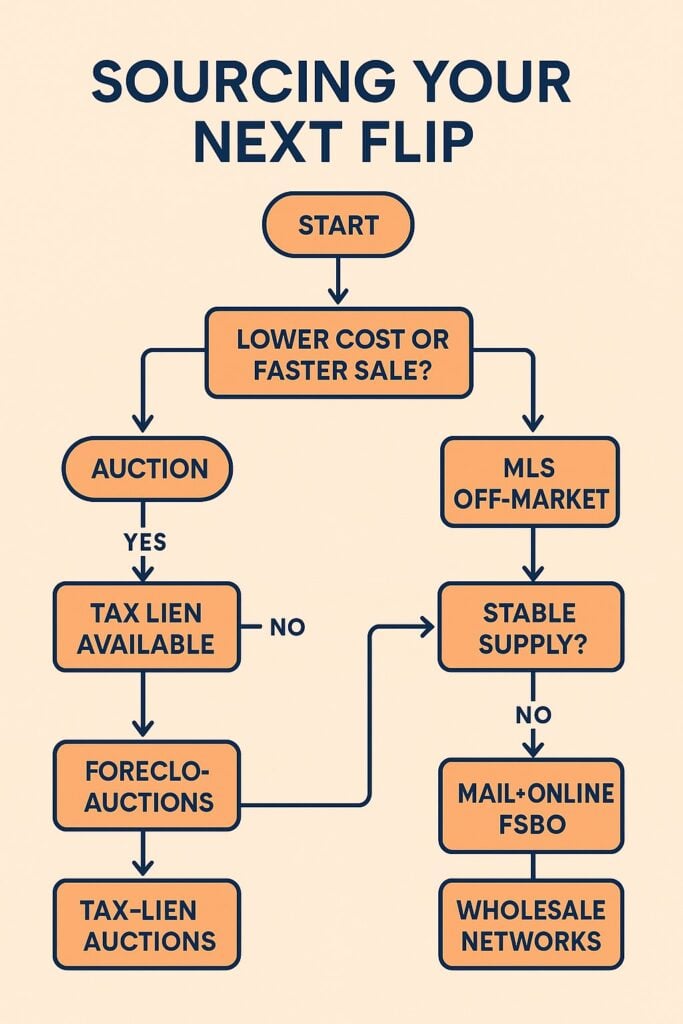
Useful sourcing channels can include:
- Direct outreach to owners who may have inherited, relocated from, or lost interest in a parcel.
- County records and local property data that help identify ownership patterns, delinquent taxes, or long-held land.
- Land-focused listing sites, MLS listings, and expired listings where a seller may need better positioning or a simpler transaction.
- Local agents, attorneys, surveyors, contractors, and title professionals who understand activity in a specific market.
- Public auctions and foreclosure-related sales, where the rules, title position, redemption rights, and buyer obligations must be understood before bidding.
A common mistake is treating tax-related sales as automatic bargains. The buyer may be purchasing a limited interest rather than clear ownership, and the rules can vary significantly by location. Review the auction terms, investigate the parcel, and speak with the appropriate county office or a qualified local professional before participating.
How should I estimate a parcel’s resale potential?
Estimate resale potential by comparing the parcel with genuinely similar land that has sold or is competing for buyers now. Adjust for the features that influence a buyer’s decision, especially access, terrain, utility availability, zoning, restrictions, location, and the condition of the title.
Do not rely on a single online estimate or a seller’s claimed value. Build a small comparison set from nearby parcels with similar use potential. Separate active listings from closed sales. Active listings tell you what sellers are asking. Closed sales, when available and comparable, are more useful for understanding what buyers have accepted. Then ask why a buyer would choose your parcel over the alternatives.
Write down the answer in plain language. For example: “This parcel appeals to a recreational buyer because it has verified road access, usable topography, and nearby demand for weekend-use property.” If you cannot explain the buyer and value proposition clearly, the deal is probably not ready for an offer.
What makes an off-market lead worth pursuing?
An off-market lead is worth pursuing when it matches your buy box and the owner is open to a straightforward conversation, not merely because the property is unlisted. The goal is to solve a seller’s problem while leaving enough room for verification, marketing, holding costs, and a reasonable resale strategy.
Ask respectful, practical questions: Why are they considering a sale? How did they acquire the land? Have they used it recently? Do they know of access concerns, unpaid obligations, association rules, boundary disputes, or prior improvement attempts? Their answers are leads to verify, not facts to accept without documentation.
How do I finance a land flip?
Finance a land flip with a structure that fits the parcel, your cash position, the expected holding period, and the risks you can carry if the resale takes longer than planned. The cheapest-looking capital is not always the best choice if it adds restrictive terms, creates a rushed sale, or leaves no room for surprises.
For a practical overview of common funding paths, review options to finance a land flip. The right choice depends on the deal rather than a universal formula.
| Funding approach | Best fit | What to verify |
|---|---|---|
| Cash purchase | Simple acquisitions with adequate reserves | Cash remaining for closing, holding, and resale |
| Seller financing | Seller and buyer both want flexible terms | Payment obligations, security documents, transfer terms |
| Institutional financing | Borrowers and parcels that meet lender standards | Approval conditions, collateral requirements, timing |
| Private capital | Clearly documented projects with aligned parties | Written roles, repayment terms, risks, and authority |
Before selecting financing, model the full carrying burden. Include acquisition funds, closing expenses, taxes or assessments, insurance if applicable, financing charges, marketing, maintenance, and any work needed to make the property marketable. Then stress-test the plan: What happens if a title issue needs resolution? What if the buyer pool is smaller than expected? What if the property needs to be held longer?
When does seller financing make sense?
Seller financing can make sense when the seller prefers ongoing payments and both parties can document a structure they understand. It may create flexibility, but it is still a legal and financial obligation that should be documented and reviewed by professionals familiar with the property location.
Clarify the purchase price, payment schedule, interest or finance charge if any, maturity terms, default remedies, prepayment treatment, responsibility for taxes and insurance, and whether the buyer can resell before paying in full. Do not assume a handshake agreement protects either side. Local rules and recording practices can affect how the arrangement should be handled.
What should I watch for with short-term or private financing?
Short-term and private financing can help when speed matters, but it can also turn a manageable deal into a forced-sale situation. Focus on the total obligation, not just whether funds are available quickly.
Read the documents closely. Understand what triggers default, whether the lender can require additional collateral, when payments are due, what happens if the property does not sell, and who controls important decisions. If another person is contributing capital, use a written agreement that states each party’s role, authority, risk, and expected distribution of proceeds. Have qualified legal and financial professionals review documents that create obligations or ownership rights.
What due diligence must I perform before flipping?
Due diligence before a land flip should confirm that you can acquire the interest you expect, access the parcel, describe it accurately, and sell it to the buyer you have in mind. The depth of review should match the parcel and planned use, but title, access, land use, physical conditions, and marketability are core concerns.
A detailed due diligence before flipping process helps prevent the most expensive kind of mistake: discovering after closing that the land cannot be used or transferred as expected.
| Review area | Key question | Who can help verify |
|---|---|---|
| Title | What interest is being conveyed and what exceptions remain? | Title company or local real estate attorney |
| Access | Is there practical and legally supported access? | County office, title professional, surveyor |
| Land use | What uses, structures, or divisions may be allowed? | Planning or zoning department |
| Boundaries | Do markers, maps, and legal description align? | Licensed surveyor |
| Physical conditions | Do terrain, water, soils, or hazards affect use? | Appropriate local specialist |
| Costs and restrictions | Are there taxes, assessments, association rules, or obligations? | County office, association, title professional |
Do not advertise possibilities as facts until they are verified. Saying a parcel is buildable, subdividable, unrestricted, suitable for septic, or served by utilities can create serious problems when the statement is inaccurate. Describe confirmed features, identify unverified items clearly, and encourage buyers to complete their own review.
How do I uncover liens, easements, and title problems?
Start with a current title review through a qualified title professional or local real estate attorney. Recorded documents may reveal mortgages, liens, easements, restrictive covenants, mineral interests, boundary matters, or other exceptions that affect value and use.
Read the exceptions instead of treating the title document as a formality. An access easement may be beneficial, burdensome, unclear, or insufficient for the buyer’s intended use. A recorded restriction may affect structures, animals, commercial activity, or subdivision plans. If the chain of title, legal description, or ownership authority is unclear, pause the deal until the issue is understood.
What environmental and zoning risks should I check?
Environmental and zoning risks depend on the parcel’s history, surroundings, and intended use. Check with local planning and building officials about current land-use designations, setbacks, permits, road standards, division rules, and any special approvals that could affect your plan.
For physical and environmental concerns, inspect the property and consider whether professional review is appropriate. Past commercial use, dumping, nearby industrial activity, flood exposure, steep slopes, drainage, wetlands, wildfire conditions, and soil limitations can all affect marketability. The appropriate professional depends on the concern. Avoid relying on informal assurances when a buyer’s use depends on a technical conclusion.
How do I market and list a land flip effectively?
Market a land flip by making it easy for the right buyer to understand the parcel without overstating what it offers. Strong land marketing answers the questions buyers ask first: Where is it, how do I get there, what does it look like, what can I verify about it, and what is the next step?
Create a complete property file before publishing the listing. It may include a clear parcel map, legal description, road directions, photographs, aerial views, known access information, tax or assessment information where appropriate, and documents you are permitted to share. Keep the listing factual and consistent across every channel.
What should a land listing include?
A useful land listing should lead with the clearest verified benefit, then provide the details needed for a buyer to decide whether to investigate further. A homesite buyer and a recreational buyer may respond to different benefits, so write for the likely audience rather than trying to appeal to everyone.
- A precise location and clear directions or map reference.
- Current photographs showing the road, entry point, terrain, vegetation, views, and notable features.
- Accurate parcel size and legal identification as supported by available records.
- Verified information about access, utilities, restrictions, and land use, with careful wording where confirmation is still needed.
- A direct call to action for a viewing, document request, or conversation about the property.
A common mistake is using only aerial images. Aerial views are helpful, but buyers also want to see the road, the actual entry, the condition of neighboring land, and whether the property feels usable on the ground.
Which marketing channels are worth using?
Use channels where your likely buyer already looks for land, and measure lead quality rather than chasing visibility alone. Depending on the parcel, that may include land listing platforms, local agent relationships, buyer email lists, community groups where promotion is permitted, signage where allowed, and targeted online advertising.
Track the source of every inquiry, the questions prospects ask, whether they request documents, and why serious prospects do not proceed. That feedback often reveals a pricing issue, a missing fact, weak photos, unclear access, or a mismatch between the listing message and the actual parcel.
How do I negotiate land deals without damaging the margin?
Negotiate land deals by setting a maximum purchase price before speaking with the seller, supporting your offer with facts, and retaining the ability to walk away when the parcel no longer meets your criteria. A good negotiation is not about making the lowest possible offer. It is about reaching terms that preserve a workable exit after all known risks are considered.
Build your offer from the resale case backward. Estimate a conservative resale range, subtract all expected transaction and holding costs, allow for unresolved risk, and decide what remains available for the acquisition. If the numbers only work with optimistic assumptions, the margin is not real.
How should I present an offer?
Present an offer in writing, explain the practical basis when appropriate, and avoid making promises you cannot keep. A seller may value certainty, a simple closing process, flexibility around possession, or fewer contingencies as much as the headline price.
Use contingencies carefully and make them understandable. A due-diligence contingency gives you time to verify the parcel. A financing contingency may be appropriate if financing is genuinely required. Any right to assign, option, or other contract structure should be clearly disclosed, mutually agreed, and reviewed by a qualified local professional. Contract rules and disclosure expectations vary by jurisdiction.
What negotiation mistakes hurt land investors?
The biggest mistake is negotiating based on ego after the numbers stop working. Other problems include ignoring a seller’s title issues, failing to document verbal changes, assuming the seller has authority to sign, and overlooking the cost of fixing a defect after closing.
Keep communication professional. Ask questions, document material terms, and make decisions from your written deal criteria. Walking away from an unclear parcel can be the most profitable decision available.
What closing process supports a smooth land flip?
A smooth land closing depends on matching the closing method to the transaction’s complexity and local practice, then verifying documents, funds, and transfer details before the final signing. Title, escrow, recording, and deed practices differ by state and county, so use professionals who regularly handle land transactions in that location when appropriate.
Before closing, confirm the seller’s identity and authority, the legal description, the deed type, the title exceptions you accept, payoff or release requirements, tax and assessment treatment, and the instructions for disbursing funds. Be alert to wire fraud. Independently verify payment instructions through a trusted contact method rather than relying solely on an emailed change request.
Should I use a title company, attorney, or self-closing process?
The appropriate process depends on local custom, the parcel, the parties, and the complexity of the title. A title company or local real estate attorney may help coordinate documents, funds, title review, and recording. A self-managed closing may appear simpler, but it can create avoidable risk when ownership, access, liens, financing, or legal descriptions are involved.
Do not choose a closing method solely to reduce an upfront expense. Consider what documentation is needed, who will hold funds, how the deed will be recorded, and how both parties will confirm completion. If the transaction involves seller financing, an estate, a trust, multiple owners, an entity, or an unresolved title matter, seek qualified local guidance.
How do I scale and repeat a land-flipping business?
Scale land flipping by improving repeatable decisions, not by buying more parcels before your process is reliable. A durable operation has a defined buy box, documented due diligence, consistent marketing, clean records, and enough liquidity to handle delays without forcing a poor decision.
Start with a simple operating checklist for each stage: lead intake, initial screening, offer analysis, due diligence, closing, listing preparation, buyer follow-up, and post-sale review. Record what was assumed, what was verified, what surprised you, and what the next deal should handle differently.
What should I track on every land flip?
Track the information that improves your next decision: lead source, seller motivation, parcel characteristics, comparable listings and sales, due-diligence findings, acquisition costs, carrying costs, marketing activity, buyer feedback, and final disposition. The purpose is not to create a complicated dashboard. It is to identify patterns that make your underwriting more accurate.
Review each deal after it closes or is rejected. Did the buyer profile match the parcel? Did a title or access issue slow the process? Did prospects repeatedly object to the same feature? Those lessons should change your buy box, offer terms, or listing process.
How should I approach teams and joint ventures?
Teams and joint ventures can expand capacity when each person contributes a clearly defined function, but unclear roles can create more risk than leverage. Before combining capital, deal flow, or labor, document responsibilities, decision authority, access to records, ownership interests, expense approvals, exit decisions, and dispute procedures.
Use qualified legal and tax professionals for agreements involving shared ownership, compensation, securities considerations, or complex financing. A good partnership structure protects the relationship by making expectations clear before a problem arises.
What is the practical mindset for profitable land flipping?
The practical mindset is simple: buy only what you can explain, verify, and market honestly. Profit is a possible outcome of disciplined acquisition and execution, not something a spreadsheet can promise. When a parcel has unclear access, weak demand, unresolved title issues, or an exit plan built on assumptions, slow down.
The best land flippers are not the people who chase every cheap listing. They are the ones who know their market, document their decisions, communicate clearly, and protect their ability to say no.