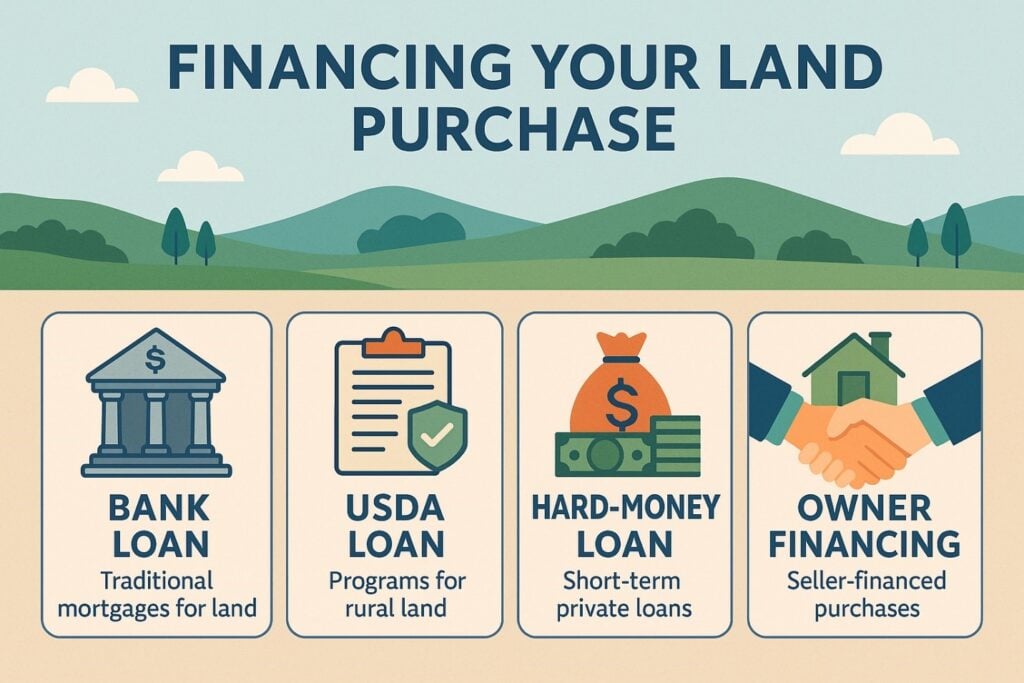
Buying land often requires a different financing plan than buying a finished home. Raw land can be harder for a lender to value, the intended use may be uncertain, and the property itself may not produce income. The right option depends on the parcel, your cash position, your timeline, and whether you plan to hold, build, farm, improve, or resell.
The practical approach is to match the financing to the project. Bank financing may fit a long-term buyer with strong documentation. Seller financing can create flexibility when the seller is willing. Private financing may help when speed matters, but only if you have a realistic payoff plan. Before applying, verify the parcel’s access, zoning, utilities, title, physical condition, and permitted use. A loan approval does not solve a bad land-buying decision.
What USDA rural land financing options should buyers explore?
USDA-related financing may be relevant when land will support a qualifying agricultural operation or when a buyer plans to purchase an eligible rural home property. Program availability, borrower eligibility, property standards, and loan terms can change, so confirm current details directly with the appropriate USDA office and a participating lender.
For agricultural land, Farm Service Agency programs may be worth exploring if the purchase supports a legitimate farm or ranch operation. These programs are not general-purpose raw-land loans. The applicant typically needs to show that the property will be used in an eligible agricultural business and that the proposed operation has a credible repayment plan.
A rural home purchase may involve a different USDA-backed lending path. In those cases, the land is generally part of an eligible residential property rather than a stand-alone investment parcel. The lender will evaluate the home, site, borrower finances, occupancy plans, and local eligibility standards.
What does USDA financing usually require?
What matters is whether the borrower, parcel, and intended use fit the program. For farm-related financing, expect questions about agricultural experience, the business plan, projected operating income, production assumptions, water access, soils, equipment, and market plans. For rural housing programs, expect the lender to focus on owner occupancy, household finances, property condition, and location eligibility.
Do not assume that acreage alone makes a parcel eligible. A rural-looking property may fail a program’s use, location, appraisal, or condition standards. Likewise, an eligible area does not mean every borrower or property qualifies.
How should you prepare for a USDA-related application?
Start with the parcel, not the application. Gather the legal description, survey if available, access information, zoning records, soil or water information when relevant, and details about existing improvements. Then prepare a clear explanation of the intended use. If farming is part of the plan, make the operating assumptions conservative and be prepared to explain how the business will support the debt.
📘 Get Your FREE Land Investing Strategy Guide
Discover how savvy investors build passive income with vacant land.
Ask the agency representative or lender for its current document checklist. Tax returns, bank records, entity documents, leases, business records, maps, and proof of available funds may all be relevant. A complete, consistent package is more useful than an optimistic projection with missing land due diligence.
How do conventional bank land loans compare with other options?
Conventional bank and credit-union land loans can be a solid fit for buyers with stable finances, a meaningful cash contribution, and a parcel that is easy to understand and value. They are often more conservative than home mortgages because vacant land can be harder to sell if a borrower defaults.
Lenders commonly distinguish among raw land, recreational land, agricultural land, improved lots, and land intended for immediate construction. A surveyed parcel with recorded access, utility availability, a clear build path, and nearby comparable sales is usually easier to finance than remote acreage with uncertain access or use restrictions.
| Property type | What a lender may review | Common concern |
|---|---|---|
| Raw land | Access, terrain, comparable sales, intended use | Limited resale market |
| Improved lot | Utilities, roads, buildability, neighborhood sales | Construction timing |
| Recreational parcel | Access, water features, restrictions, market demand | Seasonal or limited use |
| Agricultural land | Soils, water, leases, production plan | Operating risk |
The key is to ask a lender how it classifies your parcel before spending heavily on an appraisal or other lender-requested work. A lender that regularly finances homes may not be the best fit for vacant acreage. A local institution with land-lending experience may better understand the market, but you should still compare the full proposal and not rely on a verbal estimate.
What should you compare in a bank land-loan proposal?
Look beyond the stated interest rate. Ask whether the rate is fixed or adjustable, how long the repayment period lasts, whether a balloon payoff is required, what collateral is pledged, and whether the lender can require additional reserves or documentation before closing. Review how the lender handles prepayment, late payments, default, loan servicing, and future construction financing.
A balloon structure deserves special attention. It can create a lower scheduled payment while leaving a large balance due later. That is not automatically bad, but it only works if you have a credible source of repayment. Do not assume you will be able to refinance, sell, subdivide, or build on the land when the balloon comes due.
When is a fixed or adjustable rate more appropriate?
A fixed rate can make budgeting simpler for a buyer planning a longer hold. An adjustable rate may be considered by someone with a short, well-supported ownership plan, but it introduces payment uncertainty. Read the adjustment method and caps carefully, and ask the lender to explain how a changed rate could affect the payment.
Choosing a loan because its initial payment looks manageable is a common mistake. The better question is whether the financing still works if the project takes longer, costs more, or cannot be refinanced on the schedule you hoped for.
What are the pros and cons of hard-money and private land loans?
Hard-money and private loans can provide flexibility when a bank will not finance a parcel or when a closing needs to happen quickly. In exchange, they may carry more expensive terms, shorter repayment expectations, stronger collateral requirements, and greater default risk. Use them only with a clear and conservative exit strategy.
A hard-money lender generally focuses heavily on the property and the planned exit. A private lender may be an individual or a small lending group and may evaluate the relationship, the property, the borrower, and the proposed use differently. Neither category is automatically better. The documents control the deal.
When can private or hard-money financing make sense?
It may be appropriate when the parcel has a time-sensitive purchase opportunity, the buyer needs a bridge while arranging longer-term financing, or the property does not yet fit conventional underwriting. It can also be considered for a project where the buyer has verified demand, clear title, practical access, and a realistic sale or refinance path.
It is not a substitute for due diligence. Fast funding on land with no legal access, unusable terrain, unclear title, or prohibited intended use can simply accelerate an expensive mistake.
What should you verify before accepting private financing?
- Who the lender is and whether the lender has authority to make the loan.
- What property or assets secure the obligation.
- How payments are calculated and when the full balance becomes due.
- Whether there are origination charges, extension charges, servicing charges, default charges, or prepayment restrictions.
- What events count as default and what remedies the lender may have.
- Whether you can realistically sell, refinance, or pay off the loan before maturity.
Have a qualified real-estate attorney review the note, security instrument, and related documents before you commit. This is especially important when the transaction involves an entity, multiple owners, additional collateral, or a lender-provided form that you do not fully understand.
How do owner-financing and seller-carry land deals work?
Owner financing, also called seller financing or seller carry, means the seller accepts payments over time rather than receiving all purchase funds from a third-party lender at closing. The buyer and seller negotiate the repayment structure, security, possession, responsibilities, and remedies if either party fails to perform.
Seller financing can be useful because the parties can tailor terms to the property and buyer. It can also be risky because informal agreements often leave critical questions unanswered. The practical way to think about it is simple: treat it as a real loan transaction, not a handshake arrangement.
Depending on the state and structure, the arrangement may use a note and mortgage, deed of trust, contract for deed, lease-option structure, or another documented method. Each can allocate title, possession, default remedies, and responsibilities differently. For a closer look at the issues involved, review this guide to an owner financing contract for land.
What terms should be clear in a seller-financing agreement?
- The purchase price, cash paid at closing, financed balance, and payment schedule.
- Whether the payment amount or interest treatment can change.
- When any remaining balance must be paid.
- Who pays taxes, insurance, association charges, utilities, and maintenance.
- Whether the buyer may improve, lease, assign, or sell the property before payoff.
- Whether prepayment is allowed and how payments will be applied.
- What happens after a missed payment or other default.
- How notices will be delivered and whether the agreement will be recorded.
How can buyers and sellers reduce seller-financing risk?
Start with title and authority. Confirm that the seller actually owns the property, identify existing liens, and understand whether any existing loan could affect the transaction. Use a reputable closing or escrow process where appropriate, and make sure the transaction is documented in a way that fits local law.
Buyers should not assume they can build, live on, subdivide, or resell the parcel simply because the seller agrees to finance it. Those questions depend on local rules, recorded restrictions, utility realities, and the contract itself. Sellers should also understand that financing a sale can leave them exposed if the buyer defaults or damages the collateral. Local legal and tax advice is appropriate before signing.
What specialized land-loan products should you consider?
Specialized financing may fit a property with a defined use, such as a build-ready homesite, agricultural operation, or property being acquired together with construction. The lender and program must match the actual project, not just the buyer’s preferred payment structure.
A construction-to-permanent loan may be worth exploring when you intend to buy land and build promptly. It can coordinate land acquisition and construction funding, but lenders often require detailed plans, a qualified builder, a realistic budget, a draw process, and approval of the completed home’s projected value. If building is your goal, this guide to buying land and building a house can help you organize the property due diligence before financing.
Government-backed home-loan programs may sometimes be relevant when land is purchased as part of an eligible primary residence project. They are generally not designed for a buyer who wants vacant land alone for recreation, future speculation, or a loosely defined plan. Verify current program rules with an approved lender rather than relying on broad online claims.
Bridge financing can help cover a temporary gap, but it should be viewed as short-term capital with a specific repayment source. The danger is using a bridge loan to postpone a problem that has no defined solution. If the permanent lender, buyer, or sale is not already reasonably identified, the bridge can become the riskiest part of the deal.
How can you improve your chances of land-loan approval?
You improve approval odds by making the lender’s job easier. Present a financeable borrower, a well-documented parcel, and an understandable purpose for the loan. Lenders do not need a glossy pitch. They need reliable information that supports repayment and collateral value.
Build a clean borrower file
Organize the materials a lender is likely to request: identification, income records, tax records, bank statements, information on existing debts, entity documents when applicable, and evidence of funds available for the purchase and closing. Avoid making major financial changes while a loan is under review unless your lender tells you otherwise.
If the land will support a business, farming operation, construction project, or resale plan, explain it plainly. State what you intend to do, what approvals are already in place, what work remains, and how the loan will be repaid. Do not present projected land value or future income as a certainty.
Build a clean parcel file
Before submitting an offer or loan package, confirm the parcel’s legal access, road condition, boundary information, title status, zoning, restrictive covenants, flood or drainage concerns, utility availability, water and wastewater options, and any special use limitations. The lender may require its own review, appraisal, survey, or title work, but your early due diligence helps prevent surprises.
For an investment purchase, include a simple acquisition thesis: why this parcel is marketable, who the likely buyer or user is, and what facts support that view. If your plan is to flip land, distinguish verified facts from assumptions. A lender or private capital source will want to know that your exit plan is based on real parcel research rather than hope.
How should partnerships and 1031 exchanges affect financing decisions?
Partnership financing and like-kind exchange planning add complexity because ownership, debt, tax treatment, and closing instructions must align. These structures can be useful, but they should be planned before contracts are signed or sale proceeds move.
In a partnership, the loan application may require information from the entity and from the people backing the debt. The operating agreement should clearly address ownership, capital contributions, decision-making, distributions, refinancing authority, guarantees, sale authority, and what happens if a partner cannot contribute as expected.
What is cross-collateralization?
Cross-collateralization means more than one asset may secure the same obligation. It can increase borrowing flexibility, but it also means trouble with one loan can put multiple properties at risk. Before agreeing, identify every asset pledged, determine how the lender releases collateral, and understand whether a sale of one parcel requires lender approval.
What should buyers know about financing in a 1031 exchange?
A like-kind exchange may involve strict tax and transaction procedures. Financing choices can affect the overall structure, including how title is held, how proceeds are handled, and how the replacement property is acquired. Do not assume that a lender’s approval means the exchange treatment is correct.
Coordinate early with the qualified intermediary, lender, closing professional, and tax adviser. Give each party the same ownership and contract information. A common mistake is treating the financing as separate from the exchange until late in the transaction, when changing the borrower or vesting can become difficult.
Mini FAQ
What down payment do I need for land?
There is no universal land-loan down payment. The amount depends on the lender, borrower profile, parcel type, intended use, collateral value, and overall risk. Ask each lender how it classifies the property and what funds must be available before you make an offer.
Can I use a VA loan to buy rural land?
A VA-backed loan may be relevant when land is part of an eligible owner-occupied home purchase, but vacant land by itself is generally a different financing question. Confirm the current property and occupancy standards with a VA-approved lender.
How long does land-loan approval take?
Timing varies with the lender, title work, appraisal availability, survey needs, property complexity, and how complete your file is. Ask the lender for its current process and conditions, but leave room for delays when a parcel has access, title, valuation, or use questions.



