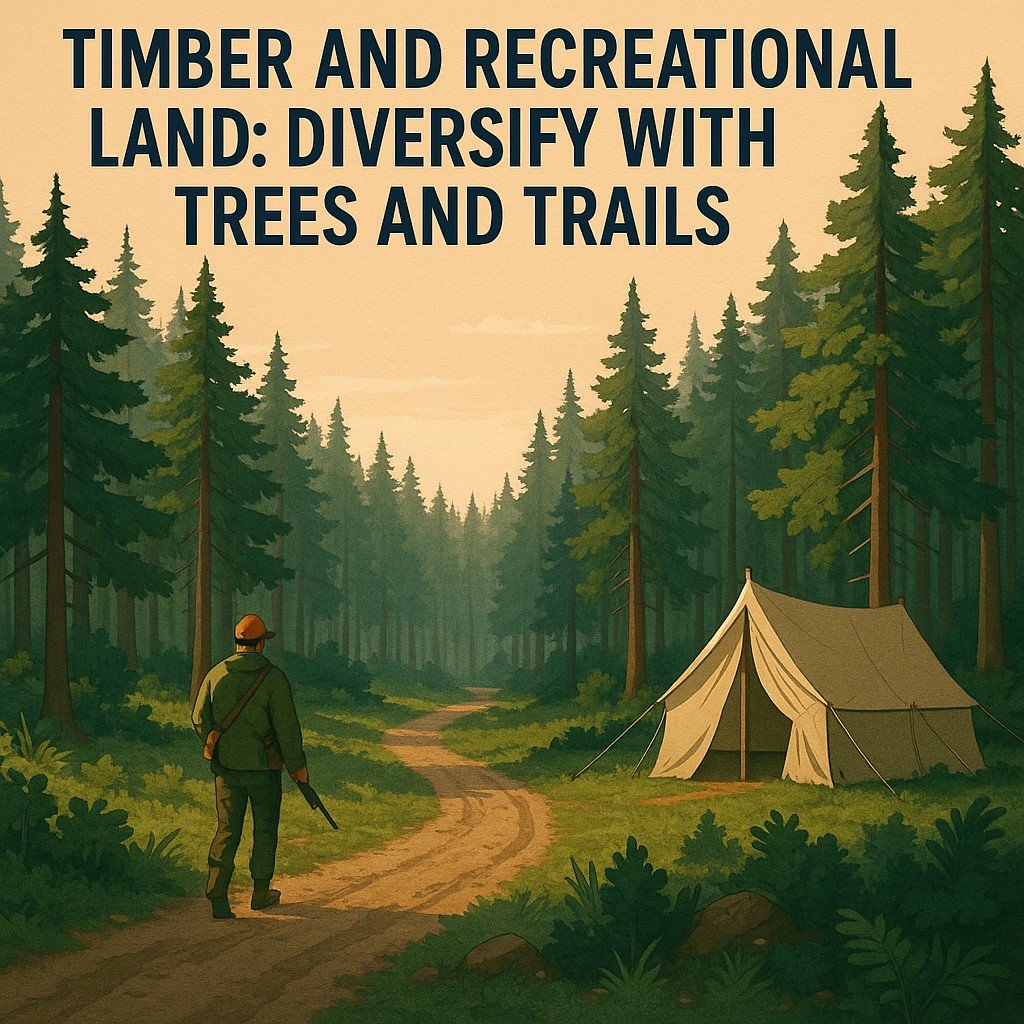
Timber and recreational land can diversify a land investment because the same parcel may support carefully managed timber, outdoor access, habitat work, seasonal uses, and selected visitor experiences. The key is to treat the property as one working landscape, not a collection of unrelated income ideas. Start with the forest, access, legal use rights, and operating capacity. Then choose only the uses that fit the land without damaging its long-term value.
A wooded parcel is not automatically a timber investment, a hunting property, or a glamping site. Its potential depends on tree species and condition, soils, topography, nearby timber markets, road access, water features, neighboring uses, zoning, title restrictions, and local demand. Before buying or adding a new activity, build a written plan for how the property will be used, protected, and maintained.
For a wider look at alternative land asset types and how they can fit a portfolio, explore Timberland and recreational properties.
How should you evaluate timberland before investing?
Evaluate timberland by confirming what is growing on the tract, what condition it is in, how it can be accessed, and whether a realistic market exists for the wood. A property with attractive trees but poor access, uncertain boundaries, or no practical buyer market can be far less useful than it appears.
Begin with a professional forest inventory or timber cruise. A consulting forester can help identify species, stand age, tree quality, stocking, disease concerns, harvest readiness, and regeneration needs. The inventory should distinguish between merchantable timber and younger stands that may need time and management before they have a harvest opportunity.
Then study the operating realities around the parcel:
- Access: Confirm legal ingress and egress, road condition, bridge capacity where relevant, and whether logging equipment can reach workable portions of the tract.
- Markets: Ask local forestry professionals what types of wood are commonly purchased in the area and where the likely outlets are located.
- Terrain and soils: Steep slopes, wet ground, fragile soils, and drainage issues can affect harvest timing and road costs.
- Boundary confidence: Review surveys, recorded descriptions, fences, marked lines, and possible encroachments before assuming you control the timber.
- Encumbrances: Check for easements, conservation restrictions, mineral rights issues, access rights, and covenants that could limit cutting or development.
- Management history: Find out whether the forest was previously harvested, replanted, neglected, burned, or affected by pests or storm damage.
A common mistake is buying based on a seller’s broad statement that a parcel has “valuable timber.” Timber value is highly specific to the trees, the site, the market, and the harvest conditions. A timber inventory and local forester’s perspective are far more useful than a rough visual impression from the road.
How can timber harvesting support long-term land value?
A timber harvest should be part of a written forest-management strategy, not simply a one-time extraction event. The goal is to make a harvest decision that fits the stand’s condition, protects the site, and leaves the property positioned for future growth, recreation, and resale appeal.
Depending on the forest and the owner’s goals, a forester may recommend thinning, selective cutting, an improvement harvest, a regeneration harvest, or no immediate cutting at all. Each approach has tradeoffs. Removing lower-quality or overcrowded trees may improve the remaining stand. A more intensive harvest may be appropriate in some forest types but can temporarily change the property’s appearance, wildlife cover, road conditions, and recreational use.
Your timber-sale agreement should be tailored to the parcel and reviewed by qualified local professionals. Important topics to address include the harvest area, marked boundaries, trees or species excluded from cutting, road use, stream crossings, cleanup expectations, damage responsibility, payment method, insurance, timing restrictions, and reforestation or regeneration responsibilities.
Do not assume a buyer’s contract is designed to protect the landowner. The practical approach is to have a consulting forester represent your interests during the inventory, bidding process, contract review, harvest oversight, and final inspection. A forester can also help separate a legitimate timber opportunity from a proposal that removes the best trees while leaving a weakened stand behind.
Questions to ask before approving a harvest
- What is the objective of this harvest: forest health, regeneration, access improvement, habitat work, or income?
- Which trees will remain, and why are they being retained?
- How will equipment enter, exit, and operate on the property?
- What protections apply to streams, wetlands, slopes, and sensitive soils?
- Who will inspect the work while it is underway?
- What must happen after the harvest to support the next forest stage?
What recreational leases work well on forestland?
Hunting, fishing, trail access, camping, and other recreational leases can fit forestland when the use matches the property’s habitat, access, safety profile, and carrying capacity. A good lease is selective. It gives the right people a defined use of the land without handing over uncontrolled access or creating conflicts with timber operations.
📘 Get Your FREE Land Investing Strategy Guide
Discover how savvy investors build passive income with vacant land.
Hunting leases are often the most natural fit because active forest management can create varied habitat. Timber edges, young regrowth, mast-producing trees, water sources, and carefully planned openings may all affect wildlife use. Still, habitat quality does not eliminate the need for a clear agreement, safe access rules, and communication around harvest activity.
Other possibilities may include fishing access where water resources support it, private trail use, equestrian access, primitive camping, educational outings, or organized outdoor events. Each use brings different risks. Motorized trail access, for example, can create erosion, noise, gate damage, neighbor issues, and conflicts with wildlife management if it is not tightly controlled.
| Use | Best fit | Main concern | Key control |
|---|---|---|---|
| Hunting | Managed wildlife habitat | Safety and access | Named users and written rules |
| Fishing access | Suitable pond or stream | Water safety | Defined entry points |
| Trail use | Durable terrain and routes | Erosion and liability | Mapped permitted trails |
| Primitive camping | Private, accessible sites | Fire and sanitation | Site-specific occupancy rules |
Before offering access, speak with a local attorney and insurance professional who understand rural recreational uses in your state. Ask about lease language, waivers, insurance expectations, landowner-liability rules, emergency response, and whether the intended use triggers permits or additional obligations. These issues vary materially by location and activity.
How do you structure a recreational lease that protects the property?
A strong recreational lease identifies who can use the property, where they can go, what they can do, and what happens when they break the rules. Vague permission is a common source of disputes, property damage, and unsafe conditions.
At a minimum, define the leased area on a map and identify gates, parking areas, roads, trails, water features, no-entry zones, and any active forestry areas. Specify whether guests are allowed, whether subleasing is prohibited, what vehicles may enter, how keys or gate codes are handled, and when the owner may access the land.
Practical rules often address:
- Required compliance with hunting, fishing, fire, vehicle, and wildlife rules administered locally.
- Restrictions on permanent structures, tree stands, feeders, trail construction, and ground disturbance.
- Trash removal, firewood collection, sanitation, and damage reporting.
- Procedures for reporting injured people, wildfire, trespass, damaged gates, or fallen trees blocking access.
- The owner’s right to close areas during forestry work, wet conditions, or emergency situations.
- Insurance and indemnity provisions prepared with appropriate legal and insurance guidance.
Document the property condition before occupancy. Take dated photographs of gates, roads, campsites, bridges, signs, and known trouble spots. This creates a baseline and makes inspections much easier. A lease can be valuable, but only if the owner consistently enforces it.
How can agroforestry and mixed-use strategies add value?
Agroforestry can add a compatible use to a wooded property when it respects the forest’s ecology and does not interfere with the primary management plan. The best mixed-use strategy is usually the simplest one that the owner can realistically supervise.
Examples may include managed woodland products, carefully located tree crops, specialty plants suited to shade conditions, beekeeping, grazing in appropriate silvopasture settings, or a lease to an operator who has the knowledge to run the activity. The opportunity is not the product itself. The opportunity is matching a use to the site, market, labor requirement, and legal permissions.
For example, a wooded parcel with accessible clearings may support a compatible seasonal use, while a dense timber tract with limited roads may be better reserved for forest management and controlled hunting. A remote tract may look ideal for a specialty crop, but that does not help if the operator cannot reliably reach it, protect it, process it, or sell it.
Before adding agroforestry, verify soil conditions, water availability, wildlife pressure, equipment access, biosecurity concerns, local land-use rules, and the operator’s responsibilities. If another party will run the activity, use a written agreement that addresses access, maintenance, restoration, insurance, improvements, and removal of equipment at the end of the relationship.
Landowners considering multiple income paths may also benefit from this guide on ways to turn land into income. The central lesson is the same: choose uses that the property can support and that you can manage responsibly.
What sustainable timber practices protect a forest asset?
Sustainable timber management protects soil, water, regeneration, wildlife habitat, and future harvest options. It does not mean never harvesting. It means making harvest and improvement decisions that preserve the land’s productive capacity instead of consuming it.
A written forest-management plan is the operating manual. It should describe stand conditions, management objectives, access routes, harvest priorities, invasive-species concerns, fire considerations, regeneration goals, sensitive areas, and inspection routines. A consulting forester can help develop and update this plan based on the actual forest rather than a generic template.
Pay particular attention to roads and water. Forest roads can be an asset for harvesting, recreation, emergency access, and resale, but neglected drainage can create erosion and expensive repairs. Protecting stream corridors, wetlands, and unstable slopes is equally important. Local forestry agencies and qualified professionals can explain the best management practices that apply to the area.
Also plan for the period after a harvest. Will natural regeneration be sufficient? Is site preparation needed? Are invasive plants likely to take advantage of disturbed ground? Will young trees need protection from browsing pressure? The harvest is not the end of the work. It is a transition into the next management stage.
Can firewood, carbon, and habitat arrangements diversify income?
Firewood access, carbon arrangements, and habitat-focused agreements can be options for certain properties, but each requires careful verification. These are not interchangeable revenue streams, and they can impose commitments that affect future timber harvests, resale flexibility, or land-use choices.
A controlled firewood arrangement may work where the owner can identify safe cutting areas and supervise access. It should never become an open invitation for people to cut wherever they choose. Mark approved areas, define acceptable material, limit vehicle access, require cleanup, and protect roads, young stands, and boundary trees.
Carbon programs can be complex. Eligibility may depend on acreage, forest condition, baseline measurements, projected management, contract duration, verification procedures, and restrictions on future harvesting. Before signing anything, ask who controls the data, what happens if fire or storm damage changes the forest, whether the agreement transfers to a future owner, and what penalties or obligations may apply. Have a qualified attorney, forester, and tax professional review the documents based on your circumstances.
Wildlife habitat agreements or conservation easements also deserve careful review. Some arrangements may limit future uses of the property for a long time or permanently. Confirm exactly what rights are being conveyed, who monitors compliance, how amendments work, and how the restriction could affect future buyers or heirs.
How do you decide whether eco-tourism or glamping fits the land?
Eco-tourism or glamping can fit a timber property only when the site can safely support guests, sanitation, access, and ongoing operations. The appeal of a secluded forest setting does not override zoning, building, health, fire-safety, environmental, or neighborhood considerations.
Start by evaluating the guest experience and the operating burden separately. A quiet ridge, pond edge, or wooded clearing may be attractive, but the site still needs practical access, emergency response considerations, waste management, water planning, drainage, parking, and a system for cleaning and maintenance. Remote locations can be a feature for visitors and a challenge for operations.
Before building or advertising accommodations, contact the relevant county or municipal planning, building, health, and fire offices. Ask how the proposed use is classified, whether short-term stays are allowed, what approvals may be needed, and whether utilities or roads trigger separate review. Requirements can differ even between nearby jurisdictions.
A common mistake is investing in structures before confirming allowed use. The better sequence is to verify entitlement and site feasibility first, then create a simple operating plan, then invest in improvements that match verified demand and your management capacity.
How can you manage and scale timber and recreational operations?
Scale by improving systems before adding more uses or more acreage. Timber and recreation can become operationally demanding when leases, vendors, roads, guests, gates, maintenance, and harvest schedules are handled informally.
Create a property file for each tract. Keep the survey, title documents, management plan, maps, contact list, lease agreements, insurance records, inspection notes, photographs, road-maintenance history, and harvest records in one organized location. Use consistent naming and renewal reminders so important dates and responsibilities do not disappear in email threads.
Build a small local team around the property’s actual needs. That may include a consulting forester, surveyor, attorney, insurance professional, road contractor, wildlife manager, or local caretaker. The goal is not to outsource judgment. It is to have the right expertise available before a problem becomes expensive.
For investors comparing woodland with other ownership models, investments without traditional tenants offers useful context. Recreational lessees and guests may not be residential tenants, but they still require agreements, oversight, communication, and clear boundaries.
Mini FAQ
Can timber harvesting and hunting leases coexist?
Yes, they can coexist when access, timing, safety zones, and communication are managed carefully. Suspend or redirect recreational access during active logging, map restricted areas clearly, and make harvest plans part of the lease communication process.
Should I buy land based on estimated timber value alone?
No. Timber is only one part of the property analysis. Confirm access, markets, stand condition, harvest feasibility, boundaries, restrictions, road needs, taxes, carrying costs, and the condition of the land after any potential harvest.
Is glamping a passive use of recreational land?
Usually not. Guest accommodations require active management or a capable operator. Cleaning, maintenance, booking communication, safety, utilities, weather events, and local compliance can create meaningful operating responsibilities.
Who should prepare a timber-management plan?
A qualified consulting forester is often the right starting point. The plan should reflect the specific tract, the owner’s goals, local forest conditions, and any recreational or conservation uses that need to coexist with forestry.



