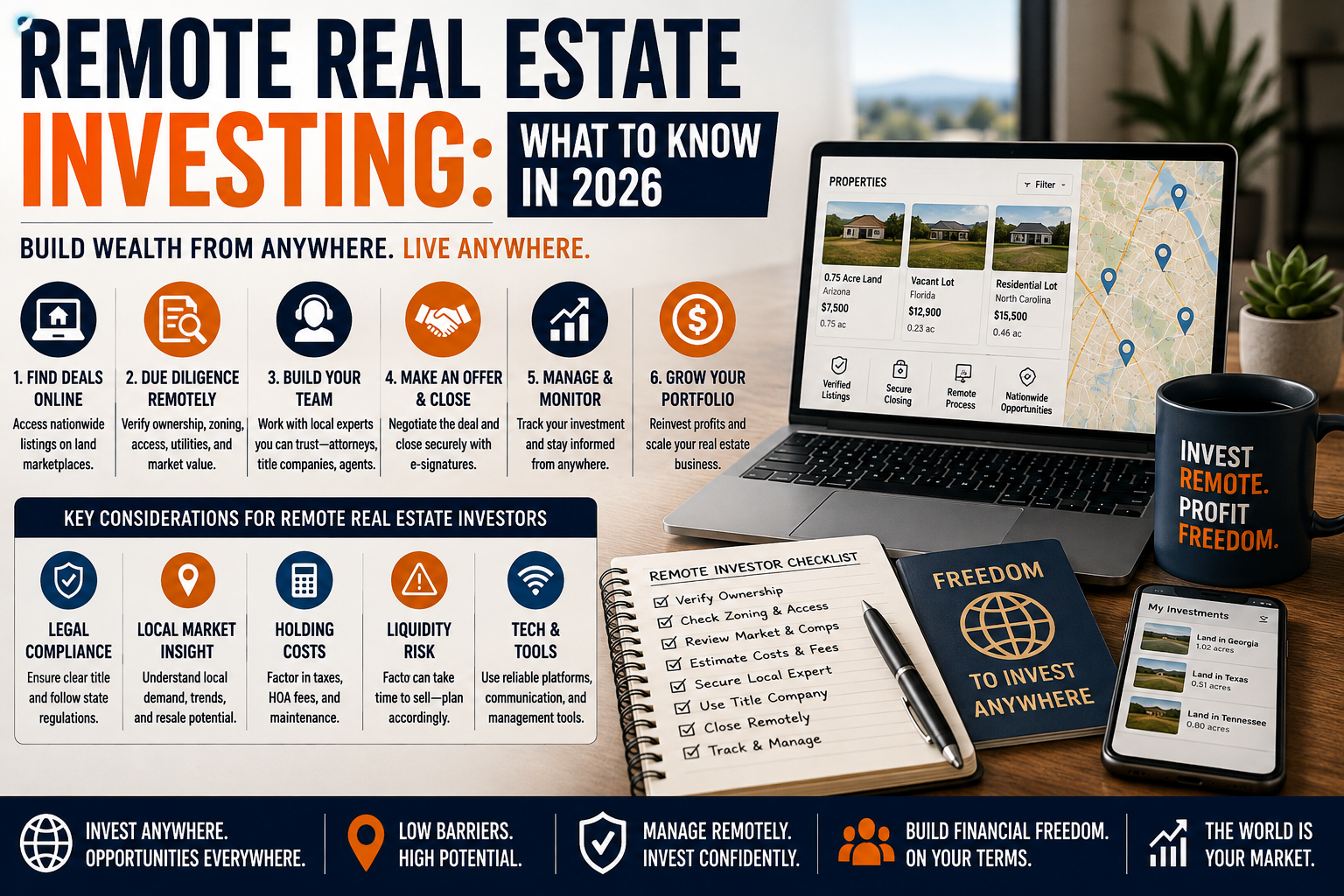
Remote real estate investing in 2026 means buying and managing properties without physically visiting them, relying heavily on trusted local professionals and verified official records to ensure investment security. The key challenge is compensating for distance by systematically verifying ownership, legal access, zoning compliance, and property condition before acquisition,and establishing a reliable local network for ongoing management. Skipping these steps or treating online data as sufficient can expose investors to costly surprises, legal disputes, or unmanaged maintenance that are hard to fix remotely.
What Is Remote Real Estate Investing and How Does It Work?
Remote real estate investing means purchasing and overseeing land, residential, or commercial properties without on-site visits, using local agents, inspectors, property managers, and digital tools to bridge the information gap created by distance. This approach requires a disciplined verification process backed by official county records and consistent communication protocols to minimize risks associated with physical absence.
Understanding this matter affects your offer, due diligence timeline, and management approach. Unlike local investing, you cannot rely on personal inspections or occasional visits. Instead, you must build a structured reliance on local experts and verified records from the outset. Confirming clear title, legal access, zoning, and physical condition remotely is the groundwork that shapes your ability to manage the property and anticipate costs.
Before making an offer, ensure you have identified trusted local professionals, verified public records, and have a plan for ongoing communication and oversight. Neglecting this sequence exposes you to risks that technology alone cannot resolve.
What Types of Properties Are Common in Remote Real Estate Investing?
Remote investors typically focus on undeveloped land, residential rentals, or commercial properties. Land requires less hands-on management but demands rigorous legal and physical verification of access, zoning, and title. Residential and commercial properties usually require active tenant management and maintenance, increasing operational complexity remotely. Your investment choice should align with your ability to manage these demands via local networks and digital tools.
How Does Remote Investing Differ from Traditional Local Investing?
Remote investing shifts your role from direct supervisor to coordinator of local professionals and relies heavily on remote verification tools. This creates asymmetric risk: errors or incomplete information provided by local contacts can have significant impacts, as you can’t easily inspect or intervene personally. Structured research, layered verification, and frequent communication become mandatory to compensate for the lack of physical presence.
📘 Get Your FREE Land Investing Strategy Guide
Discover how savvy investors build passive income with vacant land.
Can I Invest in Land or Property Without Visiting It in Person?
Yes, but only if you compensate for the lack of physical inspection with thorough due diligence and qualified local experts verifying critical property aspects. Virtual tours and satellite images provide initial information but cannot replace onsite assessments of soil quality, drainage, boundary markings, or access roads.
Failing to verify these factors through trusted local professionals risks purchasing property with undisclosed encumbrances, access problems, or environmental hazards. Before proceeding, always retain licensed inspectors, surveyors, and agents to perform onsite verification and produce written reports.
What Are the Limitations of Relying Solely on Remote Evaluation Tools?
Remote tools can overlook crucial issues like unauthorized property alterations, zoning violations, or poor utility infrastructure. They also cannot capture neighborhood conditions, future development plans, or subtle physical defects. A common mistake is to skip hiring a local inspector or surveyor due to perceived cost or inconvenience, which often results in unpleasant surprises that can complicate ownership or resale.
What Alternative Real Estate Investing Options Are Suitable for Remote Investors?
Remote investors often lean toward land investing, certain commercial properties with stable long-term leases, and real estate investment trusts (REITs) as alternatives that align better with remote management capabilities. Land investing, in particular, offers simpler operational demands but requires intensive upfront legal and zoning research due to access, title, and use restrictions.
Why Is Land Investing Common for Remote Investors?
Land offers lower upfront management because it generally lacks tenants and buildings requiring maintenance. However, it demands confirmation of legal road access, zoning conformity, environmental status, and clear title. These checks impact both your usage plans and resale options and can vary substantially between counties and states.
How Do Land Investments Compare to Residential and Commercial Remote Properties?
| Property Type | Investment Scale | Management Complexity | Liquidity | Key Risks |
|---|---|---|---|---|
| Land | Low to Moderate | Low (less daily management) | Generally lower (longer time to sell) | Title clarity, legal access, zoning, environmental restrictions |
| Residential | Moderate | High (tenant and maintenance management) | Moderate | Tenant turnover, maintenance, market fluctuations |
| Commercial | High | High (complex leases, specialized upkeep) | Moderate to Low | Lease default, market cycles, regulatory changes |
Selecting your property type must reflect your comfort with managing complexity remotely, your available local support, and your investment timeline.
How Do I Conduct Thorough Due Diligence Remotely?
Begin with verifying legal ownership and encumbrances by obtaining official title reports and lien searches from county or state land registries or by hiring a reputable local title company. Then, confirm zoning and land use regulations through municipal planning offices and examine recent or pending zoning changes that affect your intended use.
Lastly, commission professional onsite inspections and surveys from licensed local experts to verify physical boundaries, access roads, utility availability, soil conditions, and environmental factors.
Skipping any of these steps creates blind spots that can lead to ownership disputes, regulatory penalties, unexpected repair costs, or unusable properties.
What Should I Look for When Verifying Title and Encumbrances?
Confirm that ownership records match seller disclosures, and scrutinize for liens, judgments, easements, or restrictive covenants affecting use or transfer. Local title companies or attorneys can assist when online records are incomplete or unclear. Lack of clear title is a deal-breaker or requires legal resolution before purchase.
How Can I Verify Zoning and Restrictions Remotely?
Access official zoning maps and land use ordinances, paying attention to permitted uses, setbacks, building restrictions, and environmental overlays. Contact local planning officials to clarify ambiguous rules or upcoming changes. Zoning that conflicts with your intended use or limits development potential significantly affects value and should guide your offer or walk-away decision.
Why Are Professional Local Inspections Essential?
Remote data sources rarely reveal physical access issues, problematic terrain, or encroachment risks. A licensed surveyor can confirm precise boundaries and legal road access. Inspectors assess physical site conditions, identify drainage problems or unauthorized changes, and ensure utilities function as expected. Their detailed reports provide an evidence base for your investment decision.
What Tools and Resources Assist with Remote Property Management?
Effective remote management combines technology platforms for communication, rent collection, and condition monitoring with trusted local professionals who handle daily operations, maintenance, tenant relations, and emergency responses.
Cloud-based property management software and video conferencing tools enable regular updates and tenant communication. IoT devices like security cameras and environmental sensors provide real-time condition alerts but cannot replace periodic onsite inspections.
You must also select qualified local property managers and inspectors with proven records, clear contractual expectations, and reporting schedules to ensure you remain informed and responsive despite being offsite.
How Do I Vet Local Property Managers and Inspectors?
Verify licenses and certifications through state regulatory agencies. Check references and interview multiple candidates to assess experience and responsiveness. Clearly outline responsibilities, communication frequency, and emergency protocols in writing to avoid misunderstandings or gaps in oversight.
What Legal and Title Verification Steps Are Critical for Remote Investments?
Foundation of remote investing is confirming legal ownership and identifying any title burdens through official county recorder or state land registry offices. Request comprehensive title reports that disclose liens, easements, or encumbrances affecting transfer or use.
Be aware of jurisdiction-specific rules limiting out-of-state ownership or imposing additional taxes or reporting requirements. Consult local legal professionals when these issues arise or if title histories appear complicated.
Where Should I Obtain Property Records and How to Interpret Them?
Most counties provide some online access, but availability varies. When online records are partial or unclear, instruct trusted local title companies or attorneys to obtain official documents and provide interpretation. Clear title status is your green light; unresolved issues here should postpone or cancel your offer.
What Risks and Challenges Are Unique to Remote Real Estate Investing?
Here are risks that require deliberate mitigation in remote investing:
- Verification gaps: Without being onsite, you rely on others for accurate property and neighborhood information, increasing risk of overlooked defects or encumbrances.
- Fraud and misinformation: Remote deals can attract misrepresentations or undeclared liens since physical inspection is limited.
- Management delays: Managing tenants, repairs, or emergencies remotely depends on prompt local contacts; delays raise costs and risk damage.
- Legal and regulatory complexities: Different state or local ownership rules can complicate transactions unknowingly.
- Infrastructure and access assumptions: Presuming legal road access or utilities without verification can undermine property usability.
How Can I Mitigate These Risks Effectively?
Use a multi-layered due diligence approach involving multiple sources of verification: official records, licensed local experts, and technology. Develop a strong local professional network to monitor property condition and respond quickly. Document communication plans and monitor progress regularly to avoid surprises.
How Do I Build a Reliable Local Support Network for Managing Remote Properties?
Identify and engage licensed and vetted local agents, inspectors, and property managers who understand the market. Verify credentials through state agencies and professional associations. Use referrals and references to select trustworthy professionals, then formalize your relationship with clear agreements on roles and communication.
Maintain frequent contact and schedule regular performance reviews to preserve accountability. Your local network substitutes for your onsite presence and is critical to protecting your remote investment.
Why Each Role Matters for Remote Investors?
Agents streamline transactions and market insight.
Inspectors and surveyors confirm physical property condition and boundaries.
Property managers handle tenants, maintenance, and emergencies. Building a dependable team among these roles is your best safeguard.
What Decision Criteria Should Guide Remote Real Estate Investment Choices?
Remote decisions require balancing your risk tolerance, your ability to manage or delegate, and the local market context:
- Risk tolerance: Choose properties that fit your comfort with management complexity and uncertainty.
- Property type and management need: Land demands less hands-on work but more regulatory research; residential and commercial require supervising tenants and upkeep.
- Availability of reliable local support: Do not invest where you cannot access qualified professionals for inspection and management.
- Investment scale and diversification: Consider managing only as many properties as your network and resources allow without compromising oversight quality.
What Workflow Ensures Smart Remote Investment Decisions?
- Define your investment goals and risk comfort.
- Choose property types consistent with your management capacity.
- Research local legal, zoning, and market environments.
- Conduct comprehensive due diligence with official records and local experts.
- Assess and acquire technology tools for remote monitoring.
- Establish formal agreements and communication protocols with local professionals.
- Maintain ongoing oversight and be prepared to adjust or exit if risks emerge.
When Should I Reconsider or Walk Away from a Remote Investment Opportunity?
Pause or walk away if key verifications fail or reveal red flags such as unclear or contested title, inaccessible or uncooperative local support professionals, contradictory or unverifiable property information, prohibitive legal restrictions, or unresolved access and infrastructure challenges.
Reacting promptly to these warning signs protects your capital and reputation. No investment is worth accepting unmanaged legal or financial risk.
Examples of Walk-Away Signals
- Title chain contains unresolved disputes or extensive liens.
- Local agents, inspectors, or managers cannot be found or fail basic verification.
- Zoning or use restrictions prohibit your intended plans.
- Access to the property depends on unconfirmed easements or private roads.
- Environmental hazards or physical defects cannot be independently verified or mitigated.
Practical Scenario: Remote Land Investment Decision-Making
Scenario: A remote investor from New York considers undeveloped land in Arizona without visiting.
How Should Verification Proceed?
- Order a title search and lien report via a reputable local title company.
- Request official zoning and land use information from county and municipal planning departments.
- Confirm legal road access through recorded easements and local surveyor input.
- Hire a licensed local surveyor and property inspector to assess boundaries, condition, and any encumbrances.
- Vet and engage local property managers or caretakers for ongoing oversight if held long-term.
Balancing Local Input and Online Data
While aerial imagery or virtual tours can suggest property features, only local professionals provide legally binding confirmation of access and boundary details. For example, a road appearing on satellite images may lack legal easements, which a local surveyor can validate. When discrepancies occur, prioritize local expert reports.
When Should the Investor Walk Away?
If title confirmation fails, access is uncertain, or no reliable local professionals can be found, this signals excessive risk and should trigger a pause or walk-away. Similarly, unresolved zoning conflicts or environmental concerns without viable remediation warrant reconsideration.
Checklist: Remote Real Estate Investing Due Diligence
- Verify clear property title and ownership status through official county or state records.
- Identify liens, easements, or encumbrances that affect transfer or use.
- Research local zoning laws, land use restrictions, and pending changes via municipal sources.
- Confirm physical access, utilities, and easements with recorded documents and local experts.
- Commission licensed local inspectors and surveyors for onsite evaluations.
- Assess local market conditions relevant to property value and resale potential.
- Identify and vet local professionals,agents, property managers, inspectors,with verified credentials and references.
- Establish clear communication protocols and reporting schedules with your local support team.
- Utilize technology tools for rent collection, tenant communication, and property monitoring.
- Understand any applicable legal restrictions on out-of-state or remote ownership.
- Prepare contingency plans for emergencies, repairs, or tenant issues through local contacts.
FAQ: Common Questions About Remote Real Estate Investing
Is remote real estate investing appropriate for beginners?
It can be done by beginners if approached cautiously with thorough education, a realistic understanding of risks, and a strong local professional network to supplement their remote management limits. Prioritizing due diligence is essential to mitigating risks common in remote transactions.
How are repairs and emergencies handled from a distance?
Reliable local property managers or contractors with clear protocols for urgent repairs and emergencies are critical. Without such trusted contacts, managing maintenance remotely is risky and can lead to prolonged issues and higher costs.
Can technology fully replace onsite inspections?
No. While virtual tours, satellite imagery, and IoT devices assist monitoring, they cannot substitute detailed physical inspections and local professional assessments, especially for evaluating property condition and legal access.
Do certain states have restrictions on remote property ownership?
Yes, some states impose legal, tax, or reporting restrictions on out-of-state or remote owners. Verify these state-specific rules with qualified local professionals before purchasing to avoid unexpected legal or financial complications.
What level of ongoing communication is necessary with local contacts?
Regular, clear communication is vital,schedule routine progress updates, condition reports, and immediate alerts for emergencies. This transparency prevents surprises and helps maintain the property’s condition and value despite your physical absence.



