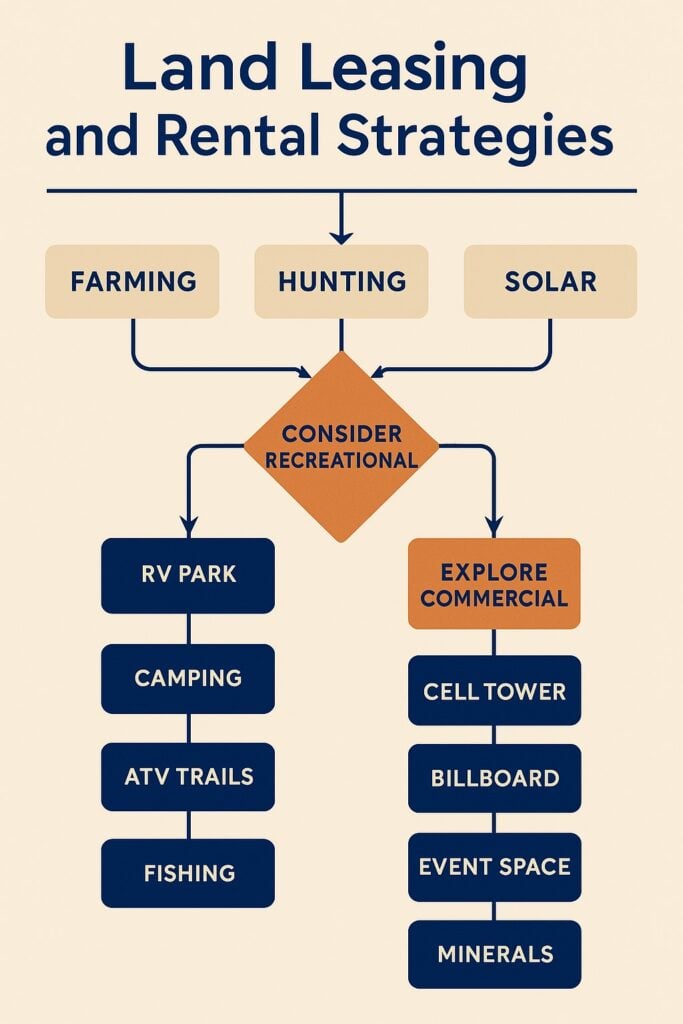
Land can produce recurring rental income when the use fits the parcel, the local market, and the level of management you are willing to take on. The best lease is rarely the one with the most exciting headline. It is the one with a qualified operator, clear boundaries, workable access, sensible risk controls, and an agreement that protects the land’s future value.
Start by looking at what your property can realistically support. Productive soil may suit a farm lease. Privacy, habitat, and access may support hunting. Road frontage may create a commercial opportunity. Utilities and zoning may make an RV, mobile home, or specialized-use lease possible. Vacant land income ideas are broad, but the practical work is narrowing those ideas to uses that are permitted, insurable, and manageable on your specific parcel.
The key is to treat every lease as both an income opportunity and a land-use decision. A tenant can improve the property’s usefulness, or create a costly cleanup, access, insurance, or neighbor problem. Before offering a lease, verify ownership rights, zoning, deed restrictions, access, utilities, environmental conditions, and any local approval process with the appropriate local professionals and officials.
How can I lease land for farming to generate income?
Farming leases can provide steady land income when the soil, water access, field layout, and farm operator are a good match. A cash-rent arrangement is usually simpler for the owner, while a crop-share arrangement may create more involvement and more exposure to production and market changes.
Begin with the land itself. Walk the fields, identify usable acreage, note drainage issues, inspect fences and gates, and determine whether the tenant can safely move equipment to and through the property. Soil information, irrigation availability, topography, and prior land use all affect which crops or grazing uses make sense. A parcel that looks open from the road may still be difficult to farm because of wet areas, irregular boundaries, poor turning space, or unreliable access.
Then speak with local farmers, agricultural land managers, and county agricultural offices about customary lease structures in the area. Do not rely on generic online pricing. The value of a farm lease can change substantially based on crop potential, pasture condition, water rights, improvements, field size, and local demand.
Choose the lease structure that matches your role
| Structure | Best fit | Owner focus | Main tradeoff |
|---|---|---|---|
| Cash rent | Owners seeking simpler administration | Tenant quality and payment reliability | Less participation in farm upside |
| Crop share | Owners comfortable with more oversight | Records, marketing, and production terms | Income can vary with operations |
| Grazing lease | Pasture or land needing vegetation management | Stocking, fencing, and water access | Animal damage can be overlooked |
A common mistake is treating a farm lease as a simple permission slip. The agreement should define the leased area, permitted crops or livestock, access routes, maintenance duties, payment process, insurance expectations, soil-conservation practices, and what happens when the lease ends. If the tenant will install fencing, irrigation, storage, or other improvements, address ownership, maintenance, and removal before work begins.
For owners evaluating agricultural land more broadly, this guide to farmland investing considerations can help frame the property-level questions that affect long-term usability.
How can I rent land for hunting and outdoor recreation?
Hunting leases can work well on rural land with suitable habitat, controlled access, and clear safety rules. The lease value depends less on acreage alone than on game habitat, privacy, neighboring uses, road access, water features, and the quality of the hunting experience.
Before marketing the property, decide whether it is appropriate for hunting at all. Consider nearby homes, public roads, livestock, hiking areas, utility corridors, and other users of the parcel. Verify local hunting rules, discharge restrictions, and landowner responsibilities through relevant local authorities and qualified insurance and legal professionals.
A well-managed hunting lease identifies the authorized hunters, permitted game, allowed hunting methods, vehicle routes, parking areas, stand locations, camping rules, and dates of access. It should also address guest policies, gates, keys or access codes, trash removal, trail cameras, food plots, and the removal of equipment at the end of the agreement.
Put safety and access ahead of marketing
The practical way to think about a hunting lease is that you are managing access to a potentially hazardous activity. Require the operator or hunting group to provide appropriate insurance documentation and a written acknowledgment of property rules. Use mapped boundaries rather than vague descriptions. Mark sensitive areas, keep emergency access open, and establish a process for reporting damage, trespassing, or unsafe conduct.
📘 Get Your FREE Land Investing Strategy Guide
Discover how savvy investors build passive income with vacant land.
Do not promise amenities that the property cannot reliably provide. If a road becomes impassable in wet weather, say so. If there is no potable water, do not imply otherwise. Clear expectations attract better tenants and reduce disputes.
Other recreation concepts may include camping, trail access, outdoor classes, equestrian use, or organized activities. These uses can bring more operational complexity than a private hunting lease. Noise, parking, sanitation, traffic, neighbor concerns, and special-use approvals often become central issues. The more public-facing the activity, the more important it is to investigate zoning, safety, insurance, and operator qualifications before signing anything.
What ground lease ideas can diversify land income?
Ground leases can diversify land income by allowing another party to operate a compatible use on the property while you retain ownership of the land. Potential uses include agricultural operations, storage, communications infrastructure, signage, utility-related facilities, parking, or specialized commercial uses where local rules allow.
Not every parcel should have multiple leases. Layering uses can create income, but it can also create conflicts over access, noise, utility capacity, drainage, liability, and exclusive-use rights. The best candidates are parcels with clearly separable areas, durable access, and uses that do not interfere with each other.
For example, a larger property might support farming in one area and a carefully separated storage or communications use near a road. But the leases must identify exact boundaries, easements, utility routes, maintenance responsibilities, and who has priority if operations conflict. Never assume that a tenant’s use of one corner of a parcel will have no effect on another tenant.
Evaluate a ground lease before negotiating rent
- Confirm that you own the rights needed to grant the proposed use.
- Review zoning, overlays, deed restrictions, and any local approval path.
- Identify legal and physical access, including whether heavy vehicles can reach the site.
- Check utility availability, drainage, visibility, and site conditions.
- Ask whether the proposed use could affect neighboring owners or future buyers.
- Clarify whether the tenant needs exclusivity, expansion rights, or utility easements.
- Determine how structures, equipment, and site restoration will be handled when the lease ends.
A common mistake is negotiating the payment before understanding the tenant’s site requirements. A prospective tenant may need a larger footprint, dedicated access, security fencing, drainage work, utility upgrades, or long-term control of the site. Those items can matter more than the stated rent because they affect the property long after the tenant arrives.
How can I lease land for energy, communications, or resource uses?
Energy, communications, and resource leases can be valuable, but they require unusually careful due diligence because they may involve long commitments, infrastructure, easements, environmental concerns, and complicated restoration obligations. Landowners should use qualified local legal, title, environmental, and technical advice before granting these rights.
Potential opportunities include solar development, wind-related infrastructure, battery or utility facilities, communications equipment, transmission corridors, mineral activity, and water-related uses. Suitability depends on far more than open acreage. Developers often evaluate transmission access, interconnection feasibility, topography, wetlands, habitat, road capacity, setbacks, local policy, title conditions, and the ability to secure permits.
Protect the land beyond the lease term
The important question is not simply, “What will the tenant pay?” It is, “What rights am I giving up, what improvements can be built, and what condition will the property be in when the agreement ends?” A lease should be reviewed for site control, access rights, assignment rights, construction standards, insurance, indemnity, maintenance, reporting, restoration, and dispute procedures.
For mineral or water-related opportunities, first verify the ownership record. Surface ownership does not always mean the owner controls every underlying right. Title professionals and attorneys who work in the relevant jurisdiction can help identify severed interests, prior leases, easements, and recorded limitations.
Be especially cautious with broad option language or open-ended rights to expand. A tenant may need flexibility during development, but the owner needs a precise description of where activity is allowed and what happens if the project does not proceed. If a proposed agreement is difficult to understand, that is a reason to slow down, not a reason to sign quickly.
How can I lease land for RV, mobile home, or storage uses?
RV, mobile home, and storage uses can create recurring occupancy income, but they are operating businesses as much as they are land leases. They often require significant attention to zoning, access, utilities, wastewater, fire safety, road maintenance, tenant management, and local licensing or inspection processes.
Before considering this path, confirm whether the parcel can legally support the intended density and occupancy pattern. Then assess whether utilities can serve the use reliably. Water, wastewater, electrical capacity, drainage, road design, emergency access, and trash handling can determine whether the concept is practical.
Decide whether you want a tenant or an operating business
Leasing raw land to an experienced park or storage operator is different from directly managing individual spaces. With an operator lease, the operator may handle customer acquisition, billing, maintenance, and day-to-day issues, subject to your agreement. With direct occupancy agreements, you carry more control but also more management responsibility.
Do not underestimate the operational side. Late payments, abandoned property, utility disputes, vehicle rules, pet issues, maintenance calls, and tenant turnover can consume time. If your goal is a more hands-off land investment, an experienced operator may be a better fit than becoming the operator yourself, assuming the local market and lease structure support it.
The same framework applies to open storage. Outdoor storage may look straightforward, but it can create drainage, visual, security, environmental, and zoning issues. Define what can be stored, where it may be stored, how the site must be maintained, and what removal obligations apply.
How can I lease land for community and specialized uses?
Community and specialized leases can be a good fit when a parcel has a distinctive location, existing improvements, or a local need that larger commercial operators overlook. Possibilities may include garden space, beekeeping, greenhouse operations, nurseries, orchards, educational uses, event space, film locations, or compost-related activity, subject to local rules.
These uses are not interchangeable. Beekeeping may require thoughtful placement near neighboring properties and water sources. A greenhouse operation may depend on utilities and water. A film or event use may create traffic and restoration concerns. Composting can raise environmental, odor, drainage, and permitting questions. The lease must be tailored to the use rather than copied from a generic template.
Match the agreement to the operator’s real-world needs
Specialized tenants often invest time and money into a site, which means they may seek longer control, renewal rights, signage rights, utility access, or permission to make improvements. That can be reasonable, but the agreement should protect both sides by defining approval rights, maintenance standards, ownership of improvements, insurance expectations, and restoration duties.
For community-oriented uses, communication matters as much as the lease. Establish a single responsible contact, a process for complaints, operating rules, cleanup expectations, and clear limits on the tenant’s ability to transfer use of the property to someone else.
What steps should I take to price and manage multiple land leases?
Price and manage land leases by first understanding the parcel’s permitted use, then comparing truly similar local opportunities, documenting responsibilities, and tracking every deadline. Strong lease management is less about sophisticated software and more about consistent records, inspections, communication, and follow-through.
Do not use a generic rate from another county, state, or land type as your answer. Ask local operators what site features matter to them, review comparable offerings carefully, and separate asking prices from completed agreements whenever possible. A parcel with difficult access, limited utilities, weak visibility, or restrictive zoning may not command the same terms as a superficially similar property.
Build a repeatable lease-management workflow
- Create a property file with the deed, survey, access information, maps, photographs, utility information, and known restrictions.
- Document the proposed lease area with a clear exhibit or map.
- Screen the tenant or operator for experience, references, insurance capacity, and financial reliability.
- Use an agreement tailored to the use and reviewed by qualified local counsel when appropriate.
- Keep records of payments, insurance documents, notices, inspections, maintenance requests, and communications.
- Calendar renewal discussions, insurance expirations, inspection dates, and notice periods well before they become urgent.
- Inspect the property periodically and document its condition with dated notes and photos.
Separate lease files are essential when a parcel has more than one user. Each tenant should know the exact leased area, shared access routes, parking rights, utility responsibilities, and restrictions on interfering with another user. If the leases overlap or contradict each other, the conflict will eventually become the landowner’s problem.
Owners who want to place leasing within a broader wealth-building strategy may also find value in this overview of creating passive income with vacant land. The right approach is not always fully passive, but it can be designed to match your desired level of involvement.
What are the biggest mistakes landowners make with rental income?
The biggest mistakes are rushing into an attractive offer, using an agreement that does not match the use, and failing to verify local restrictions. Rental income is only useful if the lease is enforceable, the tenant performs, and the land remains in acceptable condition.
- Assuming zoning allows a use because a neighboring property has something similar.
- Failing to verify access, utility capacity, recorded easements, or deed restrictions.
- Giving a tenant vague rights to expand, assign the lease, or use the entire parcel.
- Ignoring site restoration, equipment removal, and damage responsibility.
- Accepting insurance language without confirming what it covers.
- Allowing verbal changes to the agreement without written documentation.
- Skipping regular inspections because the tenant seems trustworthy.
- Choosing a high-maintenance use when the owner wants hands-off income.
Steady rental income from land is possible, but it comes from disciplined selection and management, not from putting a sign on a parcel and hoping for the best. Start with the land’s real capabilities, choose a tenant whose needs fit those capabilities, verify the local rules, and use a clear agreement that protects the property as carefully as it pursues income.



