
Farmland investing can be approached through direct ownership, farmland REITs or funds, ETFs, leases, and operating partnerships. Compare each route by land quality, tenant or operator risk, commodity exposure, fees, liquidity, taxes, capital required, and whether you want control over the underlying property.
Why Investors Consider Farm Land as Part of a Diversified Portfolio
Farm land can offer a tangible way to participate in agriculture, but it is not a shortcut to passive income or a substitute for careful due diligence. Investors generally choose among direct ownership, farmland leases, agricultural ETFs, public real estate vehicles, and private online offerings. The right path depends on how much control, liquidity, research, and operational responsibility you want.
Farmland investing is different from buying an undeveloped parcel for a future land flip. Productive agricultural land is an operating asset. Its value and lease potential can be affected by soil, drainage, water, access, tenant quality, crop economics, conservation practices, nearby markets, and the rules that apply to a specific parcel.
The practical way to think about farmland is to separate the land from the farming business. A landowner may lease acreage to an operator, while the tenant makes many of the crop-production decisions. That does not eliminate owner risk. The owner still needs to understand the lease, verify the property’s condition, monitor stewardship, maintain appropriate insurance, and plan for vacancies or changing local conditions.
Before choosing an investment method, decide what you actually want from the asset:
- Direct control over a specific property and tenant relationship
- Indirect agricultural exposure that can be bought or sold through a brokerage account
- Access to professionally managed farmland without owning a whole parcel
- A long-term landholding strategy with limited day-to-day involvement
- International exposure, with the added complexity of foreign laws, currency, and local operations
A common mistake is treating all of these choices as interchangeable. An agricultural ETF, a share in a private farmland offering, and an owned farm leased to a local operator may all be called “farmland investing,” but they have very different risks, ownership rights, liquidity, costs, and decision-making requirements.
How Can You Invest in Farm Land With ETFs?
Agricultural ETFs can provide indirect exposure to agriculture through a regular brokerage account, but they usually do not give you ownership of physical farm land. Before investing, review what the fund actually holds, how it is structured, and whether its risks match your objective.
An exchange-traded fund is a publicly traded investment vehicle. Agricultural ETFs may hold commodity futures, shares of agribusiness companies, or a mix of agriculture-related securities. That distinction matters. A fund tied to crop commodities may react to supply conditions, weather, storage, transportation, and futures-market pricing. A fund holding agribusiness companies may be influenced by management decisions, equity markets, equipment demand, fertilizer costs, and broader business conditions.
What kind of exposure does an agricultural ETF provide?
Most agricultural ETFs provide exposure to agricultural markets rather than direct exposure to the value of a specific farm. They can be useful for an investor who wants a liquid, hands-off position, but they should not be assumed to move in the same way as local cropland values or farmland lease income.
📘 Get Your FREE Land Investing Strategy Guide
Discover how savvy investors build passive income with vacant land.
| Investment type | What you own | Control | Key consideration |
|---|---|---|---|
| Agricultural ETF | Fund shares | Very limited | Holdings may be commodities or operating companies |
| Public real estate vehicle | Shares in a company or trust | Very limited | Property strategy and management affect results |
| Private online offering | Interest in an offering or entity | Limited | Liquidity and terms can be restrictive |
| Direct farmland ownership | A specific parcel or ownership entity | High | Requires property, tenant, and lease oversight |
Names commonly associated with agricultural market exposure include funds that focus on agricultural commodities and funds that hold companies serving the agricultural supply chain. A commodity-oriented fund can behave very differently from a fund invested in seed, machinery, fertilizer, food-processing, or farm-management companies. Do not choose based on a ticker symbol or a theme alone.
What should you review before buying an agricultural ETF?
The key is to read the fund documents before placing a trade. A fund’s name can sound like farmland exposure while the portfolio may be concentrated in a different part of the agricultural economy.
- Underlying holdings: Determine whether the fund holds futures contracts, public companies, real estate-related securities, or something else.
- Investment objective: Identify the market exposure the fund is designed to provide and the benchmark, if any, it follows.
- Fees and trading costs: Review the fund’s disclosures and your brokerage’s current terms rather than relying on old comparisons.
- Concentration: Check whether the portfolio is heavily exposed to a crop, region, company type, or commodity cycle.
- Liquidity: Consider how easily you can enter or exit the position under changing market conditions.
- Tax treatment: Ask a qualified tax professional how the fund’s structure may affect your situation.
ETFs can be easier to buy and sell than land, and they do not require you to find a tenant or inspect drainage. The tradeoff is that you give up control over the underlying assets and may receive exposure that is only loosely connected to farmland ownership. They are a market investment, not a farm lease in a brokerage wrapper.
Is Buying Farm Land a Good Investment?
Buying farm land may fit an investor who understands the local agricultural market, has a realistic plan for management, and can hold an illiquid asset through changing conditions. Whether it is a good investment depends on the specific parcel, the lease arrangement, the buyer’s financing and holding plan, and the risks they are prepared to manage.
Farmland is tangible, limited by geography, and connected to food and fiber production. Those qualities can make it appealing, but they do not make every farm parcel productive or every purchase sensible. A field with poor access, uncertain water, weak soils, drainage problems, unresolved title issues, or no dependable tenant can be much harder to operate or sell than a listing description suggests.
Direct ownership generally creates two possible sources of economic value: payments under a lease and changes in the property’s market value. Neither is automatic. Lease payments depend on a viable tenant and enforceable agreement. Land value can change with commodity conditions, local demand, development pressure, interest rates, water availability, regulations, and the condition of the land itself.
What matters most when evaluating a farm parcel?
Start with the physical property, then work outward to the lease, market, and legal framework. A buyer who begins with projected income rather than parcel facts can miss the problems that determine whether the farm is usable.
- Soils and productivity: Review soil maps, field history where available, drainage, slope, erosion concerns, and whether the acreage is actually workable.
- Water: Confirm water sources, irrigation equipment, drainage systems, access rights, and local restrictions with appropriate local authorities and professionals.
- Access: Verify legal ingress and egress, road condition, field entrances, and whether large equipment can reach the property.
- Boundaries and title: Review a current survey when appropriate and have a qualified title professional investigate exceptions, easements, liens, and ownership history.
- Land use: Confirm zoning, conservation restrictions, flood conditions, wetlands concerns, and permitted uses with county or local officials.
- Buildings and improvements: Inspect grain storage, fencing, wells, irrigation, barns, roads, and drainage infrastructure separately from the land value.
- Tenant market: Speak with local agricultural professionals about demand for comparable acreage and the types of operators active in the area.
Do not assume that acreage shown in a listing is all tillable, leasable, or equally valuable. A parcel can include woods, waterways, road frontage, low ground, conservation areas, and other features that affect both usable acreage and management obligations. Ask the seller for supporting documents, then verify the important details independently.
How do farm land leases affect the investment?
A farmland lease defines the relationship between the owner and the operator. A well-written lease can clarify expectations; a vague agreement can create disputes over payment, maintenance, crop rights, access, improvements, and termination.
Common lease structures may include a fixed cash rent arrangement, a crop-share arrangement, or a flexible arrangement tied to agreed operating measures. Each structure allocates risk differently. With a cash-rent lease, the owner may have less direct participation in crop economics but still faces tenant and property risk. With a crop-share arrangement, the owner may have more exposure to farm operations and potentially more administrative complexity.
Before relying on a lease, review the actual document and confirm:
- Who the tenant is and whether the tenant has authority to sign
- Which acres, buildings, roads, and improvements are included
- How payment timing, late payment, renewal, and termination are handled
- Who maintains fences, drainage, irrigation, roads, and other improvements
- Whether the agreement addresses soil conservation, chemical use, erosion, and residue management
- Whether hunting, storage, subleasing, or other non-farm uses are allowed
- What insurance each party is expected to maintain
- How disputes, notices, and access are addressed
Lease terms, landlord-tenant rules, notice practices, and agricultural customs can vary by jurisdiction. Have a qualified local attorney review a lease before you buy or sign. For a broader view of lease-based land strategies, see this guide to leasing and rental income streams for landowners.
Should You Buy Farm Land to Lease in Ohio?
Buying farmland to lease in Ohio can be worth evaluating when the parcel has productive characteristics, clear access, a realistic tenant market, and a lease that fits local practices. It is not enough to rely on statewide assumptions because rental demand, soil quality, drainage, crop mix, and county-level rules can differ substantially.
Ohio includes a range of agricultural regions and property types. Some parcels are primarily row-crop ground, while others may be suited to pasture, specialty crops, mixed use, recreation, or a combination of uses. County conditions matter more than a broad state label. A buyer should investigate the actual fields, not simply assume that all acreage in an agricultural county leases the same way.
How should you evaluate an Ohio farmland lease opportunity?
Build the analysis from verified local information. Speak with more than one knowledgeable local source, such as a farm manager, agricultural lender, extension professional, experienced operator, or real estate attorney. Their roles are different, and comparing perspectives can expose assumptions before money changes hands.
- Inspect the parcel in person or hire qualified local help to inspect it.
- Ask how the land has been used and whether drainage, erosion, or access has affected past operations.
- Identify potential tenants before treating lease revenue as dependable.
- Review local comparable leases carefully, including the quality and usable acreage of each property.
- Confirm whether the current tenant has a lease, renewal rights, or expectations that could affect possession.
- Check county records and local officials for taxes, assessments, zoning, drainage matters, and permitted uses.
- Budget for ownership costs, repairs, professional review, insurance, and periods without a tenant.
A common mistake is focusing only on rent per acre. That shorthand may hide a poor field layout, a drainage issue, limited road access, difficult tenant relations, or an expensive repair obligation. The better question is whether the property can support a durable lease relationship after all owner responsibilities are considered.
What should an Ohio landowner verify locally?
Ohio lease practices should be verified with local professionals because the answer can depend on the county, the lease language, and the property’s history. Written agreements are generally easier to review and administer than informal arrangements, but the right form depends on the transaction and applicable law.
Before closing, ask a local real estate attorney to review the purchase contract, title matters, existing lease documents, and any questions about termination or possession. Ask a qualified tax professional about property-tax treatment and how ownership may affect your own tax situation. Do not assume that an agricultural use classification, exemption, assessment approach, or other tax treatment transfers automatically with a sale.
Ohio can be a reasonable place to research a farm lease investment, but it should be approached as a local operating asset. The land and lease need to work together. If you want a useful foundation for comparing this approach with other land strategies, start with how to invest in land with an understanding of cash flow rules.
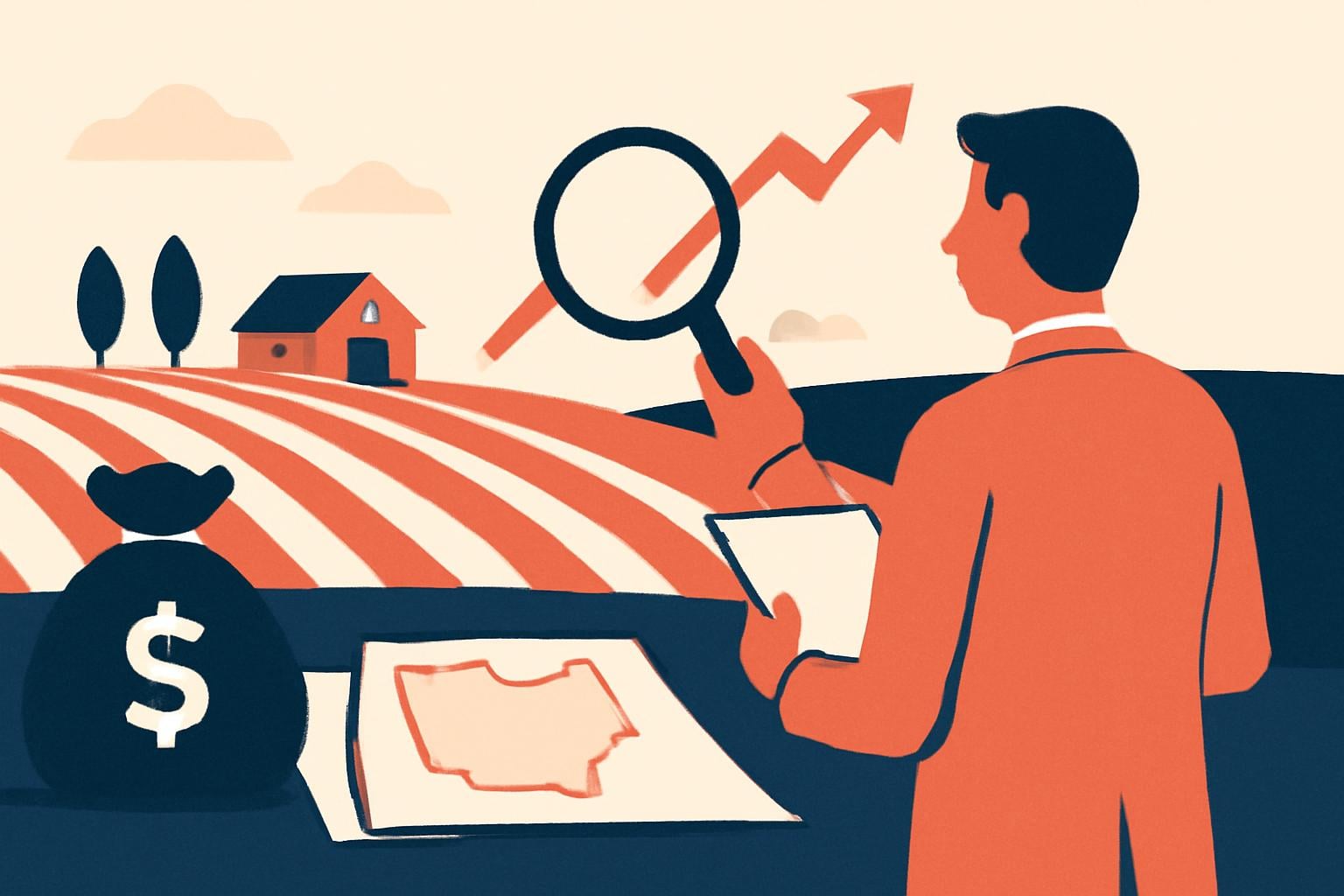
Can You Invest in Farm Land Online Without Buying Acreage?
Online farmland investments can offer indirect exposure without requiring you to purchase and manage a whole farm, but they can involve limited liquidity, platform risk, securities-law considerations, and terms that are very different from direct ownership. Read the offering documents and understand exactly what you are buying.
Private platforms may pool capital to acquire farmland or interests in entities that own farmland. Public real estate vehicles may hold agricultural properties alongside other assets. Some offerings may be available only to investors meeting specific eligibility standards. Availability, eligibility, fees, redemption policies, and investor rights can change, so verify current information directly from official offering materials.
What questions should you ask before using a farmland platform?
- What legal interest will I own: shares, membership interests, debt, or another security?
- Who controls property decisions, leasing, financing, sale timing, and distributions?
- How is the manager compensated, and what costs can be charged to the investment?
- What happens if the platform, sponsor, tenant, or property manager has financial or operational problems?
- Can I transfer or redeem my interest, and under what conditions?
- What assumptions are used in the offering materials, and what could cause them to be wrong?
- How are property condition, water, title, tenant quality, and environmental issues investigated?
- What reports will investors receive, and how often are property values determined?
Do not confuse an online dashboard with liquidity or control. Reporting can be useful, but it does not mean you can exit when you want or direct what happens on the land. Private investments often require patience and a clear understanding of the sponsor’s authority.
For investors who prefer direct ownership, online research can still be valuable as a sourcing and education tool. But digital convenience does not replace title review, local due diligence, or independent professional advice.
Is Investing in Egyptian Farm Land a Viable Option?
Egyptian farmland may interest investors looking at agricultural development beyond the United States, but it is generally a complex, high-risk undertaking. Foreign ownership rules, land-rights structures, water access, currency exposure, infrastructure, and local enforcement can all affect whether an opportunity is workable.
The key is not whether a project is described as agricultural development or land reclamation. The key is whether the investor can verify the rights being acquired, the source and reliability of water, the practical cost of operating the land, and the ability to manage the project through qualified local professionals.
What should a foreign investor investigate in Egypt?
Foreign buyers should not rely on marketing materials, informal assurances, or translated summaries of land documents. The legal and operational status of a parcel may be more important than its advertised potential.
- Ownership and use rights: Determine whether the transaction involves ownership, a leasehold, a concession, a joint venture, or another arrangement.
- Foreign-investment restrictions: Obtain advice from an Egyptian attorney experienced in land and foreign-investment matters.
- Title and registration: Verify the chain of rights, boundaries, government approvals, encumbrances, and registration status.
- Water: Confirm legal water rights, infrastructure condition, operating authority, and exposure to water shortages or restrictions.
- Soil and agronomy: Commission independent testing and a local agronomic review rather than relying on promotional descriptions.
- Infrastructure: Evaluate roads, power, labor access, storage, communications, and distance to inputs and end markets.
- Currency and repatriation: Understand how currency movements and rules affecting funds transfers could influence the investment.
- Dispute resolution: Ask local counsel how contracts are enforced and what practical remedies exist if a dispute arises.
A local operating partner can be helpful, but a partnership does not replace due diligence. Investigate the partner’s authority, experience, reputation, financial capacity, incentives, and contractual obligations. Use independent legal, tax, engineering, and agricultural advice appropriate to the transaction.
Egypt may be better suited to experienced investors with the ability to perform extensive local diligence and oversee a complicated cross-border relationship. Investors seeking simple exposure to agriculture should recognize that an overseas farm project is not a passive substitute for a domestic ETF or a locally leased parcel.
Mini FAQ: Farm Land Investing
Is buying farm land a good investment?
It can be appropriate for an investor who understands the parcel, local tenant market, lease structure, ownership costs, and liquidity limits. A farm purchase should be judged on verified property facts and a realistic holding plan, not on broad claims about farmland as an asset class.
Can I invest in farm land without owning physical property?
Yes. Agricultural ETFs, public real estate vehicles, and private online offerings can provide indirect exposure. Each option has different holdings, fees, liquidity, risks, and investor rights, so review the governing documents before investing.
What is better: ETFs or buying land to lease?
ETFs may suit someone who values liquidity and does not want to manage property. Direct ownership may suit someone who wants more control and is prepared to handle due diligence, leasing, expenses, and an eventual sale. Neither option is automatically better.
How much does farmland lease for in Ohio?
Lease terms vary by county, soil quality, field conditions, usable acreage, crop type, tenant demand, and the responsibilities assigned in the lease. Ask local agricultural professionals for comparable leases and review the details behind each comparison before using it to evaluate a purchase.
Can foreigners buy farm land in Egypt?
Foreign participation can be subject to restrictions and may involve ownership, leasehold, or partnership structures rather than a simple purchase. An Egyptian attorney with relevant land and foreign-investment experience should review the proposed structure before any commitment is made.
Is farm land investing better than residential real estate?
They are different investments. Farmland can involve agricultural and land-management risks, while residential property can involve tenant, building, and local housing-market risks. Compare the work required, liquidity, financing, operating costs, legal considerations, and your own ability to manage each asset.
This content is for informational purposes only. It does not constitute accounting, financial, or legal advice. Please consult a qualified professional before making decisions based on this information.



