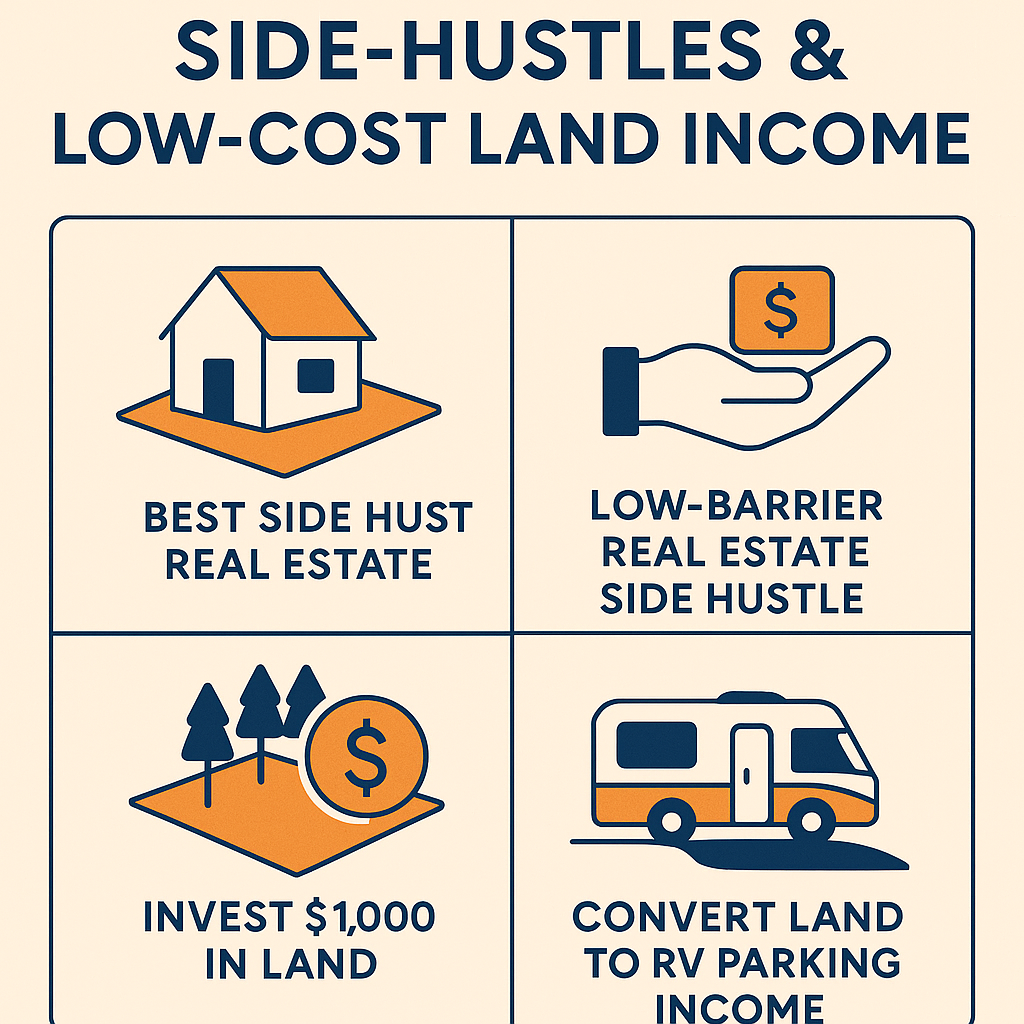
Low-cost land income is possible, but the fastest, lowest-barrier model is usually not a major development project. It is a simple transaction or permitted land use with a clear buyer, a clear exit, and a due-diligence process you can repeat. For many beginners, that means finding overlooked vacant parcels, negotiating directly with owners, and reselling or offering a simple use such as storage, parking, or a short-term site rental.
The key is to match the model to the parcel and your available time. Land flipping can fit a part-time schedule because you are not managing a building. Land rentals can create recurring revenue, but they often require more local research, site preparation, insurance, and ongoing operations. Start with a model you can understand from acquisition through exit before adding complexity.
What real estate side hustles can I start quickly?
The quickest real estate side hustles tend to focus on lead generation, contract opportunities, or simple vacant-land acquisitions rather than construction or long-term property management. A fast start does not mean skipping legal, title, or local-use verification.
For a land-focused beginner, practical options include:
- Researching vacant parcels and identifying owners who may be open to selling.
- Referring a genuinely qualified lead to an investor or licensed professional, where permitted and properly documented.
- Marketing a parcel you own or control under a valid written agreement.
- Buying a straightforward parcel with a defined resale audience.
- Offering a permitted short-term use on land you already own.
A common mistake is treating a lead as a deal before anyone has checked access, title, parcel boundaries, and allowed uses. Your reputation improves when the information you pass along is organized, accurate, and useful.
How can land investing work as a side hustle?
Land investing can work as a side hustle when you build a narrow, repeatable process: choose a market, identify a parcel type, verify the essentials, make offers, and market the parcels you buy. The work is still active, especially at the beginning, but it can be organized around focused research and communication blocks.
Vacant land has fewer moving parts than an occupied house, yet every parcel has its own risks. The practical way to think about this is to avoid buying “cheap land” and instead buy land that has a plausible next owner. That next owner may want a recreational retreat, a homesite, an adjoining parcel, storage space, or a long-term hold. Your job is to understand that use case before you make an offer.
A side-hustle workflow should include a written checklist for each property:
- Confirm the parcel identification and legal description match county records.
- Check whether there is legal, practical access, not merely a road visible on a map.
- Review zoning, overlays, setbacks, and the county’s process for confirming allowable uses.
- Investigate utilities, terrain, drainage, flood concerns, and any visible site constraints.
- Review comparable active listings and sold parcels, while recognizing that asking prices are not sales evidence.
- Identify who is likely to buy and how you will reach them.
For a deeper framework, see this step-by-step guide to land investing as a side hustle.
What low-cost land flipping options exist?
Low-cost land flipping usually means reducing complexity, not finding a shortcut around due diligence. Look for smaller, understandable parcels with a clear ownership record and a realistic resale market, then buy only when the purchase terms leave room for holding, marketing, and closing costs.
Some investors consider options, assignments, seller-financed purchases, or partnerships. Each approach can be appropriate in the right situation, but each also needs carefully written agreements and local legal review. Do not assume that a strategy commonly discussed online is available or suitable in every state.
For a beginner, an outright purchase of a clean, marketable parcel is often easier to understand than a complex control strategy. You know what you own, what you need to sell, and where responsibility sits. Before using an assignment, option, or creative financing structure, have a qualified local attorney or title professional explain the documents, disclosure expectations, and closing process.
This beginner’s guide to land flipping explains the core acquisition-and-resale model in more detail.
How can I invest a small budget in land?
A small budget is best used as a discipline tool: limit the market, limit the parcel type, and reserve enough capacity for due diligence and a clean closing. The amount you can deploy matters less than whether you can afford to walk away from a parcel that fails verification.
Instead of searching every rural listing, define a narrow buying box. It might be a particular county, a type of recreational lot, or parcels near an established road network. Then study what actually attracts buyers there. Some markets value views and privacy. Others value road frontage, mobile-home eligibility, nearby recreation, or adjacency to existing homes.
Partnerships may help pool resources, but they add another layer of risk. A written agreement should address who approves a purchase, who handles due diligence, how expenses are paid, who can sign documents, what happens if more cash is needed, and how a sale decision is made. Do not rely on an informal understanding with friends or family when real property is involved.
How do I buy rural land as a side hustle?
Buying rural land remotely can be workable, but remote research should support, not replace, property-level verification. County mapping tools, assessor records, aerial imagery, and seller conversations are useful starting points. They are not a substitute for confirming facts with the appropriate county office, title professional, surveyor, or local site visit when needed.
Begin by building a market file. Track parcels that sell, parcels that sit, common access patterns, zoning language, and buyer-facing amenities. This lets you distinguish a parcel that is simply overlooked from one that is difficult to use or resell.
When contacting owners, be direct and respectful. Ask whether they have interest in selling, confirm basic property details, and avoid representing yourself as something you are not. A fair offer is one you can explain based on the parcel’s condition, marketability, and risk, not a number pulled from an unrelated listing.
Before closing, verify:
- Whether the seller has authority to convey the property.
- Whether taxes, liens, assessments, or other obligations may affect the transfer.
- How the parcel is accessed and whether recorded easements support that access.
- Whether a boundary survey, title work, or further inspection is appropriate.
- Whether the intended use is actually allowed by the relevant local authority.
What are land parcels as micro-investments?
Land parcels can function as micro-investments when an investor focuses on smaller, simpler opportunities rather than tying up resources in a single complicated tract. The term does not make a parcel low-risk. A small parcel with no access or no practical use can be harder to sell than a larger, better-positioned property.
The best way to evaluate a smaller parcel is through buyer utility. Ask: What can the next owner realistically do with this land? A parcel may have value as a neighbor expansion, a camping or recreation site, a future homesite, a buffer parcel, or a modest storage location. If the answer is vague, the purchase case is weak.
Keep a clean inventory record from day one. Include the parcel identifier, source documents, owner communication, due-diligence notes, maps, images, listing status, and deadlines. Good recordkeeping is not glamorous, but it prevents missed tax notices, inconsistent marketing claims, and confusion when a buyer asks a basic question.
How can beginners start a land side hustle safely?
Beginners should start by learning one market and one acquisition process well enough to reject bad opportunities. The goal is not to rush into ownership. The goal is to develop the judgment to know what must be verified before committing money or making promises to a seller or buyer.
Use a practice file before pursuing a live deal. Pick several listed parcels and perform the same review you would perform if you intended to buy them. Map access, read county records, identify likely buyers, compare competing listings, and write down the unanswered questions. This exercise reveals where your research process is thin without exposing you to a costly mistake.
Then create a simple operating system:
- Choose a market and parcel profile.
- Set deal-screening rules before you start searching.
- Use a consistent due-diligence checklist.
- Document all assumptions and confirmations.
- Market only with accurate, supportable information.
- Review each closed or rejected opportunity to improve the checklist.
New investors who want a broader overview can use this guide to beginning land investing with limited resources to compare approaches and build a more deliberate plan.
How do I turn a vacant lot into income?
A vacant lot can produce income through a temporary or recurring use, but only if the use fits the site and local rules. Storage, parking, agricultural uses, seasonal events, and filming or gathering space may be possibilities depending on zoning, access, neighbors, utilities, safety, and demand.
Start with demand rather than improvements. Talk with potential users, observe nearby businesses, and determine whether the site solves a real local problem. A visible parcel near compatible activity may suit parking or storage. A secluded scenic parcel may be more suitable for an event-related use. Land that appears usable from the road may still have drainage, access, or zoning limitations that make the idea impractical.
Before advertising any use, ask the local planning or zoning office what is allowed and what approvals may be needed. Also ask about traffic, signage, lighting, sanitation, noise, occupancy, and any site-specific restrictions. If customers, vendors, or vehicles will enter the property, speak with an insurance professional and a qualified local attorney about appropriate agreements and risk management.
Which low-barrier land side hustle is the best fit?
The best low-barrier land side hustle is the one whose risks, time demands, and local requirements you can competently manage. A resale model may be a better fit for someone who prefers research and marketing. A rental-use model may fit an owner who has a suitable site and can handle operations.
| Model | Best fit | Main work | Key verification |
|---|---|---|---|
| Vacant-land resale | Research-focused investor | Acquisition and marketing | Title, access, buyer demand |
| Land lead research | Networked researcher | Finding accurate leads | Local referral rules |
| Storage use | Owner of usable land | Site operations | Zoning, safety, insurance |
| Event use | Site with local demand | Bookings and coordination | Permits, neighbors, liability |
| RV or vehicle parking | Accessible parcel owner | Guest and site management | Land-use rules, utilities, sanitation |
Use this comparison as a screening tool, not a promise of suitability. The same model can be simple in one county and highly regulated in another. Your first decision rule should be: choose the path with the fewest unanswered questions, not the most exciting revenue idea.
How can I earn recurring income by renting land?
Land rental income is not automatically passive. It can become lower-touch after systems are in place, but the owner still needs to manage agreements, payments, maintenance, insurance, customer communication, and changing local conditions.
Potential land-rental uses include equipment storage, vehicle parking, agricultural access, grazing, seasonal vendor space, or other locally allowed uses. Each needs a written agreement that identifies the permitted activity, term, payment process, maintenance responsibilities, access rules, indemnity language where appropriate, and procedures for ending the arrangement.
Do not copy a lease from the internet and assume it protects you. A local attorney can help ensure the agreement matches the property, intended use, and applicable law. An insurance professional can help you understand whether your policy fits the activity. These conversations are especially important when the public, customers, animals, or stored property are involved.
For more ideas about matching a parcel to an income strategy, explore ways to earn income from land.
How can I use land as a party or event venue?
Land can serve as an event venue only when the location, infrastructure, approvals, and risk controls support gatherings. A scenic property alone is not enough. Safe access, parking, restroom plans, emergency access, noise considerations, weather contingencies, and neighbor impact all matter.
Before promoting an event use, confirm with local officials whether the activity is permitted and whether additional review is needed. Be specific about the type of event, expected vehicle traffic, temporary structures, food service, music, alcohol, lighting, and hours. Vague questions produce vague answers, so bring a clear operating description.
A practical event agreement should address setup and cleanup, property boundaries, prohibited areas, damage responsibility, cancellation procedures, and required insurance documentation. Do not promise amenities you cannot reliably provide. A well-managed small use is better than a bigger event that overwhelms the parcel or creates avoidable conflict.
How do I convert land to RV parking income?
RV parking can be an income use for the right parcel, but it is often more operationally complex than it first appears. A level place to park is only part of the equation. Local land-use rules, site access, turning space, sanitation, water, electrical service, drainage, fire safety, and guest behavior can all determine whether the concept is viable.
First, ask the planning department whether overnight stays, recreational vehicles, short-term rentals, or campground-like uses are allowed on the parcel. Then speak with the relevant utility, health, and safety authorities about requirements that may apply to your proposed setup. Requirements can differ sharply by jurisdiction and by the duration and intensity of use.
If the use is allowed, write clear guest rules and inspect the property regularly. Define where guests may park, where they may not drive, what they may connect to, how waste is handled, and what to do in an emergency. Avoid describing a site as having services that are not legal, safe, or reliably available.
What mistakes should I avoid with low-cost land income?
The biggest mistake is buying or improving land before confirming that the intended use is realistic. Low purchase cost does not erase poor access, unclear title, restrictive zoning, weak demand, or costly site constraints.
- Assuming map imagery proves legal access.
- Using listing language as proof of zoning, utilities, or buildability.
- Ignoring title, liens, taxes, and boundary questions.
- Building a rental or event plan before asking local officials about allowed uses.
- Marketing features that have not been verified.
- Entering partnerships without written responsibilities and exit procedures.
- Calling an activity passive before accounting for administration and maintenance.
Good land investing is often unglamorous: verify, document, communicate clearly, and walk away when a core question remains unresolved.
Mini FAQ
Which land side hustle can produce income most quickly?
The fastest path depends on your existing skills, market knowledge, and the parcel itself. Lead research or a straightforward resale may require less site setup than a rental use, while a rental may take longer to approve and operate. Focus on the model you can verify and execute responsibly.
Do I need permits to make money from vacant land?
Possibly. Permits and approvals depend on the location and intended use. Contact the relevant local planning, zoning, health, building, or safety office before advertising or operating a land-based business activity.
Can land income be passive?
It can become more systematized over time, but it is rarely completely hands-off. Ownership requires oversight of payments, agreements, property condition, compliance, and customer or tenant issues.
What should I verify before buying a parcel for a side hustle?
Verify ownership, title condition, legal access, boundaries, zoning, local use rules, physical constraints, taxes or assessments, and actual buyer or renter demand. When a question involves law, title, surveying, taxes, insurance, or safety, consult an appropriately qualified local professional or official source.



