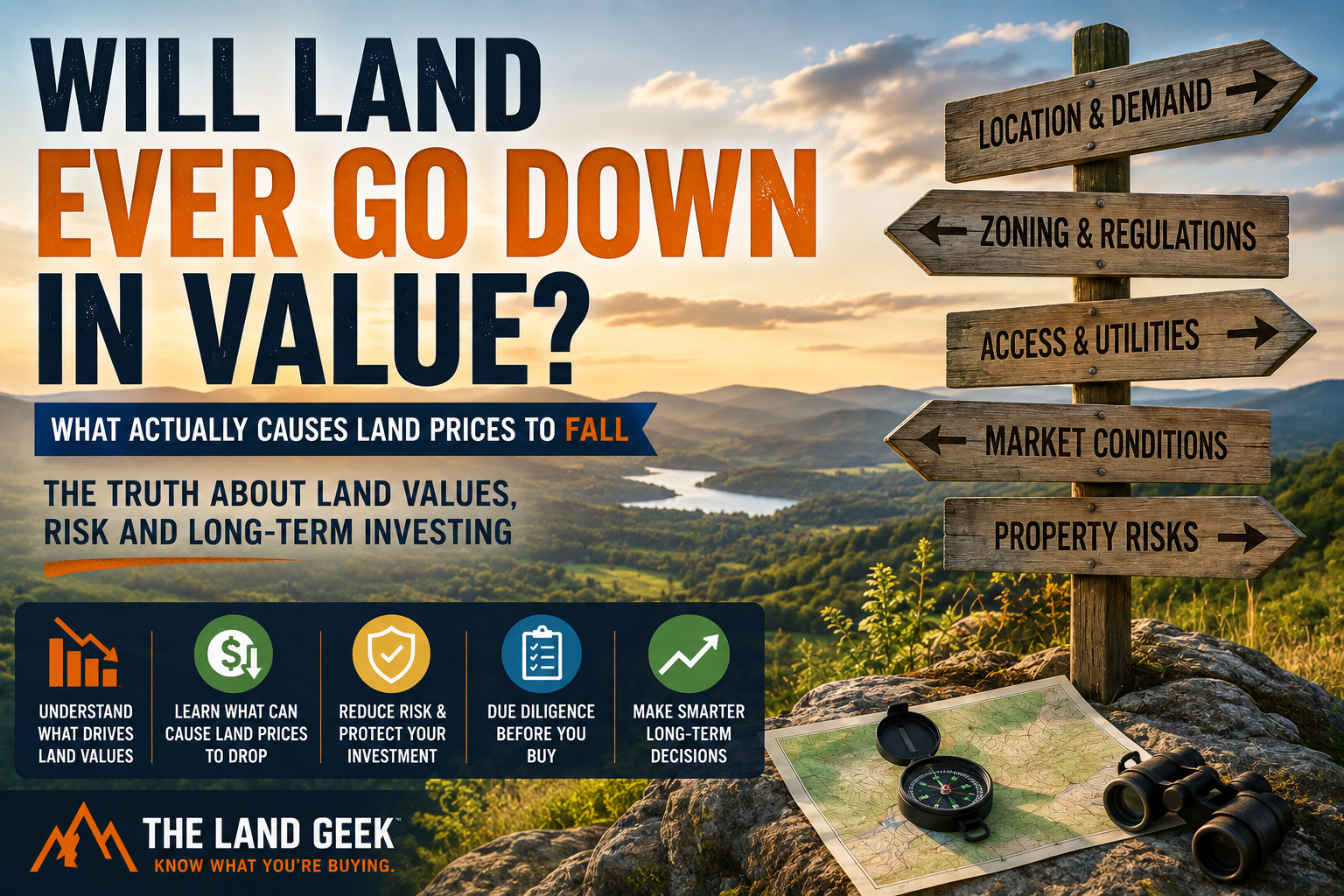
Yes, land can go down in value. Land prices can fall when buyer demand weakens, interest rates rise, local economies decline, zoning changes, access problems emerge, development becomes more difficult, or buyers discover problems with the property.
Land has historically appreciated over long periods in many U.S. markets, but that does not mean every parcel goes up in value every year.
In fact, two pieces of land only a few miles apart can perform very differently.
One may appreciate because a growing community needs more housing and infrastructure. Another may lose value because it has poor access, unusable terrain, development restrictions, environmental problems, or almost no buyer demand.
That’s why the better question isn’t simply whether land values can fall.
It’s what makes a particular piece of land valuable in the first place, and whether those conditions are getting stronger or weaker.
Can Land Actually Go Down in Value?
Yes. Land can decline in value temporarily or permanently when demand falls or something reduces the property’s usefulness, development potential, accessibility, or desirability.
Land is finite, but scarcity alone doesn’t guarantee appreciation.
A parcel needs someone willing to buy it at the price you’re asking.
If fewer buyers want that type of land, financing becomes more expensive, development becomes harder, or the local economy weakens, its market value can decline.
Does land always appreciate over time?
No. Land does not automatically appreciate simply because you own it for a long time.
National averages can rise while individual properties or entire local markets decline.
The USDA’s Economic Research Service reports that average U.S. farm real estate values have generally trended upward over the long term, but its historical inflation-adjusted data also shows periods of stagnation and decline.
You can review the current data through the USDA’s official Farmland Value research.
Can land lose value even when the overall market is rising?
Absolutely. National or statewide appreciation doesn’t guarantee that your individual parcel will appreciate.
📘 Get Your FREE Land Investing Strategy Guide
Discover how savvy investors build passive income with vacant land.
Real estate is intensely local.
A property may lose value because a major employer leaves the area, road access changes, environmental problems emerge, zoning becomes more restrictive, taxes increase, development moves elsewhere, or buyers simply stop wanting that type of property.
Can vacant land be more volatile than developed property?
It can be because vacant land’s value often depends heavily on what buyers believe they can eventually do with it.
A house provides immediate residential utility. Commercial property may generate rent. Agricultural land may produce crops.
Raw land may instead derive much of its value from future use.
If that expected use becomes less attractive or impossible, buyers may quickly reconsider what they’re willing to pay.
What Causes Land Value to Go Down?
Land usually loses value when demand decreases, carrying costs increase, financing becomes harder, or the property’s potential use becomes less valuable.
Some causes affect an entire market. Others affect only one parcel.
Understanding the difference is critical for land investors.
Can a recession make land prices fall?
Yes. Economic downturns can reduce demand for land as households, developers and investors become more cautious.
When buyers have less confidence, businesses delay expansion and developers postpone projects, fewer people may compete for available land.
Sellers who need liquidity may then accept lower prices.
But the impact is rarely identical everywhere. A growing market with strong employment and limited inventory may behave differently from an area already losing population.
Do higher interest rates hurt land values?
Higher interest rates can put downward pressure on land values because borrowing becomes more expensive for buyers and developers.
A buyer who could afford a particular purchase price at a lower borrowing cost may not be able to justify the same price when financing becomes expensive.
Developers also calculate whether a project will generate enough return relative to financing and construction costs.
If those numbers stop working, demand for development land can weaken.
Can oversupply lower land prices?
Yes. When many similar parcels are available but there aren’t enough buyers, sellers have to compete more aggressively.
This is particularly important in rural land markets.
A county may contain thousands of inexpensive vacant parcels but relatively few active buyers.
Scarcity should therefore be evaluated in terms of desirable, usable land, not simply the total amount of land on Earth.
How Important Is Location to Land Value?
Location is one of the strongest determinants of land value because it affects demand, accessibility, economic opportunity and the property’s potential uses.
Two identical five-acre parcels can command dramatically different prices depending on where they’re located.
What happens when people leave an area?
Persistent population decline can weaken land demand, particularly when it is accompanied by fewer jobs, businesses and development projects.
Population isn’t the only factor, but it can be an important demand indicator.
Before investing, study whether the local buyer pool appears to be expanding or contracting.
Can new infrastructure increase land value?
Yes. New roads, utilities, employment centers and other infrastructure can make previously less desirable land more useful and accessible.
But the opposite can also happen.
A road closure, loss of access, deterioration of local infrastructure or cancellation of a major development project can reduce perceived value.
Can neighborhood changes lower land values?
Yes.
Land values reflect what future buyers think about the surrounding area.
Changes in nearby land use, environmental conditions, traffic patterns, crime, employment or development can change buyer demand.
Can Zoning Changes Make Land Lose Value?
Yes. Zoning can dramatically affect land value because it determines what owners are legally allowed to do with a property.
A parcel that allows several valuable uses may attract more buyers than land with extremely restrictive permitted uses.
What happens if land gets rezoned?
A zoning change can increase or decrease value depending on what uses become permitted or prohibited.
For example, development potential may increase when regulations permit additional residential density.
But restrictions that eliminate a property’s expected use may reduce what buyers are willing to pay.
Can you lose money by assuming land can be developed?
Yes. Buying based on assumed development potential without confirming zoning and other restrictions is a major land-investing risk.
Never rely solely on a listing description.
Verify permitted uses with the appropriate local authority before purchasing.
Can deed restrictions affect value?
Yes. Private deed restrictions, easements and covenants can limit how land can be used even when zoning would otherwise permit the activity.
These restrictions can shrink the buyer pool and affect resale value.
Can Land Lose Value Because It Has No Road Access?
Yes. Lack of legal and practical access can significantly reduce land value because buyers may be unable to reach or develop the property as expected.
A parcel surrounded by other privately owned land may be considered landlocked.
Even if a dirt trail appears on satellite imagery, that doesn’t necessarily mean the property has legally enforceable access.
Read our guide to buying land without road access before purchasing a property with questionable access.
Does physical access equal legal access?
No. A road physically reaching a parcel does not necessarily establish a legal right to use that road.
Access rights should be verified through deeds, easements, plats and other appropriate property records.
Can bad roads hurt resale value?
Yes. Difficult seasonal or poorly maintained access can reduce the number of buyers willing to consider a property.
A parcel may technically be accessible but still require four-wheel drive, road improvements or significant maintenance.
Can fixing access increase land value?
Potentially.
Resolving a legal access issue or improving practical accessibility can make land attractive to a larger buyer pool.
But determine the cost and legal feasibility before assuming an access problem is easily fixable.
Can Environmental Problems Make Land Value Fall?
Yes. Flooding, contamination, wetlands, erosion, wildfire exposure and other environmental conditions can reduce a property’s usability and buyer demand.
Environmental risks can also increase development costs.
Can flood risk lower land value?
It can, particularly when flooding limits construction or makes ownership more expensive or risky.
Before purchasing, check the property’s flood risk using FEMA’s official Flood Map Service Center.
Flood maps should be one part of broader property-specific due diligence rather than your only investigation.
Can contamination make land nearly worthless?
Severe contamination can dramatically reduce marketability because remediation obligations and liability may exceed the property’s economic value.
This is especially relevant for land with a history of industrial, commercial, dumping or other potentially contaminating uses.
Can wetlands affect land value?
Yes. Wetlands and other environmentally sensitive areas can restrict development and therefore affect what buyers will pay.
However, the impact depends on the parcel and the buyer’s intended use.
Land purchased for recreation may be evaluated very differently from land purchased for subdivision development.
Can Property Taxes Make Land Less Valuable?
High or rising property taxes can reduce investment attractiveness because they increase the cost of holding land.
Vacant land may produce no immediate income while still generating taxes and other carrying expenses.
That means holding costs should always be included when calculating your purchase price.
What other carrying costs matter?
Depending on the property, costs may include:
- Property taxes
- HOA or POA fees
- Road maintenance
- Vegetation management
- Insurance
- Legal expenses
- Financing costs
- Surveying
- Marketing expenses
A property can appreciate nominally and still be a poor investment if years of carrying costs consume the gain.
Can Land Become Worthless?
Land can become extremely difficult to sell, although literally having zero value is uncommon.
A parcel can become economically unattractive when the cost, liability or restrictions associated with owning it outweigh its practical usefulness.
What could make land almost worthless?
Serious problems can include:
- No legal access
- Severe contamination
- Unresolved ownership disputes
- Extreme flood or erosion risk
- Unusable terrain
- Prohibitive development restrictions
- Unmanageable tax or assessment obligations
- No realistic buyer demand
Does cheap land mean something is wrong?
Not necessarily, but unusually cheap land deserves additional investigation.
The seller may simply want a fast transaction.
But a low price can also reflect poor access, unpaid taxes, difficult terrain, zoning restrictions, lack of utilities, title problems or extremely weak demand.
Price should never replace due diligence.
What Types of Land Are Most Likely to Lose Value?
Land with weak demand, limited utility, unresolved legal problems or substantial development constraints generally carries greater depreciation risk.
That doesn’t mean every imperfect property is a bad investment.
It means the purchase price must properly reflect the risk.
Is remote land risky?
Remote land can be more difficult to resell when the buyer pool is small, but remoteness itself doesn’t make a property bad.
Some buyers specifically want privacy, recreation, hunting or off-grid property.
The important question is whether there is an identifiable market for that particular parcel.
Is land without utilities less valuable?
Usually, utility availability affects what buyers are willing to pay, especially when the intended use requires development.
However, recreational and off-grid buyers may evaluate utility access differently.
Can an awkward parcel shape reduce value?
Yes.
Shape, setbacks, topography and easements can reduce the amount of land that can actually be used.
A ten-acre parcel isn’t automatically equivalent to another ten-acre parcel.
Does Agricultural Land Ever Go Down in Value?
Yes. Agricultural land values can decline even though U.S. farmland has generally appreciated over the long term.
USDA’s Economic Research Service reported that average U.S. farm real estate was valued at $4,350 per acre in 2025, 4.3% above 2024.
USDA’s longer historical series nevertheless shows that values do not move upward in a perfectly straight line.
See the USDA’s long-term farm real estate value chart for historical context.
What affects farmland values?
Factors can include:
- Farm income
- Commodity prices
- Interest rates
- Soil productivity
- Water availability
- Development pressure
- Local demand
- Government policy
- Investor demand
Again, national averages don’t determine what one particular property is worth.
How Do You Know Whether Land Is Overpriced?
Compare the property with genuinely comparable recent sales and evaluate what buyers are actually paying for similar parcels.
Asking prices are not the same thing as market value.
A seller can list a five-acre parcel for $100,000. That does not prove anyone will pay $100,000.
What comparable sales should you use?
Try to compare properties with similar:
- Location
- Acreage
- Access
- Zoning
- Topography
- Utilities
- Development potential
- Road frontage
- Property characteristics
The more different the comparable property is, the less useful the comparison becomes.
Should you rely on the county assessed value?
No. Tax assessments serve a taxation purpose and should not automatically be treated as the property’s current resale value.
Use actual market evidence when evaluating what buyers are likely to pay.
How Can You Reduce the Risk of Buying Land That Falls in Value?
The best defense is buying carefully rather than trying to predict exactly what the entire real estate market will do next.
You cannot control interest rates, recessions or population movements.
You can control how much you pay and how thoroughly you investigate a property.
Buy below your conservative estimate of market value
Buying with a margin gives you more flexibility if market conditions weaken or the property takes longer to sell than expected.
Don’t build an investment thesis that only works if prices continue rising.
Complete due diligence before closing
Investigate title, access, zoning, taxes, environmental conditions, utilities and the property’s intended use before purchasing.
Use our vacant land due diligence checklist as a starting point.
Understand who will eventually buy the land
Every land investment should have a realistic future buyer in mind.
Is the likely buyer a homeowner?
A neighboring landowner?
A recreational buyer?
A farmer?
A developer?
An off-grid buyer?
If you can’t explain who is likely to want the parcel and why, resale risk deserves more attention.
Should You Wait for Land Prices to Fall Before Buying?
Not necessarily. Trying to perfectly time a land-market correction can be less useful than finding an individual property whose price already provides an adequate margin for your strategy.
A strong deal can exist in an expensive market.
A terrible deal can exist after prices fall.
The purchase should make sense based on today’s conservative assumptions rather than depending on future appreciation.
Is buying during a downturn better?
A downturn may create motivated sellers and lower prices, but it can also mean weaker buyer demand when you eventually want to sell.
Lower price alone does not automatically create a good investment.
What matters more than timing?
The fundamentals of the individual property:
- What you pay
- What comparable land sells for
- Legal access
- Usability
- Buyer demand
- Carrying costs
- Development potential
- Your exit strategy
Is Land Still a Good Long-Term Investment?
Land can be a viable long-term investment, but its performance depends on the purchase price, location, demand, property characteristics and investment strategy.
Land should not be treated as a guaranteed appreciating asset.
The advantage investors have is that individual parcels can sometimes be acquired at prices substantially different from their potential resale value.
That’s fundamentally different from simply purchasing land and hoping appreciation does the work.
Our Land Investing 101 guide explains how acquisition, due diligence and exit strategy work together.
What Should You Check Before Buying Land?
Before purchasing land, verify the characteristics that determine whether people will actually want to own and use the property.
At minimum, investigate:
- Ownership and title
- Legal access
- Road conditions
- Property taxes
- Liens
- Zoning
- Permitted uses
- Deed restrictions
- Easements
- Flood risk
- Wetlands
- Topography
- Water availability
- Utilities
- Septic feasibility where relevant
- Nearby development
- Recent comparable sales
- Local population and economic trends
- Current land inventory
- Likely resale demand
The objective isn’t to find perfect land.
It’s to understand the problems before you price the deal.
Frequently Asked Questions About Land Values
Will land ever go down in value?
Yes. Land values can decline when demand weakens, interest rates increase, economic conditions deteriorate or problems reduce a property’s usefulness or desirability.
Does land always appreciate?
No. Historical averages may show long-term appreciation, but individual parcels and local markets can experience extended periods of stagnant or declining values.
What causes land prices to fall?
Common causes include weak buyer demand, recessions, higher financing costs, population decline, oversupply, zoning restrictions, environmental problems, poor access and declining development potential.
Can land lose value during a recession?
Yes. Economic downturns can reduce buyer and developer demand, although the effect varies substantially between locations and property types.
Can land become worthless?
Land can become extremely difficult to sell when serious contamination, title disputes, lack of access, unusable terrain or other liabilities overwhelm its practical value. Literally zero market value is less common.
Does vacant land depreciate?
Vacant land does not depreciate in the same accounting sense as a physical building wearing out, but its market value can absolutely rise or fall.
What makes land increase in value?
Growing demand, population and employment growth, infrastructure improvements, favorable zoning, improved access and increased development potential can contribute to higher land values.
Is land safer than a house during a market crash?
There is no universal rule. Land and developed real estate have different buyer pools, financing conditions and income characteristics. Performance depends heavily on location and the individual property.
Should I buy land when prices are falling?
Falling prices can create opportunities, but the individual property’s fundamentals and purchase price matter more than assuming the broader market will quickly rebound.
How can I protect myself from falling land values?
Buy conservatively, conduct thorough due diligence, understand local demand, avoid relying on appreciation and have a realistic exit strategy before purchasing.
The Bottom Line: Will Land Ever Go Down in Value?
Yes. Land can and does go down in value.
What matters is understanding why.
Land values can fall because of recessions, higher interest rates, weak local demand, oversupply, zoning changes, access problems, environmental risks, rising carrying costs or changes in what buyers want.
At the same time, long-term historical data shows that many categories of U.S. land have appreciated over extended periods.
Those two facts aren’t contradictory.
The national market can appreciate while an individual parcel loses value.
That’s why successful land investing shouldn’t depend on the assumption that land always goes up.
Investigate the parcel, understand its buyer, confirm its usable and legal characteristics, study comparable sales and purchase with enough margin that the investment can still make sense if the market doesn’t appreciate the way you expect.
This content is for informational purposes only. It does not constitute accounting, financial, or legal advice. Please consult a qualified professional before making decisions based on this information.



