
Capital gains on land in Illinois require separate federal and Illinois calculations. First establish whether the property is an investment capital asset, business property or land held for sale to customers. Then calculate adjusted basis and net proceeds, apply eligible exclusions or deferrals, and review the state return and payment obligations.
How do you calculate gain on an Illinois land sale?
Taxable gain is based on amount realized less adjusted basis, with adjustments for the actual transaction. It is not simply sale price minus the original check written for the land. Cash remaining after a mortgage payoff is also a different measure from taxable gain.
Which costs affect basis and proceeds?
Purchased land generally begins with its cost and qualifying acquisition costs, adjusted for qualifying capital improvements and other required changes. Eligible selling expenses generally reduce the amount realized. Categorize each expense correctly and use it once, rather than adding a selling cost to basis and subtracting it again.
For illustration, a $90,000 sale less $5,000 of eligible selling expenses gives $85,000 net amount realized. Subtracting $52,000 adjusted basis gives $33,000 gain before any special treatment. A $15,000 mortgage payoff changes available cash but is not another deduction from this gain.
Is every profit a capital gain?
No. Investment land held as a capital asset differs from land held primarily for sale to customers in a business. Dealer-property profit is not converted to capital gain merely by holding it more than a year or using an LLC.
📘 Get Your FREE Land Investing Strategy Guide
Discover how savvy investors build passive income with vacant land.
Investment capital assets held more than one year generally receive federal long-term treatment; one year or less generally produces short-term treatment. Business property and depreciable improvements can involve other rules and recapture. Land itself is not depreciable. Review the actual use and activity before selecting the reporting forms.
How do gifts and inheritances change basis?
Inherited property generally receives a value-based basis under applicable estate rules, often date-of-death value. That can be lower as well as higher than the prior owner’s basis. The county tax assessment is not automatically the required estate valuation.
Gift basis commonly carries over for gain purposes, with separate loss-basis and other rules potentially applying. A gift and an inheritance are not interchangeable. Obtain acquisition records, donor information or estate valuation evidence before assuming that an immediate sale produces no taxable gain.
What Illinois and federal tax rates can apply?
Illinois taxes individual net income at its regular flat rate, while federal capital-gain treatment depends on the asset, holding period and taxpayer’s circumstances. Apply rates to the proper taxable-income calculation. Neither rate is a flat charge on all gross land-sale proceeds.
What is the current Illinois individual rate?
The Illinois Department of Revenue lists an individual income-tax rate of 4.95% of net income. Illinois does not provide a separate lower individual rate merely because an investment gain is federally long-term. Review the state return’s starting amount, additions, subtractions, exemptions and applicable credits.
Use the current Illinois income-tax rate page for the actual taxpayer type. Corporate, estate, trust and pass-through situations require their own review. An LLC label does not determine which income-tax rules apply.
Can a nonresident owe Illinois tax?
A seller living outside Illinois can still have Illinois-source gain from Illinois real property. Moving before closing or having the proceeds deposited in another state does not by itself remove the source-state obligation. Part-year residency also requires appropriate allocation.
The Department’s Schedule NR instructions address capital gains from Illinois real property and business activity. Review the applicable tax-year form and any resident-state credit separately. A credit can affect double taxation but is not an automatic exemption from either state’s filing requirements.
Which other taxes and costs should be considered?
Federal long-term capital-gain rates depend on taxable income and other factors, while short-term capital gains generally use ordinary rates. Net investment income tax can also apply in relevant cases. A complete return projection is more useful than adding two headline rates.
County property taxes, tax prorations and state or local transfer charges concern different tax bases and processes. They can affect transaction cash flows and expense treatment, but a property-tax assessment appeal is not a method of challenging an Illinois income-tax assessment.
Which exclusions or deferrals may apply to vacant land?
A vacant investment parcel is not automatically covered by the main-home exclusion, and buying another property after a sale does not automatically create a tax-deferred exchange. Evaluate the exact conditions before closing or receiving proceeds. Exclusion, deferral and basis adjustments are different concepts.
Does the home-sale exclusion apply?
The federal home-sale exclusion concerns a qualifying main home. Adjacent vacant land can qualify only under specific ownership, use, timing and eligibility rules, with the land and home sales treated together for the exclusion limit. Ordinary unrelated investment land does not qualify simply because the owner also has a residence.
Review the actual facts, including whether the sales occur within the required period and whether both meet the applicable tests. A county designation as residential or a plan to build a future home is not sufficient by itself.
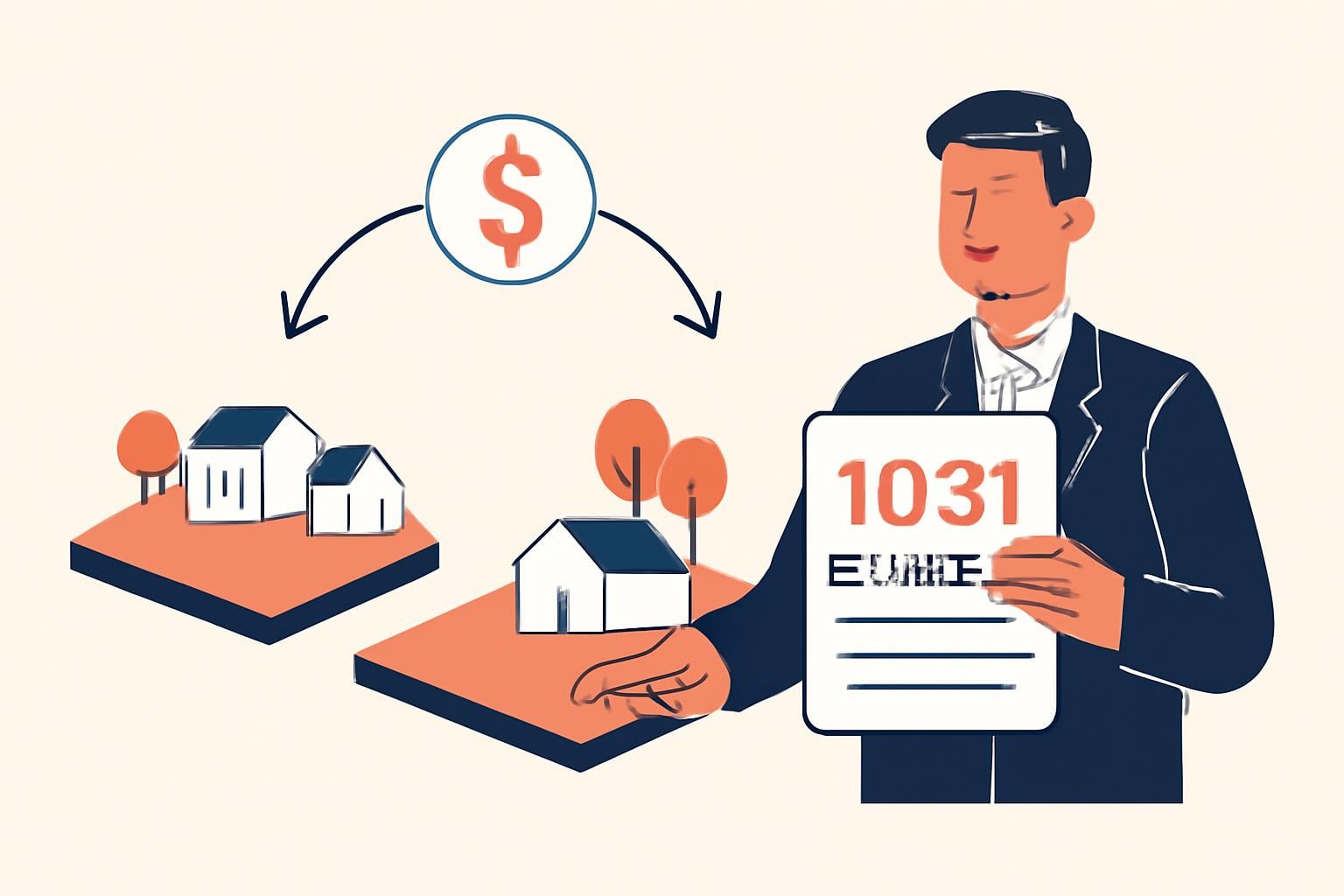
What makes a Section 1031 exchange eligible?
A qualifying exchange involves eligible real property held for investment or productive business use. Property held primarily for sale and personal-use land do not qualify merely because the seller wants to buy another parcel. Arrange the structure before taking control of the proceeds.
For a deferred exchange, identification generally occurs within 45 days and receipt by the earlier of 180 days or the relevant return due date including extensions. The IRS Form 8824 instructions address the process. Debt, cash, related parties and state adjustments require separate review.
Can installments or losses reduce the current-year amount?
Eligible installment reporting can spread gain recognition as principal is received, with interest treated separately and exceptions for certain dispositions. It does not guarantee payment or eliminate tax. Review dealer restrictions and any income recognized immediately before offering terms.
Capital losses have netting, deduction and carryforward rules. Losses on personal-use land are generally not deductible, so a sale below purchase price does not automatically create an allowable capital loss. Consider the economic loss separately from any tax effect.
How do you prepare the return, records and payments?
Reconcile acquisition, ownership and sale records with the correct federal and Illinois forms, then plan timely payments and retain supporting evidence. A closing information return does not contain the complete basis calculation. Income-tax notices and county valuation disputes must follow their respective procedures.
Which forms and documents may be required?
Capital-asset sales commonly involve Form 8949 and Schedule D; business-property sales may require Form 4797. Installments and exchanges commonly involve Forms 6252 and 8824. Complete the appropriate Illinois return, schedules and adjustments for the actual taxpayer and tax year.
Keep purchase and sale settlement statements, improvement invoices, valuations, inheritance or gift records and claimed expenses. Separate land from depreciable improvements where relevant. Confirm reporting even when a special exclusion or deferral means little current tax is expected.
How long should basis records be kept?
Preserve basis evidence throughout ownership and through the applicable limitation period after the disposition. A short blanket retention rule can discard documents needed decades later. Different facts, omitted income and other exceptions can affect the required period.
Maintain a reconciled ledger so capital improvements, selling costs and other expenses are neither omitted nor counted twice. Combine the tax file with the parcel documentation, while keeping the tax classifications and calculations clearly identified.
Who handles payments and an income-tax dispute?
Review federal and Illinois estimated-payment requirements, safe-harbor rules and actual deadlines with the return projection. Reserve enough cash at closing for expected obligations. A seller-financed or reinvested sale can create a mismatch between tax due and cash readily available.
Use IRS procedures for federal notices and Illinois Department of Revenue procedures for state income-tax notices. Follow the notice’s response route and deadline with qualified advice. A county assessor or property-tax board cannot correct the separate income-tax determination.
This content is for informational purposes only. It does not constitute accounting, financial, or legal advice. Please consult a qualified professional before making decisions based on this information.