


How should a beginner start investing in land?
Start land investing by choosing one simple property type and market, defining a conservative buy box, researching buyer demand, and completing parcel-level due diligence before making an offer. Your first goal is not to find the cheapest land. It is to buy usable land at a price that leaves room for holding costs, selling expenses, and uncertainty.
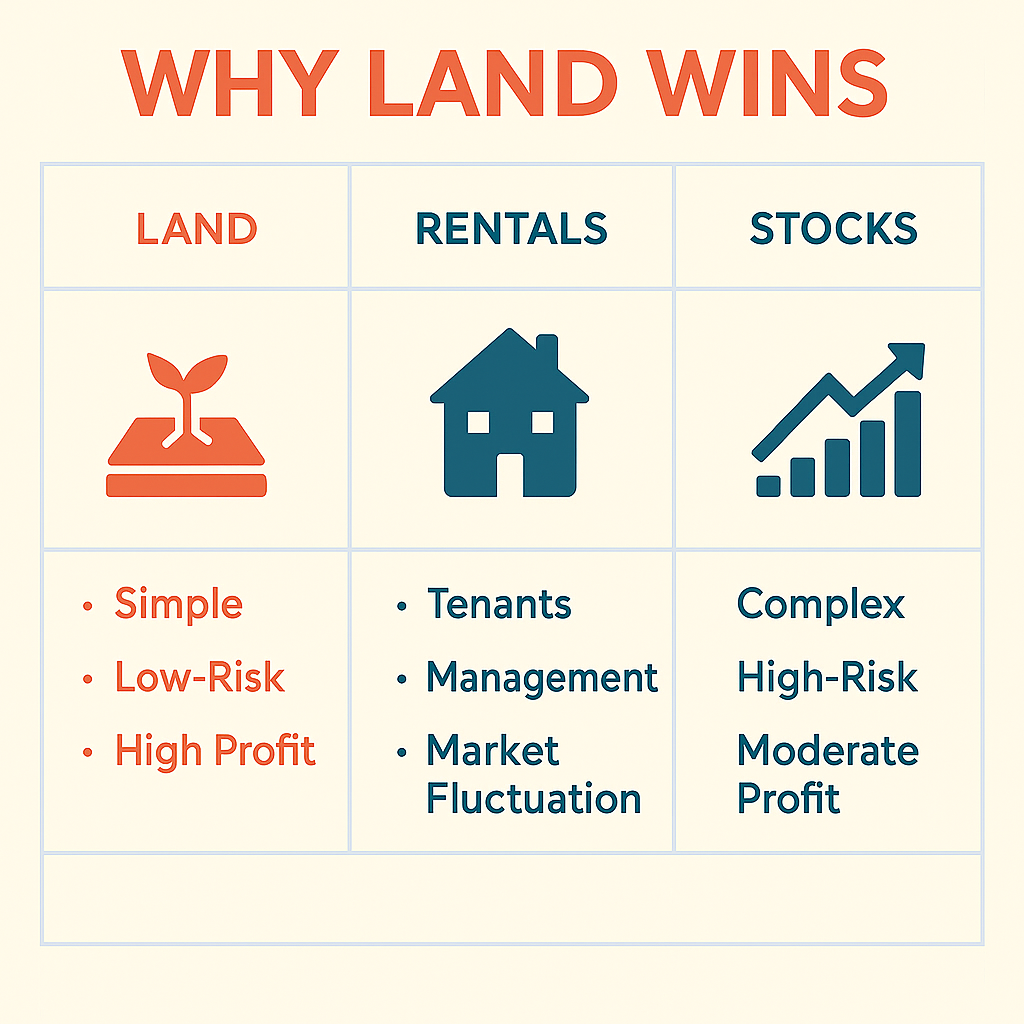
Vacant land can be operationally simpler than rental property because there are usually no tenants, buildings, renovations, or emergency repairs. It is not effortless or automatically profitable, however. You still need to find sellers, verify the property, establish market value, complete the transaction correctly, and reach qualified buyers.
If you are deciding between asset classes, review this practical comparison of land investing versus rental properties.
Why can vacant land work for a beginner?
Land can be a practical entry point because a straightforward parcel has relatively few physical components to evaluate. The investment thesis usually depends on location, legal access, permitted use, physical usability, buyer demand, and price rather than the condition of a building.
The key is to distinguish simple land from cheap but problematic land. A low purchase price does not compensate for missing access, unusable terrain, title defects, prohibitive restrictions, or nonexistent demand. Property taxes, association dues, cleanup obligations, financing costs, and marketing expenses can also create meaningful holding costs.
Land investing may suit someone who prefers transactions and marketing over tenant management. It may be a poor fit for someone expecting immediate passive income or appreciation without active research and selling.
What steps should a new land investor follow?
A beginner needs a repeatable acquisition process. Complete the steps in order so enthusiasm for a parcel does not replace evidence.
- Choose a strategy. Decide whether you plan to buy and resell for cash, offer seller financing to a buyer, hold for a specific use, or pursue another defined exit. Compare the tradeoffs among common land investment strategies before selecting one.
- Select one market. Focus on a county or small group of similar counties where sales activity, public records, and local rules can be researched.
- Define a buy box. Set standards for acreage, price, access, terrain, zoning, annual carrying costs, and disqualifying conditions.
- Identify likely buyers. Determine whether demand comes from neighboring owners, builders, recreational buyers, retirees, farmers, or people seeking an alternative homesite.
- Find potential sellers. Possible sources include direct outreach, local relationships, public records, wholesalers, agents, and existing listings.
- Estimate value and maximum offer. Use recent sold properties, not optimistic asking prices, and reserve room for transaction, holding, and resale costs.
- Complete due diligence. Verify the specific parcel with the relevant county offices, title professional, surveyor, utility provider, or other specialist.
- Close and market responsibly. Use appropriate documents, disclose known material facts, and never advertise a use that has not been verified.
What type of land is best for a first deal?
The best first parcel is usually ordinary, usable, legally accessible land with understandable demand. Small rural acreage and infill lots can both work, but neither is automatically beginner-friendly. Favor a parcel you can value from multiple comparable sales and explain to a buyer without relying on speculation.
| Property type | Potential buyer | Verify first |
|---|---|---|
| Rural acreage | Recreational or lifestyle buyer | Access, terrain, water, restrictions |
| Infill lot | Builder or future homeowner | Buildability, setbacks, utilities |
| Adjacent lot | Neighboring owner | Boundary, access, buyer depth |
| Alternative homesite | Tiny-home or RV buyer | Zoning, permits, occupancy rules |
Be cautious with wetlands, flood hazards, steep slopes, unclear ownership, unresolved liens, unrecorded access, illegal subdivisions, dumping, and parcels marketed around an unverified future development. If buyers may want a tiny home, use the tiny-home land buyer’s guide to understand why inexpensive land may still be unsuitable.
What due diligence is essential before buying land?
Land due diligence should confirm ownership, title, boundaries, legal and physical access, permitted use, taxes, restrictions, physical usability, utilities, environmental concerns, and resale demand. Conditions vary by state, county, subdivision, and parcel, so do not rely solely on a seller’s description or an online map.
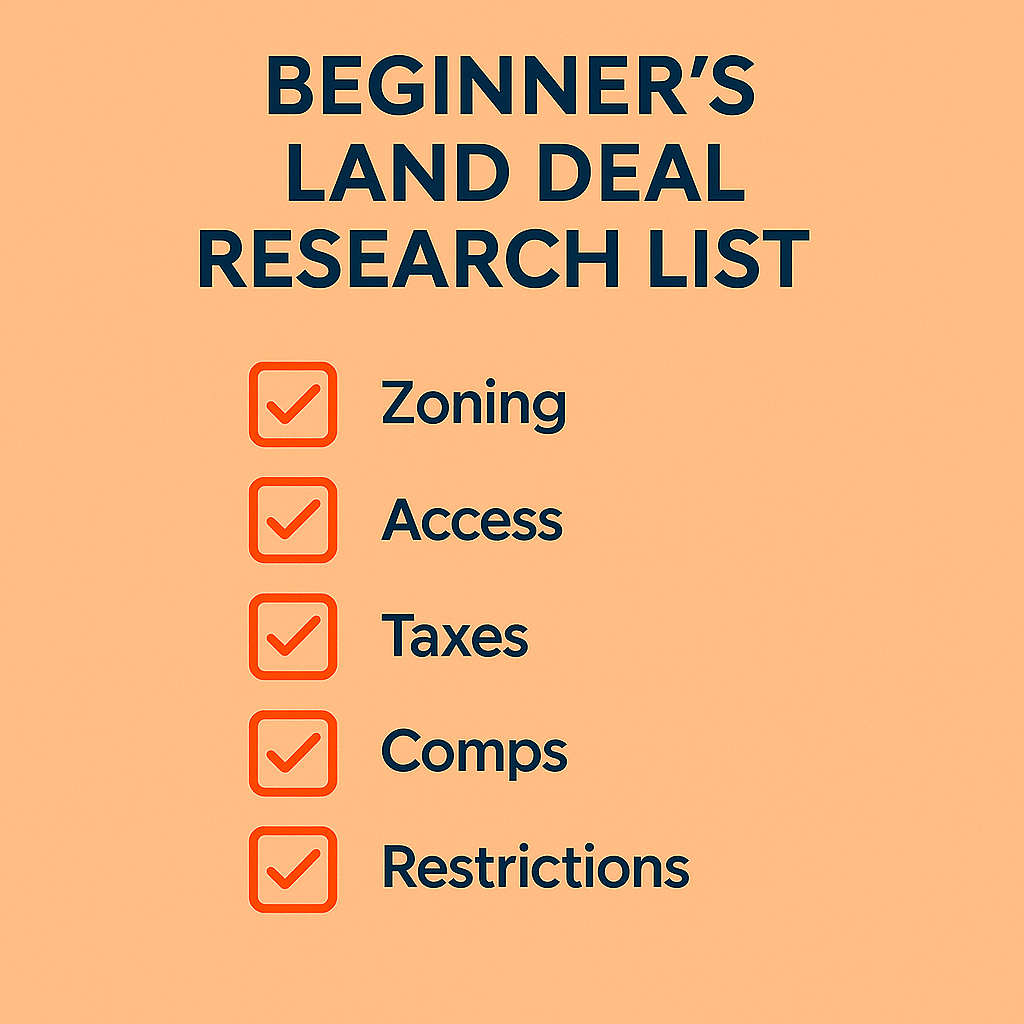
Beginner’s land due-diligence checklist
- Ownership and title: Confirm the owner of record, legal description, liens, delinquent taxes, probate issues, and the deed that can be conveyed. A title company or real estate attorney can advise on title and closing requirements.
- Access: Verify that access is legally recorded and physically usable. A road displayed on a map is not proof of a legal right to use it.
- Boundaries: Compare the deed, assessor information, GIS map, plats, and any available survey. County GIS lines are commonly approximate.
- Zoning and restrictions: Ask the planning or zoning authority about permitted uses, minimum lot size, setbacks, camping, RV occupancy, building requirements, and subdivision rules. Review recorded covenants separately.
- Physical condition: Examine slope, drainage, flood exposure, wetlands indicators, soil concerns, dumping, and neighboring uses. Hire qualified specialists when warranted.
- Utilities: Confirm electricity, water, sewer or septic feasibility, and communications service directly with the responsible providers. Rural buyers may also need guidance on internet options for rural land.
- Carrying costs: Check current and delinquent taxes, association or road dues, assessments, insurance needs, and maintenance obligations.
- Marketability: Identify recent sales, active competition, likely buyers, and the features those buyers require.
For more land-investing educational materials, explore The Land Geek Resources.
How do you estimate land value and resale potential?
Estimate land value by comparing recent sales of genuinely similar parcels in the same market. Adjust your conclusion for acreage, location, access, terrain, utilities, zoning, restrictions, and usability. Then calculate a maximum offer that accounts for all expected costs and an allowance for unknowns.
Start with sold properties whenever reliable data is available. Active listings show competition and seller expectations, not what buyers have paid. Avoid using a simple price-per-acre calculation across dissimilar parcels because smaller lots, improved access, utilities, and buildability can materially change value.
For each comparable, record the sale date, sale price, acreage, road type, utilities, topography, permitted use, and any improvement. If you cannot explain why your parcel should sell near the selected comparables, the valuation is not ready.
Resale potential also depends on buyer depth. One neighboring owner expressing interest is not a market. Look for repeated sales, multiple active buyers, sensible time on market, and properties that were removed because they sold rather than merely expired.
What mistakes cause beginners the most trouble?
The most damaging beginner mistakes are buying before verifying access, mistaking asking prices for value, assuming a desired use is legal, and having no realistic exit plan. These mistakes turn apparently inexpensive land into property that is difficult or expensive to sell.
- Buying a landlocked parcel because it appears close to a road
- Trusting assessor acreage, boundaries, or value without verification
- Ignoring back taxes, liens, association dues, or private restrictions
- Assuming a parcel can support a home, well, septic system, RV, or commercial use
- Using distant or dissimilar properties as comparables
- Paying based on hoped-for appreciation rather than current evidence
- Marketing seller financing without accounting for servicing, defaults, documentation, and applicable law
A practical rule is simple: if an issue could prevent the intended use or resale, resolve it before closing or price the known risk deliberately. Do not assume the next buyer will overlook it.
How can beginners fund a first land deal?
Common funding approaches include personal funds, seller financing, partnerships, or other financing appropriate to the buyer and property. Each option changes the risk, documentation, carrying cost, and control of the deal.
Cash can simplify a purchase but puts your capital at risk. Seller financing may reduce the upfront payment, but the note, security instrument, payment terms, default remedies, and recording requirements should be prepared or reviewed by qualified professionals. Partnerships require written terms covering contributions, authority, expenses, profit allocation, disputes, and exit decisions.
Pooling money from passive investors, offering investment interests, or soliciting capital may implicate federal or state securities laws, depending on the structure and circumstances. Before raising or accepting investor funds, consult an attorney familiar with both real estate and securities compliance.
Contract assignments may be possible in some transactions, but contract language, disclosure duties, licensing concerns, and state law vary. Consult a local real estate attorney rather than treating assignments as a universal no-money strategy.
Where should you sell land?
Sell where the parcel’s likely buyers already search. Options include land marketplaces, general real estate portals, local classified channels, social platforms, direct outreach to neighboring owners, agents, and an opt-in buyer list. The best channel depends on property value, location, intended use, and whether you offer financing.
A useful listing identifies the parcel accurately and addresses access, zoning, taxes, utilities, terrain, restrictions, and closing process. Separate verified facts from possibilities. For example, do not promote permanent RV living unless the applicable authorities have confirmed it. Prospective buyers considering that use can consult this guide to using an RV as a permanent residence on land.
How should you scale after the first few deals?
Scale only after your process produces complete due diligence and understandable results. Document each step, track the source and outcome of every lead, and identify the tasks that can be standardized without outsourcing judgment.
- Track acquisition price, closing costs, carrying costs, marketing expense, sale proceeds, and time held.
- Record why each lead was accepted, rejected, purchased, or lost.
- Create checklists for county calls, title review, comparable sales, and listings.
- Reinvest conservatively rather than assuming one successful sale will repeat.
- Use qualified professionals for legal, tax, title, survey, and environmental questions.
Land investing is not fully passive. Systems can reduce repetitive work, but valuation, risk decisions, compliance, and capital allocation still require oversight.
Frequently asked questions
Can you start land investing with no experience?
Yes, but education does not replace parcel-level verification. Begin with a narrow market, conservative criteria, and professional help where the consequences of an error are significant.
Can you invest in land with no money?
Some transactions use seller financing, partnerships, or assignments, but none eliminates risk, obligations, or legal requirements. Arrangements involving outside investors may also trigger securities-law considerations. Treat claims of effortless no-money investing cautiously.
Is land investing passive income?
Not by default. Cash resales require acquisition and marketing work, while seller-financed sales require payment administration and default management. Delegation can make parts of the operation less hands-on, but oversight remains necessary.
Important disclaimer
This article provides general educational information, not legal, tax, financial, environmental, surveying, or investment advice. Rules and parcel conditions vary. Verify material facts with the relevant government offices and qualified professionals before buying, financing, marketing, or selling land. No investment return or deal outcome is guaranteed.