

Urgency and scarcity can help land buyers move from “I’ll think about it” to a clear next step, but only when the reason to act is real. The goal is not to corner someone into buying. It is to make the actual availability, decision deadline, and value of a parcel easy to understand so a qualified buyer can act with confidence.
In land sales, hesitation is normal. Buyers may be comparing access, terrain, zoning possibilities, utility availability, title questions, and their intended use. Good urgency does not hide those questions. It gives the buyer the information needed to evaluate the parcel while clearly communicating what may change if they wait.
Selling land with persuasive principles starts with trust. Urgency works best as the final layer of a credible offer, not as a substitute for accurate parcel details, responsive communication, or proper due diligence.
Why do urgency and scarcity influence land buyers?
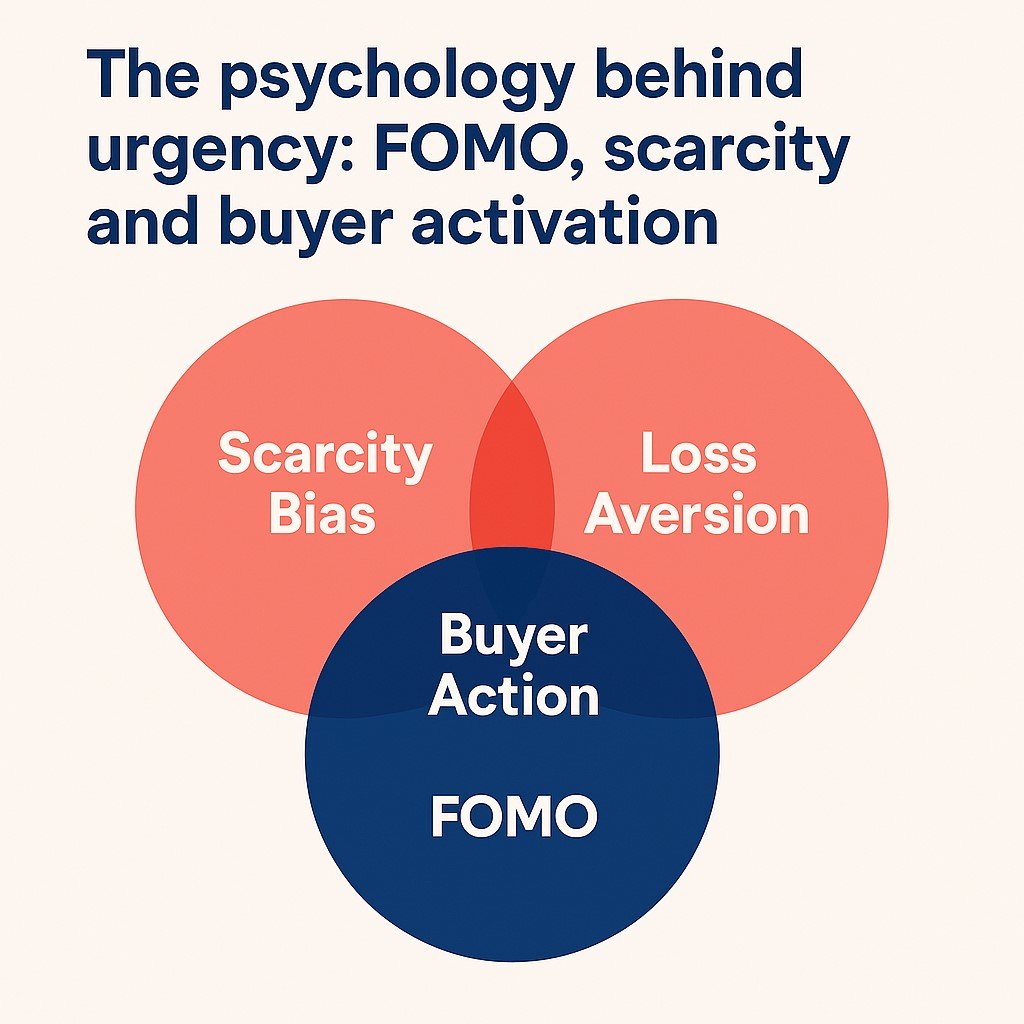
Urgency encourages action when a buyer understands that a real opportunity may no longer be available later. Scarcity increases attention when inventory, access to an offer, or a particular parcel feature is genuinely limited. Together, they help a buyer prioritize a decision that might otherwise drift.
Land is inherently unique. A buyer cannot simply replace a parcel with another listing that has the same road access, views, topography, neighboring uses, location, and potential fit for their plans. That uniqueness is a legitimate source of scarcity.
What matters here is the difference between a useful prompt and manufactured pressure. A buyer should know why a deadline exists, what happens when it ends, and what information they still need before committing. If the deadline is vague, repeatedly extended, or inconsistent with the facts, it damages credibility.
Loss aversion in a land purchase
Buyers often focus more intensely on the possibility of losing a suitable parcel than on the abstract benefit of owning it. A clear message such as “the owner is reviewing submitted offers” can be more motivating than generic language about a “great opportunity,” provided it is accurate.
The practical way to think about this is simple: identify what the buyer could genuinely lose by delaying. It might be the parcel itself, a seller-approved hold period, access to a particular release of inventory, or the ability to review a property before it is made available more broadly. Do not invent a consequence. State the real one.

What is ethical urgency in land marketing?
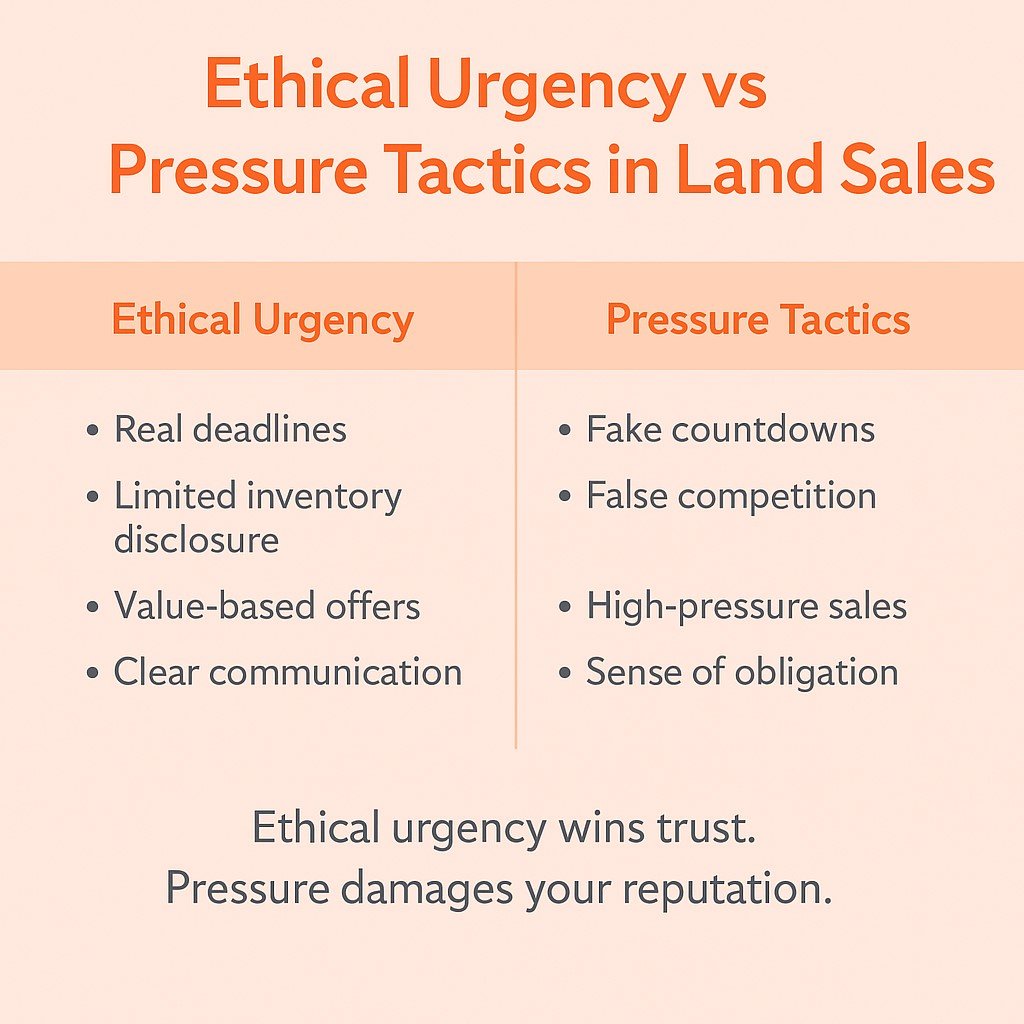
Ethical urgency is truthful, specific, and easy to verify. It tells a buyer what is limited, why it is limited, and what action is available before the opportunity changes. It never uses false competition, fake timers, or a deadline that disappears whenever a buyer waits.
A land buyer may be making a meaningful decision with long-term consequences. Respect that reality. Give them room to ask questions about the parcel, and avoid implying that urgency eliminates the need for independent due diligence. A serious buyer should still investigate access, permitted uses, boundaries, title, utilities, hazards, and local restrictions appropriate to the intended use.
Real reasons a land deadline may exist
- The seller has set a documented date for reviewing offers.
- A parcel is under active discussion with another interested party.
- A grouped release has limited remaining inventory.
- A seller-approved term is available only while a particular condition remains in place.
- The marketing plan calls for moving an unsold parcel to a different audience after a stated date.
Explain the reason in plain language. For example: “The owner plans to review complete offers after the stated date, so please send questions and documentation before then.” That gives buyers a meaningful next step without telling them to rush blindly.
Pressure tactics that undermine trust
- Claiming that other buyers are ready to purchase when no such interest exists.
- Using a countdown that restarts or an offer that never actually ends.
- Calling a parcel the last available property while similar inventory is being withheld from the message.
- Suggesting that a buyer should skip title, access, zoning, or other due-diligence questions to “beat” another buyer.
- Giving conflicting availability information across a listing, email, text message, and conversation.
A common mistake is treating urgency as louder copy. It is not. The strongest urgency comes from a believable reason, a defined process, and a seller who follows through consistently.
How should you build urgency into a land listing?
A strong land listing creates urgency by making the parcel’s fit and availability clear. Lead with the facts that help the right buyer recognize the opportunity, then state the actual condition that requires timely action.
Before adding any urgency language, make sure the listing answers the buyer’s core questions. A buyer cannot act confidently if they do not know where the parcel is, how it is accessed, what is known about the property, what is uncertain, and how to request the next document or conversation.
A practical listing sequence
- Lead with the parcel’s relevant use case. Describe the features that may fit a buyer’s goals without promising a use that has not been verified.
- Support the claim with property facts. Include location context, access information, maps, available documentation, and known constraints.
- State the true availability condition. Explain whether the seller is reviewing offers, releasing inventory, or ending a stated arrangement.
- Give a low-friction next action. Invite the buyer to request a map, ask a parcel-specific question, schedule a review, or submit the information needed for the seller’s process.
- Repeat the deadline only where it helps. Put it near the action step and in follow-up communication, rather than scattering it through every sentence.
Your pricing message needs to support, not contradict, the urgency message. If a buyer cannot see how the property was positioned relative to its attributes and market context, a deadline can feel arbitrary. A thoughtful vacant land pricing strategy helps you present the offer in a way that is understandable before you ask anyone to act.
Use specific, verifiable copy
| Situation | Useful wording | What to avoid |
|---|---|---|
| Seller review | “The owner plans to review complete offers after the stated date.” | “Buy now or lose it.” |
| Limited inventory | “This release has a limited number of remaining parcels.” | “Last chance,” unless it is truly the last chance. |
| Active interest | “Another buyer has asked for information, but the parcel remains available at this time.” | “Someone else is taking it,” without a factual basis. |
| Next action | “Request the parcel file before the review period closes.” | “Act immediately,” with no explanation. |
Notice that useful wording is calm. It does not need hype because the buyer can see the reason for the requested action. The key is to update the listing promptly when availability changes.
How can you use scarcity without making a false claim?
You do not need a hard deadline to create legitimate scarcity. A parcel’s distinct characteristics, a defined buyer process, and limited access to information can all create a reason for a qualified prospect to engage now, as long as you describe them honestly.
For example, a buyer may care about a particular road frontage pattern, a setting near a desired community, or a parcel configuration that fits their intended project. Those are not universal benefits. They are specific reasons the right prospect may decide not to wait.
Focus on fit, not artificial exclusivity
Instead of saying “rare investment opportunity” as a broad claim, explain what makes the property different and who should investigate it further. Be careful not to imply future appreciation, development approval, income, financing availability, or a particular use unless that claim has been properly verified and can be supported.
For land buyers, scarcity is often about suitability. The right question is not “How do I make every buyer feel pressure?” It is “What would make this parcel hard to replace for the buyer it actually fits?”
This is also where a disciplined acquisition and disposition process helps. A repeatable land flipping system can help organize property records, lead status, buyer questions, and follow-up so that your availability messages match the real stage of each sale.
How do you use urgency across email, text, and follow-up?
Use the same underlying facts across every channel, but let each message do a different job. Email can provide context and documents. Text can ask for a direct response. A call can resolve parcel-specific concerns. Repetition becomes useful when it helps the buyer make progress rather than merely repeating “urgent” language.
Before contacting a prospect by text or automated system, confirm that your practices, permissions, disclosures, and message content are appropriate for the location and communication method. Rules and expectations can vary, so verify with qualified local guidance when needed.
Match the message to the buyer’s stage
- Initial inquiry: Acknowledge the buyer’s interest and offer the most relevant parcel information.
- Research stage: Ask which issue is holding up the decision, such as access, intended use, or documentation.
- Active evaluation: State the real availability condition and invite the buyer to complete the next meaningful step.
- Final follow-up: Clearly communicate the approaching change in availability, then honor it.
A useful email may say: “You asked about the parcel’s access and surrounding area. The owner plans to review complete offers after the stated date. Reply with your questions, and we will provide the available property information so you can evaluate fit.”
That approach is more credible than a dramatic subject line with no substance. It also gives the buyer a reason to respond even if they are not ready to make an immediate decision.

What should buyers be allowed to verify before acting?
Urgency should accelerate communication, not eliminate diligence. Give prospective buyers a clear way to obtain the information they need and make it clear which matters require independent verification.
Depending on the parcel and intended use, buyers may need to investigate ownership and title matters, legal access, survey or boundary information, zoning or land-use controls, building and septic feasibility, utility service, flood or environmental conditions, easements, association restrictions, road maintenance, and local permitting. The appropriate questions vary by county, municipality, parcel, and planned use.
A seller or marketer should avoid giving legal, tax, engineering, environmental, or financing advice beyond what they are qualified to provide. When a buyer’s intended use depends on an official determination, encourage them to contact the relevant local office or a qualified professional.
How do you measure whether urgency is helping your land sales process?
Measure urgency by the quality of buyer action, not just attention. A successful approach produces clearer replies, more complete buyer questions, and a cleaner path from inquiry to a decision. If messages create confusion, complaints, or repeated requests for clarification, the process needs work.
Track patterns in your own records: which listing messages prompt informed responses, which questions keep appearing, when prospects disengage, and whether deadlines are being honored. Compare similar messages carefully, changing only the element you want to evaluate, such as the call to action or the explanation for a deadline.
Signals to review
- Whether prospects reply with parcel-specific questions rather than generic requests.
- Whether buyers request documents or take the next defined step.
- Whether availability messages lead to clearer decisions instead of confusion.
- Whether buyers say the deadline or inventory statement was unclear.
- Whether your team can consistently honor every stated deadline and hold policy.
Do not assume more urgency is always better. If prospects feel rushed before they understand the property, you may attract weak commitments and create more follow-up work. The better result is an informed buyer who understands both the opportunity and the limits of the offer.
Common questions about urgency and scarcity in land sales
What if there is no real deadline for the land offer?
Do not invent one. Focus on the parcel’s fit, provide helpful information, and invite a clear next action. You can explain that availability may change as other buyers inquire, but only if you communicate the current status accurately.
Can a countdown timer be used in land marketing?
A timer is appropriate only when it reflects a real, enforced event. If the offer, review period, or access condition will continue unchanged after the timer ends, the timer is likely to undermine trust rather than build it.
Should you mention other interested buyers?
Yes, when the statement is accurate and presented without exaggeration. Do not disclose private buyer information. Simply explain the current availability status and the seller’s process for reviewing interest or offers.
What is the best call to action for an urgency message?
The best call to action matches the buyer’s stage. For an early prospect, request a parcel file or ask a question. For a buyer who has completed their review, invite the next step in the seller’s stated process. Make the action specific, simple, and consistent with the facts.