

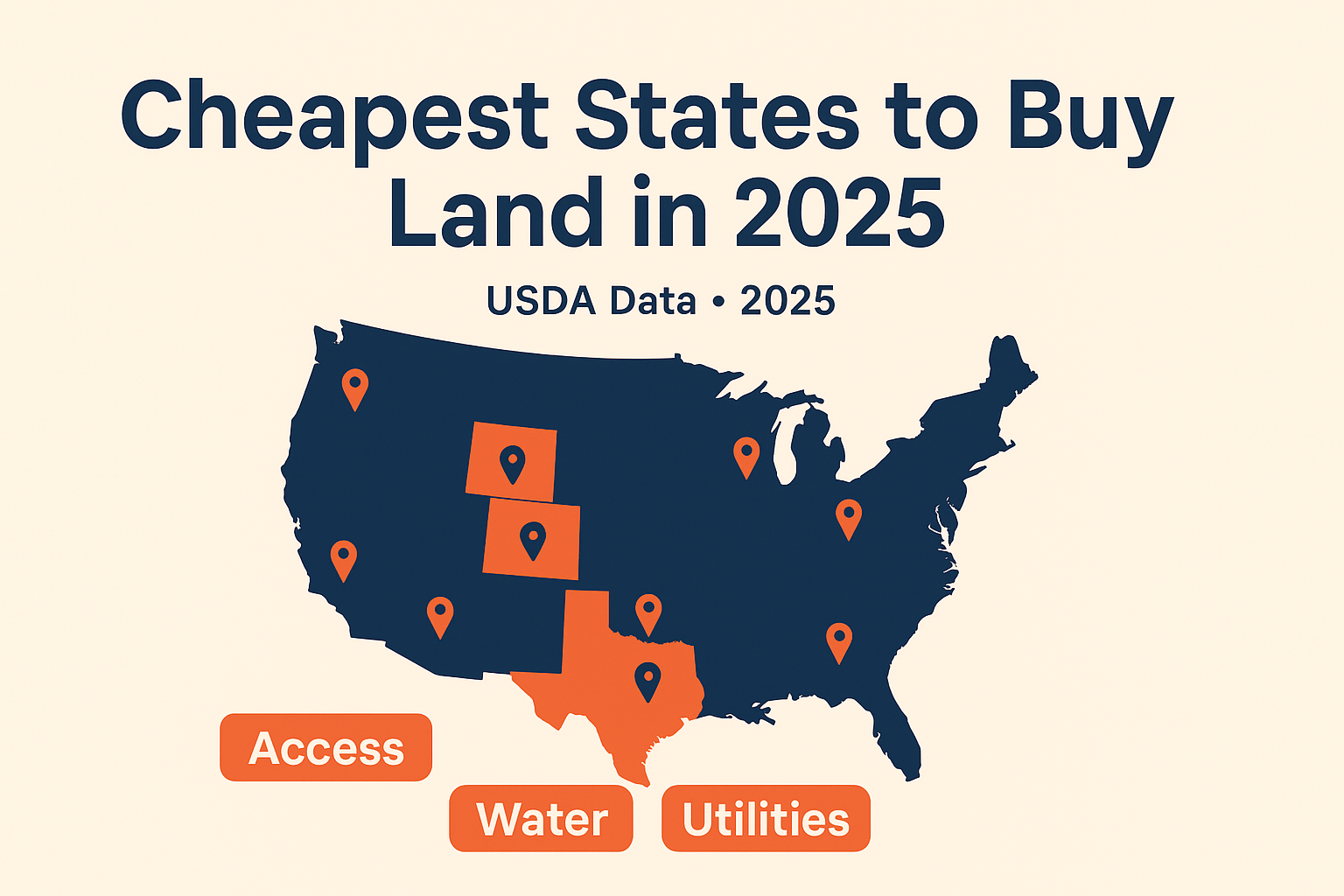
If you’re looking for the cheapest states to buy land in 2026, start with New Mexico, Wyoming, Nevada, Montana, Oklahoma, Colorado, South Dakota, Texas, Kansas, and North Dakota.

Based on the latest USDA state-by-state farm real estate values, New Mexico has the lowest average at about $725 per acre, followed by Wyoming at $1,000 and Nevada at $1,230.
But here’s the important part: cheap land is not automatically good land.
A $1,000-per-acre parcel with no legal access, no usable water source, restrictive zoning, or no realistic resale market can cost you far more than a $3,000-per-acre parcel that checks all the right boxes.
If you’re new to the process, start with our complete guide to buying land so you understand the purchase process before comparing individual properties.
What Are the 10 Cheapest States to Buy Land in 2026?
Using the USDA’s latest available 2025 farm real estate values as a consistent nationwide benchmark, these are the 10 lowest-cost states.
| Rank | State | USDA Farm Real Estate Value Per Acre |
|---|---|---|
| 1 | New Mexico | $725 |
| 2 | Wyoming | $1,000 |
| 3 | Nevada | $1,230 |
| 4 | Montana | $1,280 |
| 5 | Oklahoma | $2,540 |
| 6 | Colorado | $2,690 |
| 7 | South Dakota | $2,970 |
| 8 | Texas | $2,970 |
| 9 | Kansas | $3,100 |
| 10 | North Dakota | $3,200 |
For comparison, the USDA reported an average U.S. farm real estate value of $4,350 per acre for 2025.
These figures are useful for comparing states, but they are not the same as asking prices for every vacant lot. The USDA measure includes the value of land and buildings on farms. Actual raw, recreational, residential, or development land can sell for substantially more or less depending on the county and parcel.
Use statewide averages to identify markets worth investigating, not to determine what you should actually pay for an individual property.
What Is the Cheapest State to Buy Land?
New Mexico is the cheapest state in the USDA’s latest farm real estate data, averaging about $725 per acre.
That makes New Mexico particularly interesting if you’re looking for inexpensive rural acreage, recreational property, off-grid land, or potential land-investing opportunities.
However, the low average comes with a warning. Some inexpensive New Mexico parcels are extremely remote. Water availability, legal access, road conditions, utilities, septic feasibility, zoning, and proximity to an actual buyer market can dramatically affect what a parcel is worth.
A five-acre property that looks unbelievably cheap online may be cheap for a very good reason.
Why Is Land So Cheap in New Mexico?
Land can be inexpensive in New Mexico because the state contains enormous rural and desert areas with relatively low population density and limited infrastructure.
Water Can Determine Whether the Deal Works
Don’t assume that buying the land automatically gives you an inexpensive water solution. Investigate wells, water rights, hauling requirements, local restrictions, and the cost of bringing water to the property before making an offer.
Access Can Change the Property’s Value
A parcel on a maintained public road is very different from one that appears accessible on a map but requires crossing somebody else’s property.
Legal access is one of the issues buyers should verify before closing. Our guide to buying land without road access explains why landlocked parcels require additional caution.
Your Exit Market Matters
If you’re buying as an investment, don’t stop at asking, “Can I buy this cheaply?” Ask, “Who is going to buy this from me?”
Cheap acquisition means little if there is virtually no end-buyer demand.
Is Wyoming a Good State for Cheap Land?
Wyoming is the second-cheapest state in the latest USDA benchmark, averaging about $1,000 per acre.
Its huge rural areas can create opportunities for buyers looking for acreage, ranch land, recreation, hunting, or privacy. But Wyoming illustrates why price per acre cannot be your only metric.
Winter Access Matters
A road that looks perfectly usable in July may be a very different proposition in January. Check who maintains the road and whether year-round access is realistic.
Check Mineral and Surface Rights
Don’t assume every right associated with the property transfers with the land. Understand exactly what you’re purchasing before closing.
Look at Local Demand
A beautiful remote parcel can still be difficult to sell if the nearest pool of buyers is tiny. For investors, comparable sales and realistic buyer demand matter just as much as acquisition price.
Why Is Nevada Land Relatively Cheap?
Nevada averages roughly $1,230 per acre using the USDA farm real estate benchmark, putting it third on the list.
Large desert areas and extensive rural land help keep statewide values low. That doesn’t mean land around Las Vegas, Reno, or other high-demand locations will be inexpensive.
Check Water Before You Fall in Love With the Price
Water availability can completely change the economics of rural Nevada land.
Understand Federal-Land Boundaries
Many Nevada parcels sit near federally managed land. Verify actual boundaries, access, easements, and what neighboring public ownership means for your intended use.
Check Septic and Building Feasibility
If your plan involves building, don’t assume that an inexpensive vacant parcel is automatically buildable. Verify zoning, permitted uses, septic feasibility, setbacks, and other requirements with the relevant county.
Is Montana Still Affordable for Land Buyers?
Montana ranks fourth in the USDA data at approximately $1,280 per acre.
The statewide number looks attractive, but Montana has enormous local variation. A remote rural tract and a parcel near a popular recreational or rapidly growing market can have completely different valuations.
Location Matters More Than the State Average
County-level comparable sales should drive your actual offer.
Consider Seasonal Access
Snow, road maintenance, and distance from services can affect both usability and resale demand.
Know Your Buyer
If you’re investing, understand whether your likely end buyer wants ranch land, recreational acreage, hunting property, a homesite, or something else.
Is Oklahoma One of the Cheapest States to Buy Land?
Yes. Oklahoma’s latest USDA farm real estate value is approximately $2,540 per acre.
Oklahoma can be particularly interesting because it combines relatively affordable land with markets that may be easier for ordinary buyers to understand than extremely remote Western acreage.
Check Flood Risk
A low price can quickly become expensive if floodplain issues restrict the property’s use.
Investigate Easements and Restrictions
Review the title, county information, deed restrictions, easements, and physical property carefully before committing money.
Compare Rural Demand
A smaller parcel near a stronger buyer market may offer a better investment than a huge tract in an area with very little demand.
Can You Still Find Cheap Land in Colorado?
Colorado’s USDA statewide farm real estate value is approximately $2,690 per acre.
That number may surprise anyone familiar with expensive Colorado housing markets. Statewide agricultural values include large rural areas that bear little resemblance to land prices around Denver, mountain resort communities, or other high-demand locations.
Don’t Use the State Average as Your Offer Price
Always move down to county and local comparable sales before deciding what a parcel is worth.
Access and Utilities Can Be Expensive
Mountainous or remote terrain can make roads, electricity, wells, and septic systems significantly more expensive.
Understand the Intended Use
A cheap recreational parcel may be perfectly good for recreation but terrible for building. Know what you’re buying before you price it.
Is Land Cheap in South Dakota?
South Dakota averages approximately $2,970 per acre according to the USDA benchmark.
The state can offer relatively affordable rural property, but values and demand vary significantly by location and land use.
Compare Different Parts of the State
Don’t treat the entire state as one land market. Compare counties and individual submarkets.
Check Agricultural Value
Productive agricultural acreage may command a very different price from recreational or undeveloped property.
Watch Days on Market
For investors, how quickly similar properties sell matters. A cheap property that takes years to resell may not be the bargain it appears to be.
Where Can You Find Cheap Land in Texas?
Texas also averages approximately $2,970 per acre using the USDA benchmark, but that statewide figure hides enormous differences.
Land near Austin, Dallas-Fort Worth, Houston, San Antonio, and other growth markets can be expensive. Farther west and in more rural areas, pricing can be dramatically lower.
Texas Is Really Many Land Markets
Don’t analyze Texas as a single market. County-level demand, roads, utilities, water, subdivision rules, taxes, and proximity to population centers can completely change the economics.
Check Subdivision and Zoning Rules
Land-use rules determine what you can realistically do with a parcel. Before buying, understand how land zoning affects property use and then verify the rules with the county or municipality responsible for the specific parcel.
Don’t Ignore Holding Costs
Your purchase price isn’t your entire investment. Calculate property taxes, association fees where applicable, financing expenses, maintenance, and other holding costs until your exit.
Is Kansas a Good State to Buy Affordable Land?
Kansas averages about $3,100 per acre in the USDA’s latest benchmark.
The state offers large rural areas and can be attractive for agricultural, recreational, and investment land.
Road Access Still Matters
Don’t assume rural roads provide the access quality your buyer needs.
Utilities Affect Marketability
The distance to electricity, water, and other services can materially affect the property’s usability and value.
Use Local Comparable Sales
Agricultural productivity and local demand can create substantial differences between counties.
Why Is North Dakota on the Cheapest-Land List?
North Dakota rounds out the Top 10 at approximately $3,200 per acre.
Its rural character and agricultural land base contribute to relatively low statewide values compared with many parts of the country.
Check Easements and Energy Activity
Understand any existing easements, leases, rights, or restrictions affecting the property.
Think About Winter
Accessibility and maintenance can affect usability and resale.
Understand the Local Exit Market
Don’t buy based solely on acreage. Know how many comparable properties are selling, what buyers are paying, and how long similar parcels remain on the market.
Which Cheap-Land State Is Best for You?
The cheapest state isn’t necessarily the best state. The right market depends on what you want the land to do.
| Goal | States Worth Investigating |
|---|---|
| Very low-cost rural acreage | New Mexico, Wyoming, Nevada |
| Recreation and privacy | Wyoming, Montana, Colorado |
| Agricultural land | Oklahoma, Kansas, North Dakota, South Dakota |
| Large and diverse market | Texas |
| Off-grid possibilities | New Mexico, Nevada, Wyoming |
Use this as a starting point rather than a buying recommendation. The best property is the one where price, usability, demand, and your exit strategy all make sense together.
Why Is Some Land So Cheap?
Cheap land usually has a reason behind the price. Sometimes that reason creates an opportunity. Sometimes it creates a problem you don’t want.
The Property Is Remote
Distance from jobs, stores, schools, medical care, airports, and other services can reduce demand.
There Are No Utilities
Extending electricity or installing a well and septic system can cost far more than the land itself.
Legal Access Is Complicated
A parcel can appear accessible on an online map while lacking legally recorded access.
The Terrain Is Difficult
Steep slopes, flood zones, wetlands, rocky soils, desert conditions, or other physical constraints can reduce usability.
Zoning Limits What You Can Do
Don’t buy land for an RV, tiny home, mobile home, subdivision, rental, or commercial project until you’ve confirmed that your intended use is allowed.
There Isn’t Much Buyer Demand
This is particularly important for investors. You make your money when you buy, but you realize that value when somebody else wants the property.
How Should You Compare Cheap Land Between States?
Start broad, then narrow down. State averages help identify where land tends to be inexpensive. County and parcel-level research tells you whether an individual property is actually a deal.
Step 1: Choose a State
Use the Top 10 list to identify two or three states that fit your budget and strategy.
Step 2: Choose Counties
Look for counties with enough transactions to establish reliable comparable sales and enough buyer demand to support your exit.
Step 3: Pull Comparable Sales
Compare similar acreage, access, terrain, utilities, zoning, and location. Don’t compare a five-acre desert parcel 80 miles from town with a five-acre buildable lot beside a paved road.
Step 4: Calculate the All-In Cost
- Purchase price
- Closing costs
- Back taxes
- Survey costs
- Title work
- Road or access work
- Well or water costs
- Septic testing or installation
- Utilities
- Property taxes
- HOA or POA fees
- Holding costs
That’s your real cost.
What Due Diligence Should You Do Before Buying Cheap Land?
Before you wire money for any inexpensive parcel, verify the property independently. The Land Geek’s land due diligence checklist goes deeper into this process.
Confirm Ownership and Title
Make sure the seller actually owns what they’re selling and understand liens, easements, encumbrances, and other recorded interests.
Verify Legal Access
A road on a map doesn’t automatically mean you have a legal right to use it.
Check Zoning
Call the county or municipality and explain what you intend to do with the land.
Investigate Water and Septic
For rural property, these can determine whether the land is practically usable.
Check Flood and Wetland Conditions
Understand environmental and development constraints before closing.
Review Property Taxes
Confirm whether taxes are current and what you’ll owe going forward.
Confirm the Legal Description
The deed, survey, assessor information, and parcel maps should describe the same property.
Use an Appropriate Closing Process
For meaningful purchases, title and escrow services can help reduce avoidable transaction risks.
Are the Cheapest States Always the Best Places to Invest in Land?
No. If you’re investing rather than simply buying land for personal use, acquisition price is only one part of the equation.
You also need demand.
Imagine two parcels. Property A costs $2,000 but has almost no buyer demand. Property B costs $7,000 but sits in an active market where comparable parcels consistently sell.
The second property may be the better investment.
If your goal is investing rather than personal ownership, our complete land investing guide explains how pricing, due diligence, demand, holding costs, and the resale path work together.
How Do You Avoid Buying Worthless Cheap Land?
Never let a low asking price replace due diligence.
Before buying, you should be able to answer five questions:
- Do I have legal access?
- Can the land be used for my intended purpose?
- Are water, septic, and utilities feasible?
- What are comparable properties actually selling for?
- Who is my likely buyer if I need to sell?
If you can’t answer those questions, you aren’t ready to buy the parcel.
How Can Land Investors Find Better Deals in Cheap States?
Public listings are only one source of deals. Land investors can also look for motivated owners who may value speed, certainty, or convenience.
Look for Long Ownership Periods
Some owners have held vacant land for years and no longer have a use for it.
Research Delinquent or Unwanted Property Carefully
Tax issues can sometimes signal motivation, but always understand the legal and title implications.
Contact Neighboring Owners
Adjacent owners may want to buy or sell land to consolidate their holdings.
Track Listings With Long Days on Market
Repeated price reductions or long listing periods can indicate flexibility.
Work Backward From the Exit
Estimate a conservative resale value first. Then subtract selling costs, holding costs, due-diligence expenses, improvements or cures, and your required margin.
What’s left gives you a much better idea of the maximum price the deal can support.
Should You Finance Cheap Land or Pay Cash?
That depends on the deal and your financial situation.
Cash can make small land transactions simpler, but seller financing is also common in vacant-land markets. If you’re comparing funding methods, see our guide to owner financing for land.
The important thing is not to let easy financing convince you to overpay. A low monthly payment can sound inexpensive while hiding a purchase price or financing structure that doesn’t make sense relative to the property’s actual value.
What Is the Biggest Mistake People Make When Buying Cheap Land?
The biggest mistake is buying based on price before understanding usability.
People see five or ten acres for a few thousand dollars and think, “How could I lose?”
Then they discover there is no legal road, water is impractical, they can’t build what they planned, the parcel sits in a flood zone, the property has title complications, utilities cost more than the land, or there is little resale demand.
Cheap land can be a fantastic opportunity. But cheap and valuable are not synonyms.
What Should You Do Before Buying Land in One of These States?
Pick the market first, not the parcel.
Research two or three counties inside the state and understand typical price per acre, recent comparable sales, days on market, parcel sizes buyers prefer, road quality, zoning, utilities, water, taxes, and buyer demand.
Once you understand what normal looks like, unusual value becomes much easier to recognize.
Final Takeaway
The cheapest states to buy land in 2026 are New Mexico, Wyoming, Nevada, Montana, Oklahoma, Colorado, South Dakota, Texas, Kansas, and North Dakota based on the latest USDA farm real estate benchmark.
New Mexico sits at the bottom of that benchmark at about $725 per acre, compared with a U.S. average of $4,350.
But don’t buy a state average. Buy a good parcel.
Use statewide numbers to find affordable markets, then investigate county-level prices, legal access, zoning, water, utilities, title, physical conditions, and buyer demand before making an offer.
The goal isn’t simply to own the cheapest dirt you can find. It’s to buy land with a clear use, a sensible price, and an exit strategy that works.
Frequently Asked Questions
What is the cheapest state to buy land in 2026?
New Mexico is the cheapest state using the USDA’s latest farm real estate benchmark, at approximately $725 per acre. Actual vacant-land prices vary significantly by county, parcel type, access, utilities, water availability, and local demand.
Where can I buy the cheapest land in the United States?
New Mexico, Wyoming, Nevada, and Montana have the lowest statewide farm real estate values in the USDA’s latest data. Individual rural parcels in other states can sometimes sell below those averages.
Can you really buy land for $1,000 per acre?
Yes, inexpensive rural acreage exists in some markets, but price alone doesn’t establish value. Verify access, title, zoning, water, septic feasibility, utilities, taxes, terrain, and local resale demand before purchasing.
Is cheap land a good investment?
It can be, but only when you buy at a sensible price and there is sufficient demand for your eventual exit. A very cheap parcel with serious access, usability, title, or demand problems may be a poor investment.
What should I check before buying cheap land?
At minimum, verify ownership and title, legal access, zoning, property taxes, water, septic feasibility, utilities, flood or wetland conditions, physical boundaries, comparable sales, and your intended use before closing.