

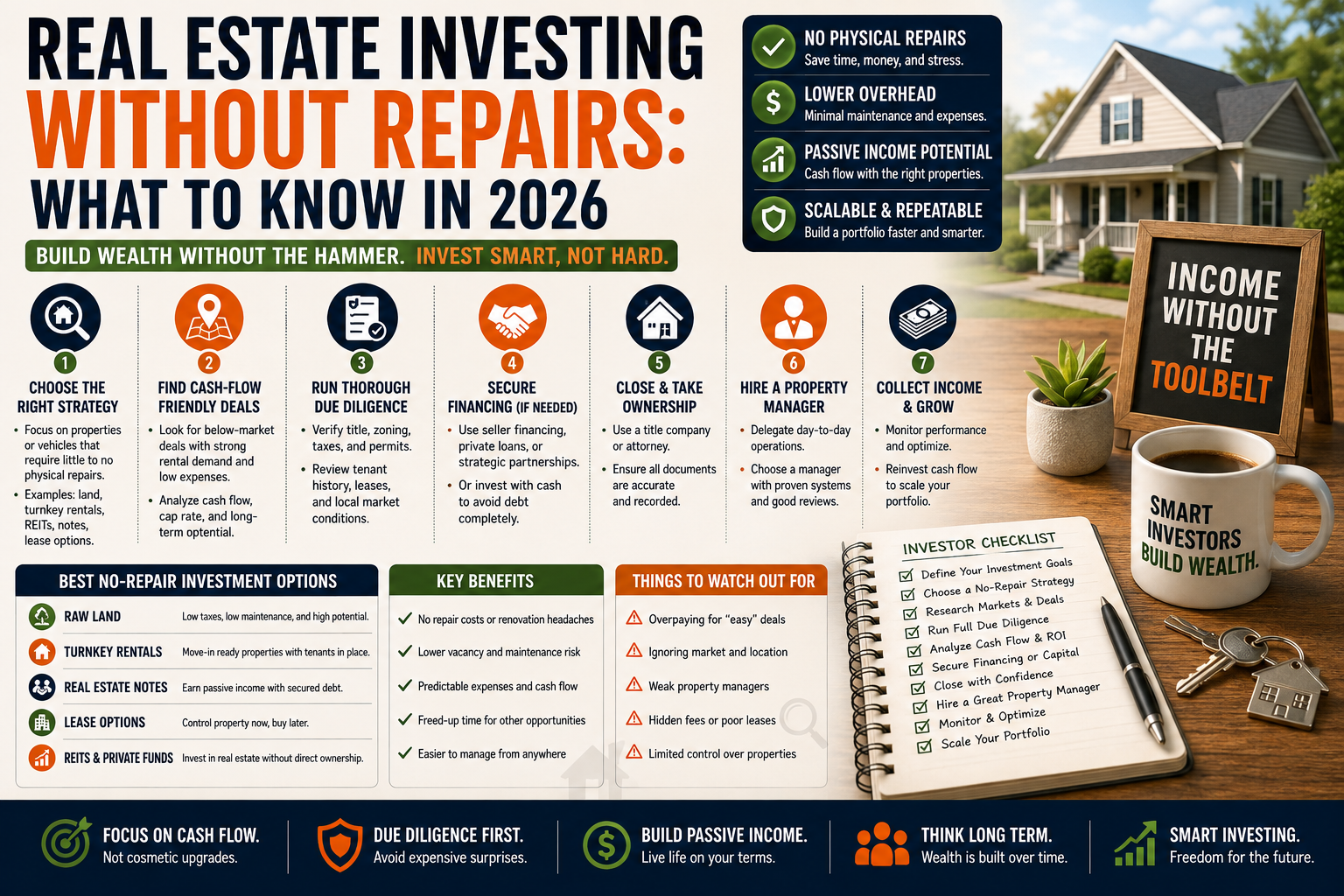
Real Estate Investing Without Repairs: What to Know in 2026

Investing in real estate without taking on repairs in 2026 is achievable by focusing on property types or strategies that intrinsically require no renovation or maintenance responsibilities. This includes acquiring raw land, purchasing turnkey rental properties with professional management, or investing passively through real estate securities like REITs and syndications. Each option substantially reduces repair obligations but involves distinct risks, holding costs, and liquidity factors that investors must verify carefully before committing funds.
Understanding these tradeoffs and performing rigorous due diligence on property title, zoning, management quality, and market conditions can help investors avoid surprises and align their no-repair investment choices with personal financial goals and risk tolerance.
How Can I Invest in Real Estate Without Doing Repairs?
To invest in real estate without repairs, choose assets such as undeveloped land, turnkey rental homes managed by professionals, or passive vehicles like REITs where physical maintenance is minimal or handled by others. However, this does not eliminate legal, financial, or market risks, which must be confirmed beforehand.
The key here is to select properties or instruments where repair-related tasks are either nonexistent (as with raw land) or outsourced to trusted management, or avoided entirely in passive investments. This reduces your hands-on involvement but shifts your focus to verifying property status, market trends, and operational costs.
Verification steps include obtaining a thorough title report to confirm ownership and liens, confirming zoning compliance with local authorities to ensure allowed uses align with investment plans, and reviewing property management agreements or REIT portfolios to assess fees and risk exposure. Ignoring these can result in unexpected expenses or legal issues despite no repair obligations.
What Alternative Real Estate Investing Strategies Avoid Repairs?
Besides raw land and turnkey homes, strategies such as seller financing and lease options can structure investments to defer or transfer repair duties, while passive investments like REITs eliminate repair responsibilities entirely by outsourcing property management.
Turnkey Properties and Management Considerations
Turnkey rentals offer move-in ready homes combined with professional property management that handles repairs and tenant relations. While this reduces direct repair involvement, investors should carefully review management contracts, fees, and tenant screening processes. Failing to do so risks poor management performance, unexpected costs, or reduced rental income.
Seller Financing and Lease Options
Sophisticated investors sometimes use seller financing or lease option agreements that defer or assign repair responsibilities to the seller or tenants. These require detailed contract analysis and legal counsel to prevent embedded repair liabilities that could surface unexpectedly. Such strategies demand financial sophistication and clarity on repair obligations before purchasing.
Passive Investments (REITs and Syndications)
Investing through real estate investment trusts (REITs) or syndications provides fully passive engagement with diversified portfolios where property repairs are handled by asset managers. Investors trade direct control and timing of income for liquidity and diversification benefits. Key verification points include understanding fund fee structures, portfolio composition, and management track records.
Is Land Investing a Good Way to Avoid Repairs in Real Estate?
Yes, investing in raw land aligns well with avoiding repairs since undeveloped parcels have no buildings, eliminating renovation and maintenance needs. However, land investing demands strict due diligence on clear title, zoning, and environmental conditions, along with acceptance of ongoing holding costs and generally slower market liquidity.
Key practical factors include verifying ownership and absence of liens with a professional title search to avoid legal disputes; confirming zoning with the county or planning department to ensure permitted uses or future development potential; and accounting for property taxes and minimal upkeep such as access maintenance.
A red flag that should pause or stop a purchase is if title issues cannot be resolved, zoning restricts intended or resale uses, or environmental liabilities exist. Land typically requires more patience for resale, so expect longer holding periods and assess market demand carefully before buying.
What Types of Property Investments Don’t Need Renovation or Maintenance?
Raw land, professionally managed turnkey rental properties, and passive real estate vehicles like REITs are the primary investment types that generally avoid renovation or maintenance, each with unique financial and liquidity characteristics.
| Property Type | Repair Needs | Typical Holding Costs | Income Potential | Liquidity |
|---|---|---|---|---|
| Raw Land | No structures,no repairs | Property taxes, occasional minimal upkeep | Usually none until sale or development | Relatively low; depends on location and market demand |
| Turnkey Rental Properties | Minimal, handled by management | Taxes, insurance, management fees | Regular rental income | Moderate; better than land but less liquid than active residential markets |
| REITs / Syndications | None; fully passive | Fees embedded in share price | Dividends and appreciation | High for publicly traded REITs; lower for private syndications |
Outsourcing repairs and tenant issues to professional management in turnkey properties reduces investor workload but introduces management fees and reliance on manager competence. Poor management can result in increased costs and lower income despite a no-repair intention.
What Are the Risks and Holding Costs Associated with No-Repair Investments?
No-repair investments still carry substantial risks such as unclear or disputed title, zoning restrictions, holding expenses, and challenges with market liquidity. Addressing these through thorough due diligence is critical to avoid costly surprises.
Title and Lien Risks
Unresolved ownership disputes, liens, easements, or unpaid taxes can cause legal challenges or financial losses. Raw land purchases are especially vulnerable to overlooked title issues. Always obtain a comprehensive title report and consider title insurance to mitigate this risk.
Zoning and Land Use Restrictions
Zoning regulations may prohibit your intended use or limit resale options. Confirm zoning designations and any special restrictions with the local planning office before buying. Noncompliance risks illiquid or unusable assets.
Market Liquidity and Holding Cost Considerations
Raw land often sells more slowly than developed property, requiring willingness to hold long term while paying ongoing taxes and minimal upkeep. Turnkey rentals incur insurance, management fees, and possible vacancy risks. Passive investments come with their own market risks and fees but usually offer higher liquidity, especially publicly traded REITs.
How Do Returns and Liquidity Compare Between No-Repair and Traditional Repair-Based Investments?
No-repair investments typically offer steadier, more predictable returns with lower operational risk, though often at lower yields and varying liquidity depending on asset type. Traditional repair-heavy investments can yield higher profits but require active management and involve renovation risks.
Return and Risk Tradeoffs
Raw land and turnkey rentals provide stable income and appreciation potential but usually come with slower liquidity or lower upside compared to fix-and-flip projects, which demand capital, time, and repair expertise and carry risk of cost overruns or delays.
Liquidity Profiles
Among no-repair options, publicly traded REITs offer the highest liquidity with shares bought and sold on exchanges. Turnkey properties have moderate liquidity contingent on local real estate markets. Raw land is generally the least liquid, with longer holding periods required.
What Due Diligence Should I Perform Before Buying a No-Repair Property?
Prioritize verifying clear title, zoning compliance, environmental factors, holding costs, and market demand during due diligence to ensure the property meets your no-repair investment criteria and avoid hidden liabilities.
- Title Search and Lien Check: Use a professional title company or attorney to obtain a full title report revealing ownership, liens, easements, or unpaid taxes. Unresolved issues should be deal killers.
- Zoning Verification: Confirm allowable uses and restrictions with the local planning department. If zoning conflicts with your intended use or resale plans, reconsider the purchase.
- Environmental Review: Investigate any contamination, protected habitats, or environmental liens that could limit use or cause cleanup costs.
- Holding Costs Estimation: Evaluate property tax assessments, insurance requirements, and potential minimal upkeep expenses to understand ongoing financial commitments.
- Market and Liquidity Testing: Analyze recent comparable sales, local economic conditions, and likely resale timelines. If demand is weak or liquidity low, it may extend your holding period undesirably.
Walk away if title, zoning, or environmental problems cannot be remedied, or if holding costs and liquidity do not align with your investment goals.
How Do I Choose the Right No-Repair Real Estate Investment Strategy for My Goals?
Match your capital level, risk tolerance, time availability, and income expectations to the characteristics of land, turnkey properties, or passive investments to select the suitable no-repair strategy.
- Investment Objectives: Choose raw land for capital preservation and potential appreciation; turnkey rentals for steady rental income; and REITs or syndications for liquidity and diversification.
- Capital Availability: Land investments often require less upfront capital; turnkey properties and REITs may need more depending on market.
- Time Commitment: Land investing requires low involvement; turnkey properties rely on trust in management; REITs are fully passive.
- Risk Appetite: Land carries title and zoning risks and slower liquidity; turnkey rentals entail operational risks; REITs subject investors to market volatility risk.
- Local Market Conditions: Evaluate zoning, demand, and economic factors impacting all types differently.
Also assess availability and cost of financing as it impacts your effective investment costs and exposures.
Practical Scenario: Comparing Land Investing and Turnkey Properties for No-Repair Investors
An investor with limited capital, no repair skills, and a desire to avoid tenant management must weigh land’s minimal involvement and slower liquidity against turnkey properties’ rental income and higher purchase price coupled with management fees.
Scenario Conditions
- Capital Constraint: Approximately $20,000 available for investment.
- Skill and Time Limitation: No interest or experience in repairs or tenant management.
- Investment Objective: Minimize hands-on responsibilities while preserving capital or generating income.
Key Verification Points
- Land: Confirm clear title, absence of liens, zoning compatible with future resale or development, and local market demand sufficient for eventual sale.
- Turnkey Property: Evaluate the home’s condition, verify property management reputation and fee structure, and analyze cash flow forecasts to ensure acceptable income after expenses.
Decision Tradeoffs
- Land requires minimal involvement and typically lower holding costs but provides no immediate income and slower liquidity.
- Turnkey rentals offer regular rental cash flow and higher liquidity but demand greater upfront capital and incur management fees requiring trust in the management provider.
- Rule of Thumb: Choose land if prioritizing low involvement and capital preservation with patience to hold long-term; choose turnkey property if requiring income now and accepting management fees.
Walk-Away Signals
- Land with unresolved title issues, restrictive zoning, or significant environmental concerns.
- Turnkey properties with opaque or high management fees, poor property condition, or negative cash flow projections.
Next Step: Proceed only after thorough due diligence including professional title searches, zoning verification, property condition inspection, and consultation with local real estate experts.
Frequently Asked Questions About Investing in Real Estate Without Repairs
Can No-Repair Investments Still Require Unexpected Expenses?
Yes. Even without repair duties, investors may encounter costs such as property taxes, insurance, legal fees, environmental assessments, or management charges. Maintaining contingency funds is prudent to cover these unforeseen expenses.
What Financing Options Are Available for No-Repair Properties?
Raw land financing often comes with stricter terms, shorter loan durations, and higher interest rates than residential mortgage loans. Turnkey properties typically qualify for conventional mortgages, while REITs and syndications require only capital investment. Consult lenders early to understand financing feasibility and terms.
How Do Market Fluctuations Affect Land Compared to Residential Properties?
Land values can be more volatile and sensitive to zoning law changes, infrastructure projects, and local economic shifts. Residential properties generally experience steadier appreciation due to ongoing housing demand, but repairs and maintenance risks increase operational complexity.
Are There Tax Considerations Unique to No-Repair Investing?
Raw land does not qualify for depreciation deductions as residential rentals do. Tax treatment varies by property type and ownership structure. Consultation with a tax professional is necessary to understand your specific tax implications.
How Can I Verify That a Land Parcel Has No Hidden Liabilities?
Engage a reputable title company or real estate attorney to perform comprehensive title and lien searches. This uncovers easements, unpaid taxes, or legal claims that could impair ownership or reduce value.
What Are the Signs of a Poor No-Repair Investment Opportunity?
Red flags include unclear or disputed title, zoning incompatible with intended use, low or declining market demand, absence of infrastructure or utilities critical for resale, and known environmental contamination. Identifying these early helps avoid costly mistakes.