

Land buyers rarely make a decision the first time they see a parcel. That does not automatically mean they are not interested. More often, they are comparing options, trying to understand the property, waiting for a spouse or partner, or simply getting pulled back into everyday life.
The best land follow-up is not relentless contact. It is a useful, well-timed conversation that reduces uncertainty and gives the buyer a simple next step. Your job is to help a prospect move from “This might work” to “I understand what I need to verify and what happens next.”
That distinction matters. A buyer does not need more generic reminders. They need relevant information, a calm tone, and a clear response path. When your timing and message match the buyer’s actual stage of interest, follow-up becomes service rather than pressure.
Why does follow-up matter so much in land sales?
Follow-up matters because land is often an unfamiliar purchase. Buyers may like the location or the idea of ownership while still having unanswered questions about access, use, utilities, terrain, title, financing, or the closing process. A thoughtful follow-up keeps the conversation open while helping them resolve the issue that is slowing the decision.
Land purchases usually involve more independent research than a typical consumer purchase. A prospect may be looking at maps, speaking with family, reviewing nearby listings, or trying to picture how the parcel fits a future plan. Silence can mean uncertainty, not rejection.
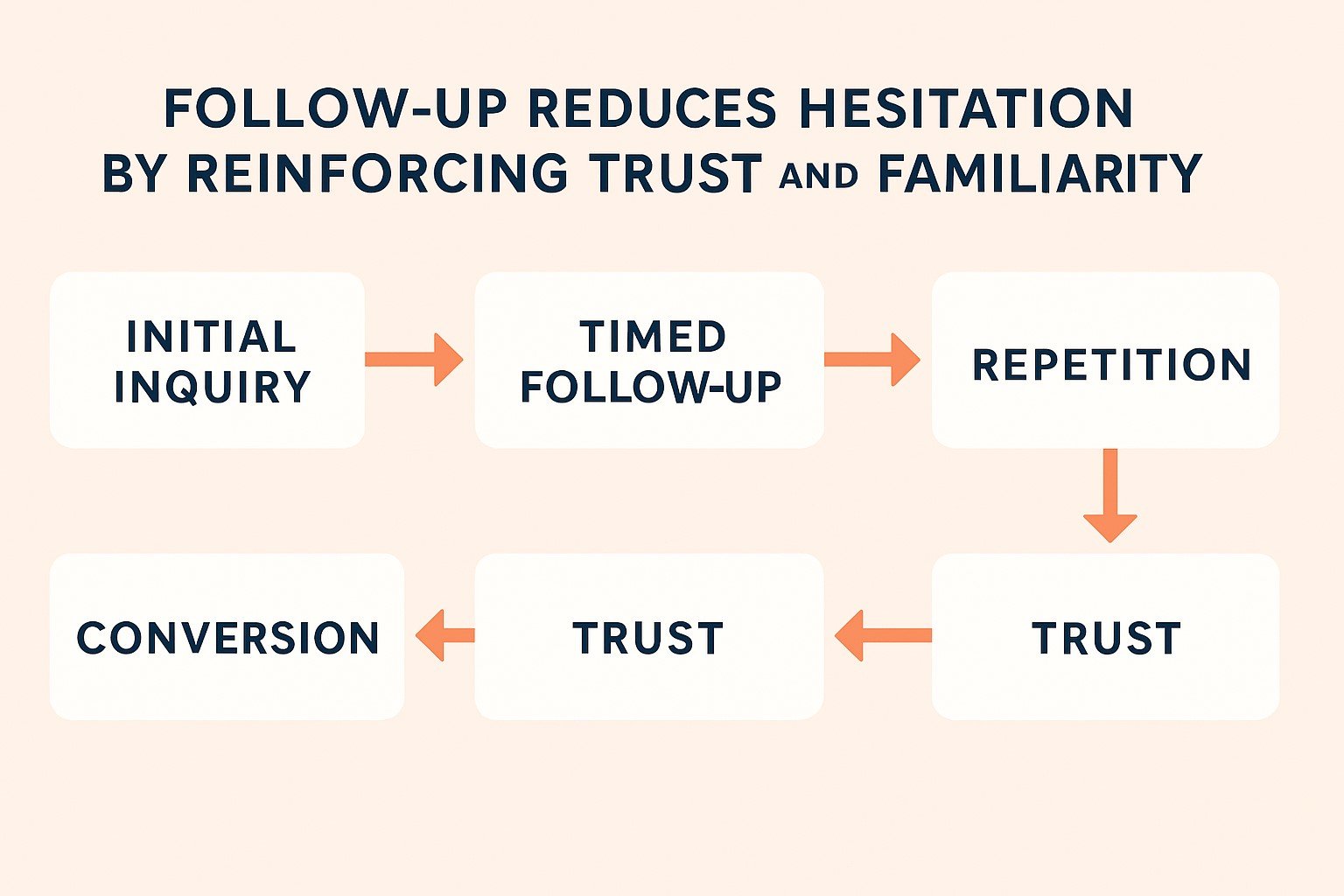
The psychology behind a good follow-up system is straightforward: familiarity lowers friction when it is paired with credibility. A buyer who repeatedly receives clear, useful communication begins to recognize your name, your process, and the information you provide. That recognition can make it easier for them to ask the question they were hesitant to ask.
What matters here is consistency without repetition. Sending the same “just checking in” message does not add value. Sending a useful answer to the next logical question does.
- A map-oriented buyer may need help understanding access and nearby landmarks.
- A future homesite buyer may need to know which local offices or providers can answer questions about building, utilities, and permitted uses.
- An investor may want the parcel facts, comparable listings, and a clear explanation of the sale process.
- A buyer who has gone quiet may simply need an easy way to say whether they are still considering the property.
Before discussing a parcel’s potential, make sure your own property file is organized. You should be able to communicate what you know, identify what still needs local verification, and avoid presenting assumptions as facts. Strong follow-up cannot compensate for weak due diligence. Investors building a repeatable acquisition and resale process can use the broader framework in this guide to buying land and reselling it.

What buyer hesitation are you really trying to solve?
Most hesitation falls into a few predictable categories: uncertainty about the parcel, uncertainty about the process, uncertainty about the buyer’s own plans, or uncertainty about timing. Identify the category before you send another message. The right follow-up answers the real objection rather than pushing for a decision.
A common mistake is treating every nonresponse as a lack of urgency. Sometimes the buyer needs a clearer answer, not a stronger call to action. For example, a person asking about road access is not necessarily asking for a sales pitch. They are asking whether the parcel fits their intended use.
| Buyer signal | Likely concern | Helpful follow-up |
|---|---|---|
| Viewed maps repeatedly | Location or access | Offer parcel maps and clarify known access information |
| Asked about use | Suitability | Explain what should be verified with local officials |
| Opened details but did not reply | Information overload | Ask one simple question about their goal |
| Asked about paperwork | Process confidence | Describe the next step in plain language |
| Stopped responding after interest | Competing priorities | Send a respectful close-the-loop message |
The key is to separate facts from possibilities. Do not imply that a buyer can build, camp, subdivide, drill a well, install a septic system, or access a property just because a nearby parcel appears to have those features. County rules, zoning, access records, utility availability, soil conditions, environmental limitations, and private restrictions can vary by parcel.
A useful follow-up might say: “You mentioned a future cabin. I can send the parcel information I have, and you may also want to confirm current requirements with the county planning office and the relevant utility providers. Is road access or building feasibility the bigger question for you?”
That message does three things well. It acknowledges the buyer’s goal, gives a responsible next step, and invites a reply that tells you what matters most.
How should you time land follow-up without overwhelming buyers?
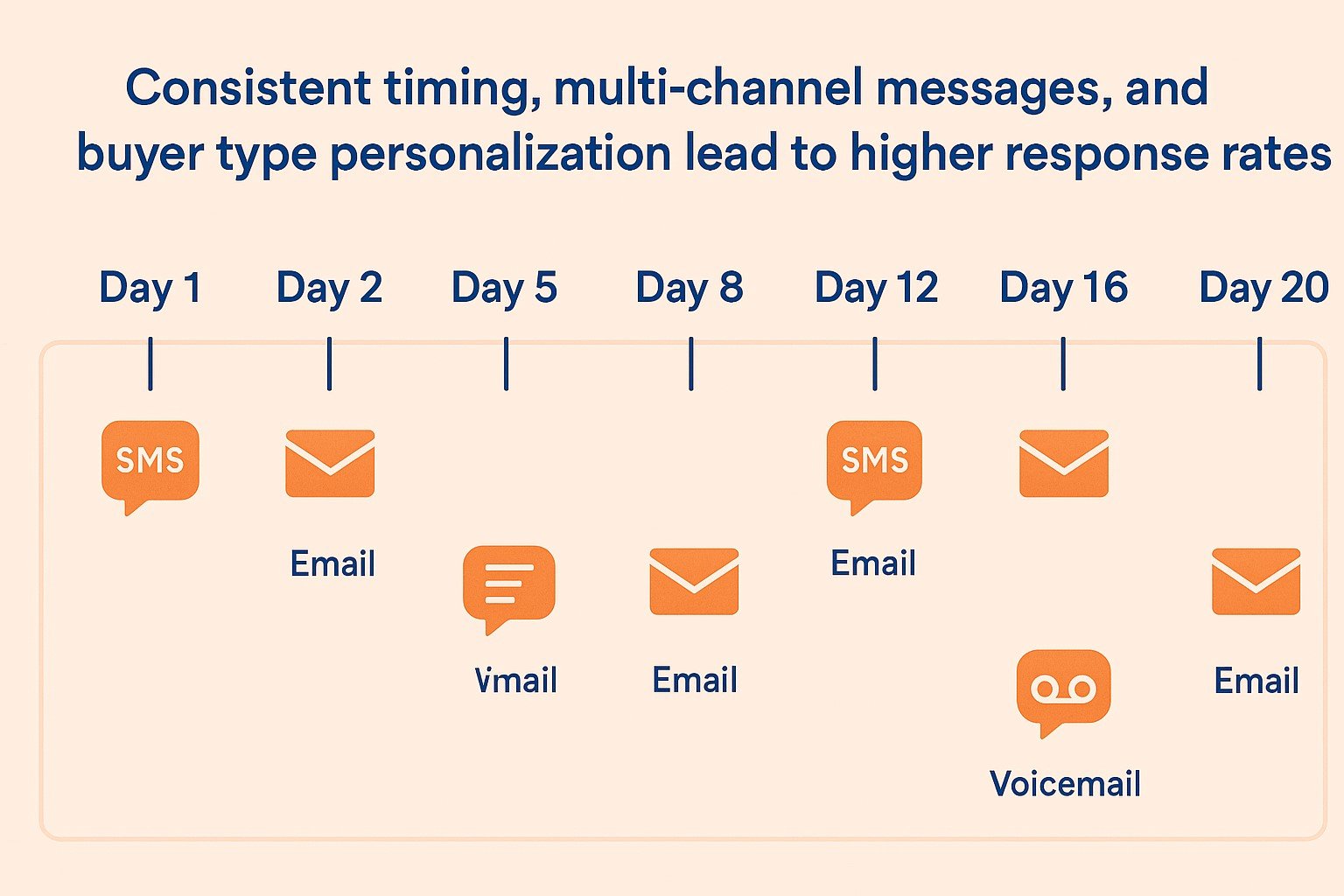
Use a responsive cadence rather than a rigid sequence. Follow up soon after a meaningful action, then give the buyer room to consider the information. Increase relevance when they engage and reduce frequency when they do not. The purpose is to remain available, not to create fatigue.
There is no universal schedule that fits every lead, parcel, or market. A buyer who requests maps and responds quickly may welcome a direct conversation. A person who only viewed a listing may need a lighter touch. Let behavior guide your timing.
Use engagement to choose the next contact
Prioritize actions that show intent over passive activity. A direct question, a request for documents, a reply to a text, or repeated attention to a specific parcel generally deserves a personal response. An email open alone is a weaker signal because it does not tell you why the prospect opened the message.
- When a buyer makes an inquiry, respond with the property information and one clear question about their intended use.
- When a buyer clicks a map, survey, or listing detail, follow up with context related to that item rather than restarting the whole pitch.
- When a buyer replies, pause automated messages and continue as a real conversation.
- When a buyer does not engage, space later outreach farther apart and change the value of the message.
- When a buyer asks to stop receiving messages, honor that request promptly and follow applicable communication rules.
Use the channel that fits the message. Email is generally better for maps, property details, disclosures, and a written explanation of the process. Text can work well for a short question or an alert that requested information has been sent. Voicemail can add a human touch when it is brief and gives the prospect an easy reason to return the call.
Before using text messaging or automated outreach, confirm that your practices, consent process, and opt-out handling are appropriate for the buyer’s location and your business. Communication rules can vary, and a qualified compliance professional can help you evaluate your process.
Do not manufacture urgency. If another buyer has made a real offer or the property is no longer available, communicate that accurately. If nothing has changed, do not imply that it has. False scarcity may get a short-term response, but it damages trust when the buyer recognizes the tactic.
What should you say in a land follow-up message?
A strong land follow-up message is short, specific, and easy to answer. It reminds the buyer why you are reaching out, offers one useful detail or next step, and asks a question that does not require a long reply.
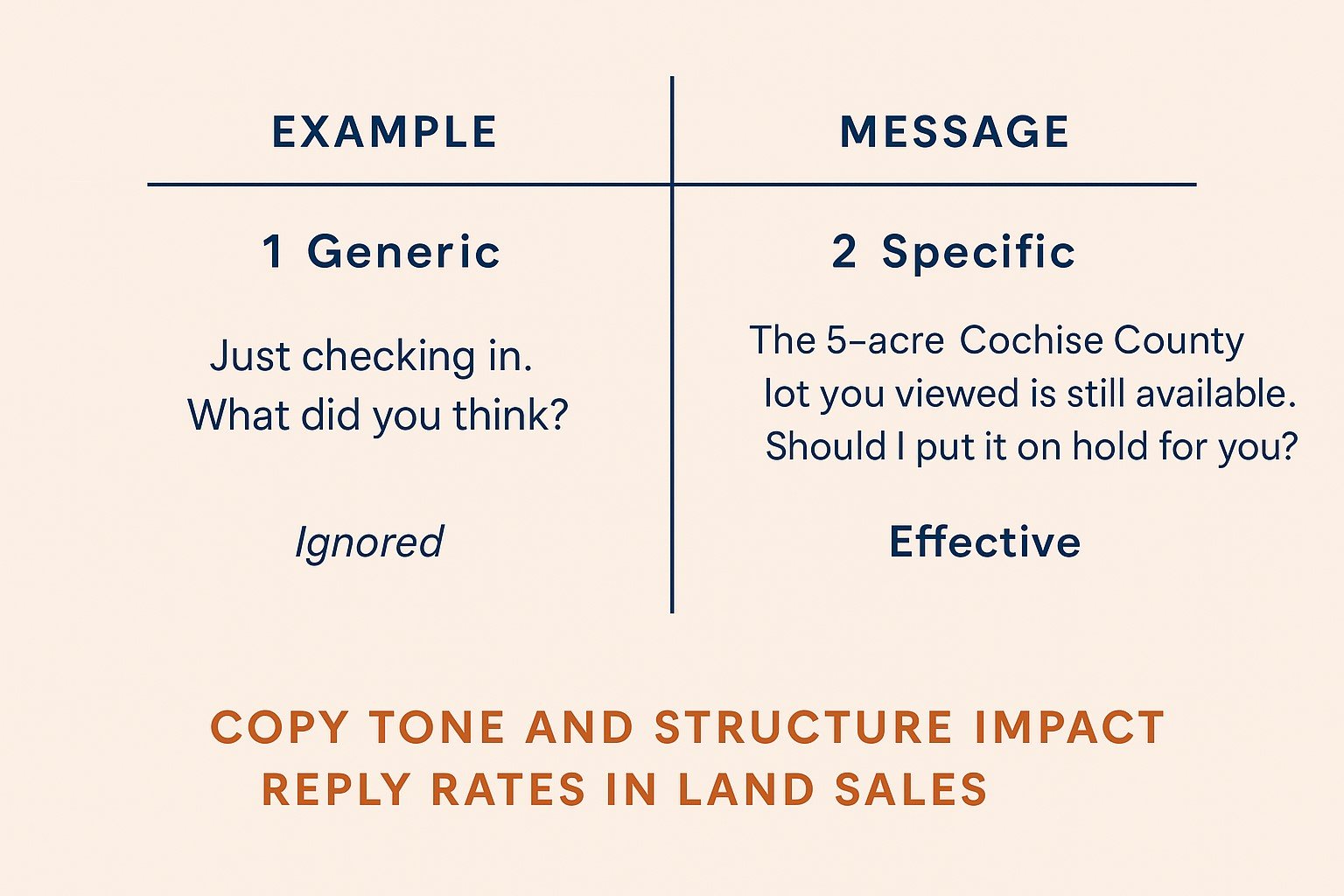
Avoid vague language such as “just checking in” when that is the entire message. A prospect may not know what to say back. Instead, give them a choice, ask about their goal, or offer a relevant document.
Use a simple message structure
- Identify the parcel or topic the buyer showed interest in.
- Reference a real concern, feature, or action connected to that interest.
- Offer one useful next step.
- End with one straightforward question.
Here are examples that can be adapted to your own facts and process:
- “Hi [Name], I’m following up on the parcel in [County]. You had looked at the access map. Would it help if I sent the map link and the parcel details together?”
- “Hi [Name], you mentioned you were considering land for [intended use]. What is the main item you still need to verify before deciding whether this parcel fits?”
- “I wanted to make sure you received the information on [Parcel]. Are you still evaluating this property, or would you prefer that I keep an eye out for something with different features?”
- “Thanks for your question about the closing process. I can outline the next step and the documents involved. Would you like that by email or text?”
Notice what these messages do not do. They do not make unsupported promises about the land. They do not pressure the buyer to act. They do not overload the reader with several questions at once. They make it easy to respond with a few words.
Personalization should be based on information the buyer actually provided or actions they actually took. Mentioning the county, parcel, map, acreage category, or stated goal can make the message more relevant. But do not pretend to know more than you do. A message that sounds overly familiar or uses inaccurate details can undermine confidence quickly.
How can automation keep follow-up personal?
Automation works best when it handles routine tasks while a person takes over when the buyer shows genuine intent or needs a specific answer. Automate reminders, property-information delivery, and internal task prompts. Keep nuanced questions, negotiations, and concerns about parcel suitability in a human conversation.
The practical way to think about automation is as a sorting system. It helps make sure leads do not disappear because someone forgot to follow up. It should not become a machine that keeps sending messages after a buyer has replied, opted out, purchased, or clearly moved on.
Build automation around meaningful buyer actions
- Tag the lead by the parcel or county that prompted the inquiry.
- Record the buyer’s stated purpose, such as recreation, investment, a future homesite, or an adjacent-land purchase.
- Send requested documents or links consistently.
- Create a task for a personal response when the buyer asks a detailed question.
- Stop or change the automated sequence when the buyer replies.
- Keep an accurate record of preferences, opt-outs, and property status.
Automation should also protect the quality of your communication. Review every template before it goes live. Check that merge fields work, parcel status is current, map links go to the correct property, and the message gives the recipient a clear way to respond or decline further contact.
A common mistake is relying too heavily on open and click data. These signals can be useful prompts, but they are not proof that a buyer is ready. Someone may open an email to find an address, forward it to a family member, or compare a property later. Treat behavior data as a reason to offer help, not as permission to pressure the prospect.
For a larger operating framework, including lead handling and systems that support a land business, see how to start and scale a land investing business.
How do you recognize when a buyer is ready for the next step?
A buyer is usually ready when the conversation becomes specific. They move beyond general interest and begin asking about documents, title, access, payment process, timing, or what they need to do next. At that point, stop sending broad nurture messages and provide a direct, organized path forward.
Readiness is not just fast replies. It is the quality of the buyer’s questions. A prospect who asks whether a parcel works for a particular purpose is still evaluating fit. A prospect who asks what information is needed to proceed is closer to a transaction decision. Both are valuable conversations, but they require different follow-up.
| Conversation stage | Buyer focus | Your best response |
|---|---|---|
| Exploring | General location and possibilities | Provide clear basics and ask about goals |
| Evaluating | Access, use, process, and parcel details | Share documents and identify local verification steps |
| Deciding | Agreement, title, and transaction process | Explain the next action clearly and answer final questions |
| Not a fit | Different needs or delayed plans | Close respectfully and retain accurate notes |
When the buyer is ready to move forward, make the next step simple. Explain what you will send, what information they should review, who handles which part of the process, and where they can ask questions. If the buyer needs legal, tax, land-use, financing, or title advice, direct them to an appropriate qualified local professional rather than trying to answer beyond your role.
For buyers considering a future build, it is especially important to distinguish a parcel’s appeal from its verified buildability. The process outlined in this guide to buying land and building a house can help frame the questions that should be verified before a buyer relies on a plan.
Which follow-up mistakes cost land investors trust?
The biggest follow-up mistakes are not usually about using the wrong software. They are about poor judgment: messaging too often without a reason, making claims that have not been verified, ignoring the buyer’s stated concern, or continuing automated outreach after the conversation has changed.
- Using generic scripts: A copied message tells the buyer that the parcel may not matter to you personally. Reference the actual inquiry and offer something relevant.
- Giving legal or land-use conclusions: Do not state that a buyer can use land in a certain way unless the claim is properly verified. Point them to the appropriate local source.
- Creating artificial urgency: Communicate real property status honestly. Do not invent competing interest or deadlines.
- Sending too much information at once: Buyers can become overwhelmed. Start with the question they care about and provide additional documents as needed.
- Failing to update records: An outdated parcel status, wrong county, or repeated message after an opt-out can damage credibility.
- Not asking for the real objection: A respectful question about what remains unclear often produces more useful information than another sales message.
The goal is not to force every lead toward a sale. The goal is to create a professional process where qualified buyers can get clear answers and unqualified buyers can exit without friction. That approach protects your reputation and leaves room for future opportunities when a buyer’s needs change.
What is a practical land follow-up workflow?
A practical workflow connects property facts, buyer intent, message timing, and accurate recordkeeping. It should be simple enough to use consistently and flexible enough to respond to real conversations.
- Respond to the inquiry with accurate parcel information and a question about the buyer’s intended use.
- Record the parcel, county, lead source, preferred contact method, and stated goal.
- Send the next message based on what the buyer viewed, asked, or replied to.
- Provide maps, documents, and process explanations in a format the buyer can review easily.
- Flag questions involving access, zoning, utilities, title, environmental conditions, or legal matters for appropriate verification.
- Move engaged buyers into a direct conversation rather than leaving them in a generic automated sequence.
- Respect nonresponse, opt-outs, and a buyer’s decision that the parcel is not a fit.
- Review your notes after each conversation so the next follow-up is relevant.
Good follow-up is ultimately a trust system. Be easy to reach, accurate about what you know, honest about what needs verification, and respectful of the buyer’s decision process. When a prospect is ready, they will remember the seller who made a complicated land decision feel clearer rather than more stressful.