

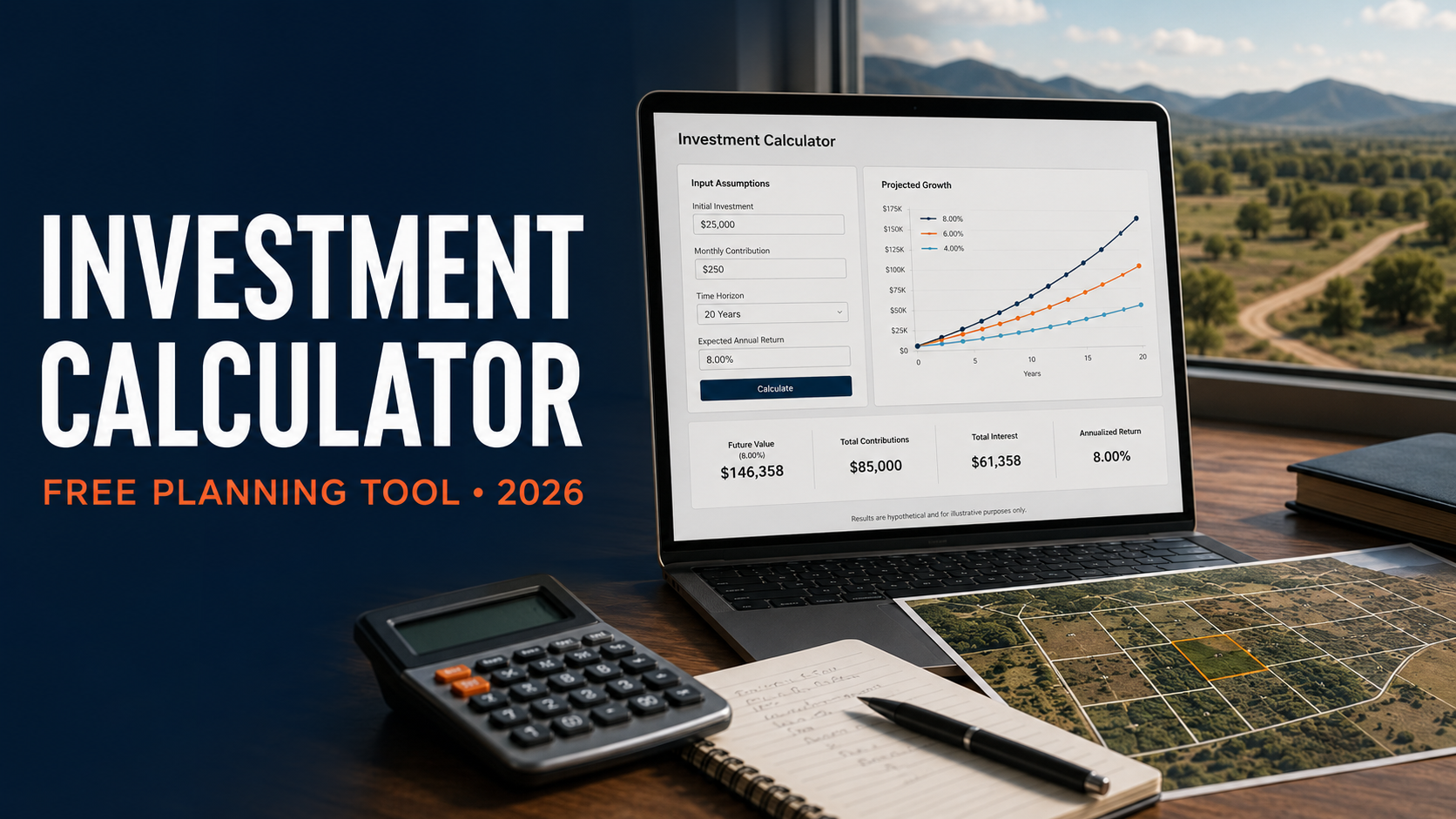

An investment calculator is a useful tool for land investors who want to estimate potential returns and evaluate investment scenarios. By entering specific data about your land purchase, holding costs, expected appreciation, and other factors, you can generate projections that help screen deals, compare options, and plan exit strategies. However, successful use requires accurate inputs and verification of key assumptions with local records and experts before making any commitments.
In this guide, you will learn how investment calculators work, what inputs matter most for land investments, how to interpret results realistically, and which checks can protect you from costly mistakes. A clear understanding of these points will help you make better-informed land investing decisions in 2026.
Using an investment calculator effectively can clarify your projected cash flow, timeline, and profitability for land purchases,critical factors that impact offer sizing, holding plans, and resale strategy.
What is an Investment Calculator and How Does It Work?
An investment calculator estimates potential future value or cash flow of an investment by applying mathematical formulas to the data you provide, typically using compound interest and cash flow projections.
This matters for land investing because land rarely generates steady income; its value depends on appreciation and resale timing. The calculator breaks down how your initial investment might grow over time, factoring in appreciation rates, holding costs, and income if any (like leasing or easements).
To verify the reliability of projections, check if the calculator’s assumptions fit your planned holding period and local market trends. Confirm with county records or local market reports what realistic appreciation and costs look like. A mismatch or lack of data here signals a higher risk or need to adjust your offer.
Calculation Methods Used in Investment Tools
Most calculators use compound interest formulas where returns earn returns over time, which magnifies growth with longer horizons. For income-producing land, they may also include expense deductions and cash flow inputs like rental income, factoring in vacancies and maintenance costs.
More advanced calculators may model fluctuating returns, reinvestment of income, or inflation adjustments, but you should always treat results as scenarios, not guarantees.
Which Inputs Are Necessary to Use an Investment Calculator Effectively for Land?
Key variables you must input reflect the purchase cost, expected appreciation, holding length, recurring expenses, and potential income sources,this allows the calculator to model outcomes grounded in your actual investment plan.
Accurate inputs let you screen deals quickly and identify risks before deeper due diligence.
Essential Inputs for Land Investments
- Purchase price and initial investment: The price you pay for the land, including closing costs.
- Expected annual appreciation rate: How much you realistically expect the land’s value to increase per year, based on local trends and zoning prospects.
- Holding period: The anticipated time you plan to own the property before selling or developing.
- Annual holding costs: Property taxes, insurance, maintenance (such as clearing or fencing), and fees. These reduce your net returns.
- Income, if any: Leasing, easements, or other revenue-generating uses that provide cash flow.
- Recurring contributions or improvements: Additional spending that affects basis or value, like land clearing or infrastructure installation.
Estimating Variables When Exact Data Is Missing
If precise estimates are unavailable, use conservative, research-based assumptions drawn from local county tax records, comparable sales data, or discussions with local real estate professionals. For example, if you don’t know the exact appreciation rate, identify the 5- or 10-year historical average in your target county and discount it slightly to avoid optimistic bias.
Always run multiple scenarios,best case, worst case, and likely case,to understand how sensitive your investment is to key variable changes. This helps set walk-away thresholds.
How Can Investment Calculators Help Compare Different Land Investment Opportunities?
Investment calculators let you input varying assumptions for multiple properties or deal structures side by side, helping visualize how returns, holding costs, and cash flow differ between options.
This comparison informs which property aligns best with your financial goals and risk tolerance. It is especially important when investing in alternative assets like land, where income is irregular or absent, and appreciation uncertainties are greater.
To verify differences, obtain parcel-specific details like zoning, road access, and utility availability from local government agencies. Differences in these factors can dramatically affect your projections and valuation.
Why Land Investments Differ From Traditional Assets in Calculations
Unlike stocks or bonds, land doesn’t usually pay dividends or interest. Its value growth depends on changing land use rules, development potential, or market shifts. Holding costs are paid out of pocket as the land sits unsold.
Therefore, calculators for land must adjust for illiquidity, irregular or nonexistent income, and holding cost drain. Comparing properties without these adjustments risks misleading conclusions.
What Unique Factors Must You Consider When Calculating Returns on Land Investments?
Land investing requires attention to zoning, environmental restrictions, access rights, property condition, and local market dynamics because these can greatly affect value and liquidity.
Return calculation must factor in these risk elements to produce realistic estimates that influence your offer, holding plan, and resale exit.
Verifying these factors up front with county zoning offices, environmental agencies, and title companies is critical. Negative findings here are red flags that can warrant renegotiating price or walking away.
Key Challenges in Projecting Land Investment Performance
- Zoning changes: A parcel may currently not allow development, limiting value, but a zoning change can increase potential or vice versa.
- Environmental restrictions: Wetlands, flood zones, or protected areas can restrict use and resale options.
- Access and utilities: Lack of legal road access or utilities can reduce marketability and increase costs.
- Holding costs without income: Unlike rental properties, land often generates no cash flow, so taxes and maintenance reduce net returns.
- Illiquidity and resale timing: Selling land can take months or years; your calculator’s holding period should reflect that realistic timeframe.
What Are the Limitations and Assumptions to Keep in Mind When Using Investment Calculators?
Investment calculators provide estimates based on fixed assumptions but cannot predict future market events, regulatory changes, or unexpected costs.
Results assume constant growth or expense rates and do not automatically factor in volatility, opportunistic sales, or tax impacts unless specified. Treat results as scenarios, not guarantees.
Check for assumptions that mismatch your local market or investment type; if calculator inputs can’t be verified by county records, sales comps, or professional advice, question the output validity.
Common Errors from Inaccurate Inputs
- Overestimating appreciation inflates value and ROI projections.
- Underestimating taxes, insurance, or maintenance leads to understating holding costs.
- Ignoring vacant periods or leasing downtime causes optimistic cash flow results.
Double-check your estimates with credible local sources and adopt conservative assumptions where uncertain to mitigate these errors.
How Do You Use an Investment Calculator for Land: Step-by-Step
- Gather property information: Purchase price, expected appreciation, holding period, property taxes, insurance, maintenance, and any income.
- Collect local data: Confirm zoning status with the planning office, research recent sales in the area, and find holding cost estimates from county records.
- Enter all data carefully into the calculator: Include all expected expenses, income, and contributions.
- Review outputs: Analyze projected future value, cash flow, net profit, and time needed to breakeven or achieve target returns.
- Test scenarios: Adjust inputs like appreciation rate and holding costs to see how changes impact results. Identify your minimum acceptable return or loss limit.
- Decide next steps: Use outputs as a screening tool. If projections lack alignment with your goals or reveal unfavorable outcomes, either negotiate terms or walk away.
For example, if a land parcel shows a projected 5% annual appreciation but confirmed local trends suggest 3%, update the input and reassess to avoid overpaying.
What Costs Should You Include for Accurate Investment Projections?
All relevant costs that impact your net return must be included in calculator inputs to avoid unrealistic profit projections.
Common costs include purchase price plus closing costs (title insurance, recording fees), annual taxes, insurance premiums, maintenance (clearing, fencing), management fees if applicable, and potential vacancy losses if renting.
Failing to include closing costs or recurring expenses often leads to overly optimistic forecasts and bad investment decisions.
Summary Table of Typical Land Investment Costs to Include
| Cost Category | What to Verify | Decision Impact |
|---|---|---|
| Purchase Price + Closing Costs | Title company, seller disclosures | Base investment amount affects ROI; underestimating increases risk |
| Property Taxes | County tax assessor | High taxes can erode cash flow; reassess if taxes spike after purchase |
| Insurance Costs | Insurance agents, agent estimates | Needed to avoid uninsured losses; high premiums reduce net return |
| Maintenance | Local contractors, past owner info | Neglecting adds risk of depreciation or fines; budget conservatively |
| Vacancy or Income Loss | Market rental vacancy stats | For leased land, plan for rental gaps; no rental income means costs fully out-of-pocket |
Why Should Beginners Use Investment Calculators in Land Investing?
Investment calculators transform complex financial concepts into straightforward projections, enabling beginners to visualize potential outcomes and understand key drivers of land investment returns.
This practical approach helps avoid common beginner mistakes like overpaying, ignoring holding costs, or underestimating time to resale. By experimenting with scenarios, newcomers build financial literacy, gain confidence, and establish realistic expectations.
Beginners should use calculators as decision frameworks,always combined with local due diligence and professional advice,to prevent costly surprises.
For example, a beginner can model how many years it may take for the expected appreciation to cover annual taxes and maintenance to break even, influencing whether a parcel fits their investment timeline.
Frequently Asked Questions About Investment Calculators
Can investment calculators predict exact returns for land?
No. They generate estimates based on provided inputs and assumptions but cannot forecast exact future returns due to market fluctuations, regulatory changes, or unforeseen expenses.
Are all investment calculators suitable for land investments?
No. Many calculators are designed for stocks or bonds and may not account for land-specific factors like zoning, irregular income, or holding costs. Make sure to use tools built or adaptable for land investing.
How often should I update inputs in my investment calculator?
Update inputs regularly to reflect changes in local market conditions, tax rates, or your investment goals. Current data ensures your projections remain relevant for ongoing decisions.
Do investment calculators automatically include taxes and fees?
Some calculators have inputs for taxes and fees, but many do not. You may need to add these costs manually or consult specialized tools to factor in tax implications accurately.
Can I rely solely on an investment calculator for a purchase decision?
No. Calculators are screening tools, not substitutes for thorough due diligence. Always verify key facts with county offices, title companies, and professionals before finalizing any land investment.