

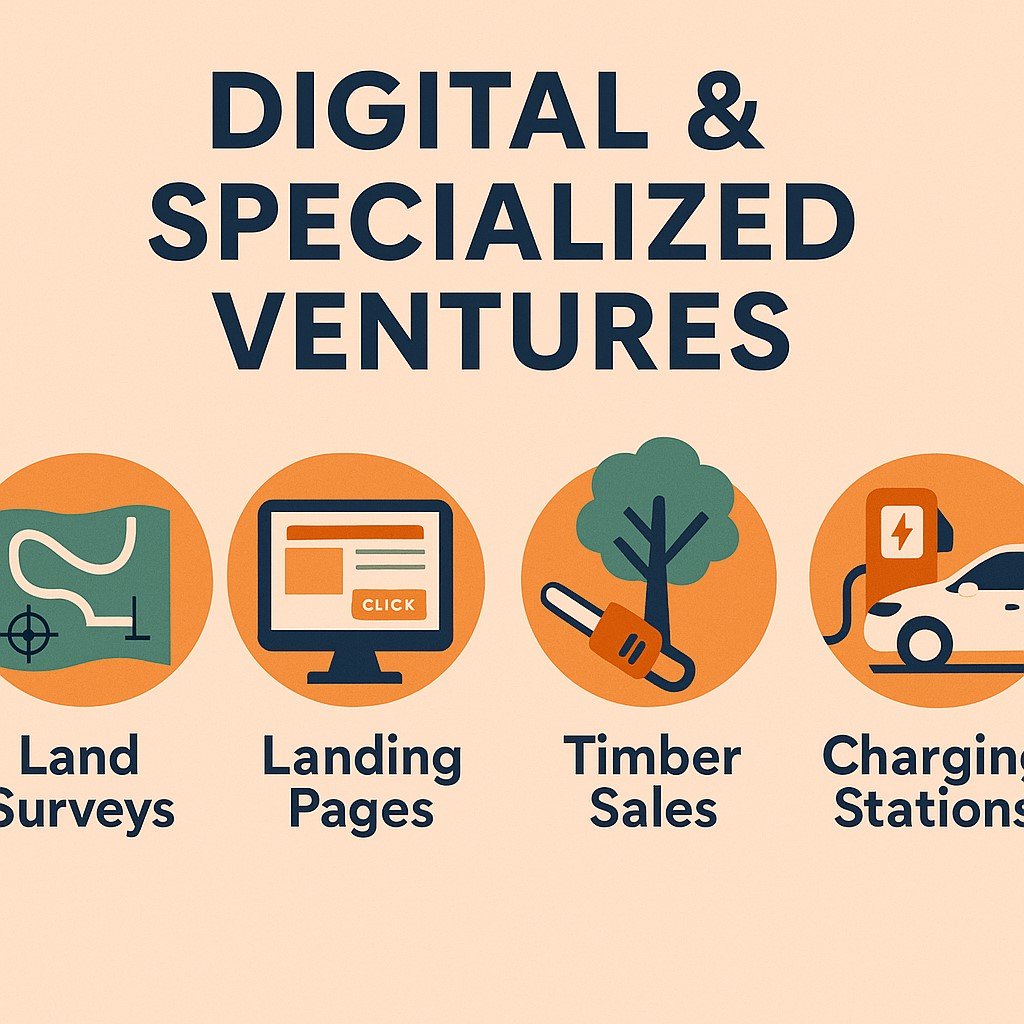

Digital and specialized land ventures can create additional ways to serve landowners, buyers, businesses, and local users without relying solely on a traditional flip or a long-term lease. The strongest model is usually the one that matches the parcel, your skills, local demand, and the approvals required to operate safely.
The practical approach is to separate opportunities into two categories. Digital ventures use your land knowledge to deliver a service, generate leads, or sell useful research. Site-based ventures put the land itself to work through storage, managed access, specialized uses, or partnerships. Before pursuing either path, confirm the real need, the operating burden, and the local rules that apply to the specific parcel.
What digital services can I offer with land survey drafting skills?
Land-related drafting can be a valuable service business when you support qualified surveyors, engineers, builders, or developers with organized CAD files and clear deliverables. The key is to understand the difference between drafting from supplied information and performing work that requires a licensed surveyor or other qualified professional.
AutoCAD Civil 3D and similar platforms can help organize topography, parcel data, utility information, grading concepts, and plan sets. However, a CAD drawing is not automatically a legal survey. Boundary determinations, certifications, stamped plans, and certain representations of property lines may require a properly licensed professional under local rules.
Build a repeatable drafting workflow
Start with a consistent intake checklist. Ask the client what source files they have, what format they need returned, what layers or standards they use, and whether the work is conceptual, construction-related, or part of a regulated survey process.
- Create templates for commonly used layers, labels, line types, and title blocks.
- Document the source of every file, measurement, and boundary reference.
- Use a clear naming convention so revisions do not overwrite prior work.
- Define what the client will receive, such as editable drawing files, PDF exhibits, terrain models, or quantity calculations.
- State in writing what your work does not include, especially legal boundary opinions or professional certifications.
A common mistake is accepting incomplete source information and trying to solve a title, boundary, or engineering problem inside a drafting assignment. Good drafting starts with good inputs. If the inputs conflict, flag the issue rather than guessing.
For buyers and investors who need to understand the role of surveys in a transaction, this guide to land surveys explains why the scope of work can vary so much by parcel and intended use.
How can landing pages help market land offers?
A landing page can help convert attention into a useful next step, such as an inquiry, property submission, consultation request, or buyer registration. It works best when the page focuses on one audience, one problem, and one clear action.
A generic website page often asks visitors to navigate, compare, and search. A focused landing page should reduce that friction. If you want landowners to submit a parcel for review, the page should explain the process, the information needed, and what happens after they inquire.
Match the offer to the visitor
A seller-facing page should not read like a buyer-facing page. A landowner may care about a simple process, clear communication, and whether the property type fits your criteria. A buyer may care about access, location, use potential, maps, and how to request more information.
- Use a headline that identifies the visitor and the reason they may be looking for help.
- Describe the next step without promising a result you cannot control.
- Ask only for information needed to begin evaluating the inquiry.
- Include a privacy explanation that accurately reflects how submitted information is handled.
- Make the page easy to use on a phone, since many inquiries begin there.
The best conversion improvement is often not a design trick. It is clearer qualification. If your form asks for county, parcel reference, access details, and the owner’s goal, you can spend less time chasing inquiries that do not fit your buying criteria.
How do I improve a land-offer landing page beyond the basics?
Improve a land landing page by making the visitor’s decision easier, not by adding more hype. A strong page answers the questions a serious prospect has before submitting information and routes qualified leads into a disciplined follow-up process.
Start by reviewing the page as if you were the visitor. Can someone tell who the page is for? Do they know what information to provide? Can they understand the next step without reading a long block of marketing copy?
Use a simple lead-handling system
The landing page is only the front door. The business value comes from what happens after the form is submitted. Build a process for acknowledging the inquiry, checking parcel basics, reviewing ownership and access, and deciding whether further conversation is warranted.
| Page Element | Purpose | What to Verify |
|---|---|---|
| Clear headline | Signals relevance | Matches the visitor’s search intent |
| Short form | Collects initial details | Fields support your screening process |
| Process summary | Sets expectations | Does not promise an outcome |
| Privacy notice | Explains data handling | Reflects actual business practices |
| Follow-up workflow | Moves leads forward | Assigned owner and response process exist |
Test one meaningful change at a time. For example, simplify the form, clarify the property types you consider, or improve the explanation of your review process. Changing everything at once makes it difficult to know what actually helped.
For broader ideas on using online tools to support land opportunities, see digital and creative strategies to monetize land.
Can affiliate marketing fit a land-focused website?
Affiliate marketing can fit a land-focused website when the recommendation is genuinely useful, clearly disclosed, and relevant to the reader’s question. It should support your editorial purpose, not distract from it or turn every visitor into a target for unrelated offers.
An affiliate relationship means you may receive compensation if someone takes action through a tracked link. Readers deserve to know that plainly. They also need realistic information about who a resource is for, what it covers, and where it may not be a fit.
Choose relevance over commission potential
A land investor researching access, due diligence, mapping, forestry, marketing, or operating systems may find certain tools useful. But the product should solve a real problem in the reader’s workflow. Avoid promoting a course, software tool, or service you cannot accurately describe.
- Disclose the relationship close to the recommendation.
- Do not imply that a product guarantees profits, deals, financing, or business results.
- Use only claims you can substantiate from the provider’s current materials.
- Do not use unapproved branding, testimonials, or comparison claims.
- Keep educational content useful even if the reader never purchases anything.
A common mistake is building a thin review page that repeats vendor copy. A better page explains the decision the reader is trying to make and gives them criteria for evaluating the resource independently.
How should I evaluate financing for an income-producing land project?
Financing can help fund a land project, but it should follow due diligence rather than replace it. Before applying for any agricultural, conservation, commercial, or conventional financing, understand whether the property use, borrower profile, project plan, and collateral are eligible for the program you are considering.
Government-related agricultural programs, private lenders, local banks, and specialty lenders may all evaluate a project differently. Eligibility, documentation, security requirements, use restrictions, repayment structure, and approval standards can change by program and location. Speak directly with the lender and qualified advisers before relying on assumptions.
Build the project plan before seeking capital
A lender or financing partner will generally need a coherent explanation of the project. That means more than an attractive idea. You should be able to explain the proposed use, site conditions, approvals needed, operating responsibilities, expected expenses, contingency plan, and how the project will be managed if demand is weaker than expected.
What matters here is the fit between the parcel and the use. A property that looks inexpensive may become difficult to finance if access, utilities, title, environmental conditions, zoning, or intended use create uncertainty.
Reviewing the fundamentals of land flipping can also sharpen the acquisition discipline that should come before any specialized development plan.
Can clearing trees create value on a land parcel?
Tree clearing can create value when it supports a well-defined land objective, such as improving access, creating a usable building area, reducing a hazard, or following a long-term forest management plan. It can also destroy value if clearing is rushed, poorly scoped, or done without understanding the timber, soil, drainage, and permitting issues involved.
Do not assume trees are simply an obstacle or that all timber has marketable value. Species, size, quality, accessibility, terrain, harvesting conditions, local demand, and buyer requirements all affect whether a timber sale or clearing project makes sense.
Start with an independent assessment
A qualified local forester can help identify species, stand condition, potential harvest approach, site impacts, and restoration needs. If timber is being sold, independent advice can help you understand what is being offered and how contract terms allocate responsibility.
- Confirm property lines before any cutting begins.
- Identify streams, wetlands, drainage paths, and sensitive areas.
- Check county and state requirements for harvesting, road work, and erosion control.
- Use a written agreement that addresses access, cleanup, damage, insurance, and timing.
- Plan for the condition of the land after equipment leaves.
Removing trees without a post-clearing plan is a classic mistake. Bare ground can create drainage, erosion, and maintenance problems. The land should be more usable after the work, not simply more exposed.
How do EV charging stations work as a land venture?
EV charging may be a potential site use for land with the right location, utility capacity, access, visibility, and nearby demand. It is not a passive plug-and-play opportunity. A viable site typically requires coordination among the landowner, utility, charging operator, contractors, local officials, and sometimes adjacent property owners.
The key is to evaluate the site before approaching the opportunity as a revenue stream. A charging provider may care about traffic patterns, dwell time, nearby destinations, electrical infrastructure, site control, safety, parking layout, and the ability to secure approvals.
Evaluate site control and utility constraints first
Start by confirming that you control the area needed for the project and that the proposed use is permitted or potentially approvable. Then ask the utility what information is required to evaluate service availability. Do not assume nearby power lines mean the site can support the equipment or load a charging project may require.
Any lease, license, operating agreement, or revenue-sharing arrangement should be reviewed carefully by qualified legal and financial professionals. Pay attention to site access, construction responsibility, maintenance, insurance, signage, restoration, exclusivity, assignment rights, and what happens if the operator stops serving the location.
Which niche ventures can monetize vacant land?
Niche land ventures can work when they use a property’s actual strengths instead of forcing a trendy business model onto the wrong site. A scenic parcel, a visible highway location, a secure industrial area, and a quiet rural tract each suggest different possibilities.
Potential concepts include managed outdoor recreation, agricultural support uses, event-related space, contractor staging, equipment storage, small-scale hospitality, specialty parking, or site services. Each use carries its own operational demands and approval questions.
Choose a concept using a parcel-first filter
Before spending money on infrastructure, evaluate the physical and legal realities of the parcel. Consider access, road condition, sight distance, parking, drainage, utilities, neighbors, noise, fire risk, environmental features, insurance availability, and local zoning.
Then validate demand with real conversations. Speak with potential users, nearby businesses, local operators, and the planning office. Online interest is helpful, but it is not the same as a customer willing to use the site under the conditions you can legally and safely provide.
How can outdoor storage become a land-based business?
Outdoor storage can be a practical land use for the right parcel because many users need secure space for vehicles, equipment, trailers, materials, or recreational assets. The model only works when the site is appropriate for storage and the operator can manage security, access, customer communication, maintenance, and compliance.
Storage is not merely putting a fence around a field. The condition of the entrance, turning space, surfacing, drainage, lighting, visibility, and traffic flow can determine whether the site is usable or creates recurring problems.
Verify the operational details
- Confirm that the zoning district permits the proposed type of storage.
- Check whether screening, setbacks, surfacing, fire access, or site-plan review may apply.
- Determine who will manage gate access, customer disputes, abandoned property, and maintenance.
- Use written customer agreements reviewed for local compliance.
- Confirm appropriate insurance needs with an insurance professional.
Automation can help with inquiries, reservations, access records, and reminders, but it does not replace management. A neglected storage site can create security issues, neighbor complaints, damage claims, and collection problems. Build the operations plan before inviting customers.
What land business models go beyond leasing and flipping?
Land knowledge can be turned into a service business, research business, or partnership role without requiring you to own every parcel involved. The best opportunity usually comes from solving a problem that landowners, buyers, investors, surveyors, or local businesses already have.
Examples may include parcel research support, acquisition screening, mapping coordination, landowner outreach, listing preparation, site-selection assistance, due-diligence organization, or referral relationships with appropriately qualified professionals.
Package a narrow, useful service
Instead of calling yourself a general consultant, define the decision you help a client make. You might help an investor organize county research before making offers, help a business identify parcels that meet stated criteria, or help a landowner prepare basic property information for a sale conversation.
Be careful about crossing into services that require licensure, such as legal advice, surveying, engineering, appraisal, brokerage, or environmental determinations. When a client needs a licensed expert, refer the matter to one.
What specialized skills improve land-venture decision making?
The most useful land education builds judgment, not just vocabulary. Look for training that helps you analyze parcels, ask better due-diligence questions, communicate with professionals, and create repeatable systems for acquisition, marketing, and operations.
Useful skill areas may include title review, county research, zoning interpretation, GIS and mapping, negotiation, direct-response marketing, property operations, forestry basics, utility research, and financial recordkeeping. Not every investor needs every skill. The goal is to know enough to identify risks and know when to bring in a specialist.
How to evaluate a course or educator
Review the curriculum, the intended audience, the level of support described, and whether the material explains limitations as well as opportunities. Be cautious with training that relies on vague success claims, urgency, or promises that skip the hard work of due diligence.
A thoughtful guide to evaluating land investing courses can help you compare educational options based on fit rather than marketing pressure.
What mistakes should I avoid with specialized land ventures?
The largest mistakes usually happen before the project begins: buying for an idea rather than a verified use, ignoring local approvals, underestimating operations, or signing an agreement without understanding the exit terms. Specialized ventures require more discipline, not less, because the moving parts multiply quickly.
- Do not confuse interest in a concept with verified local demand.
- Do not rely on verbal statements about zoning, access, utilities, or permitted uses.
- Do not spend on improvements before confirming the project can proceed.
- Do not represent yourself as qualified to provide regulated professional services when you are not.
- Do not assume a partner will handle every operating problem unless the agreement clearly says so.
- Do not ignore the cost, responsibility, and practical challenge of restoring the site if the venture ends.
The practical way to think about a specialized project is to ask: if this venture never launches, does the parcel still make sense? A land purchase with multiple viable paths is generally more resilient than one that only works if a single niche idea succeeds.
Mini FAQ
Do I need special software to offer digital land services?
You may need software that fits the service you provide, such as mapping, drafting, customer relationship management, or booking tools. Start with the workflow and client deliverable, then choose technology that supports it. Do not buy complex software before you have a clear service process.
Can I combine digital services and land ownership?
Yes. A land business can combine parcel acquisition, marketing systems, research support, and site-based uses. Keep each activity organized, document responsibilities, and avoid letting one venture distract from proper due diligence on another.
When should I contact local officials or professionals?
Contact the appropriate local office or qualified professional before relying on assumptions about zoning, permits, access, utilities, environmental conditions, timber activity, business licensing, or site operations. Early verification is usually far less expensive than correcting a bad assumption later.
What is the best first specialized land venture?
The best first venture is usually the one with the clearest demand, simplest operating plan, and strongest fit with your parcel and current capabilities. Start with research, verify the use locally, and choose a model you can manage responsibly rather than chasing the newest idea.