

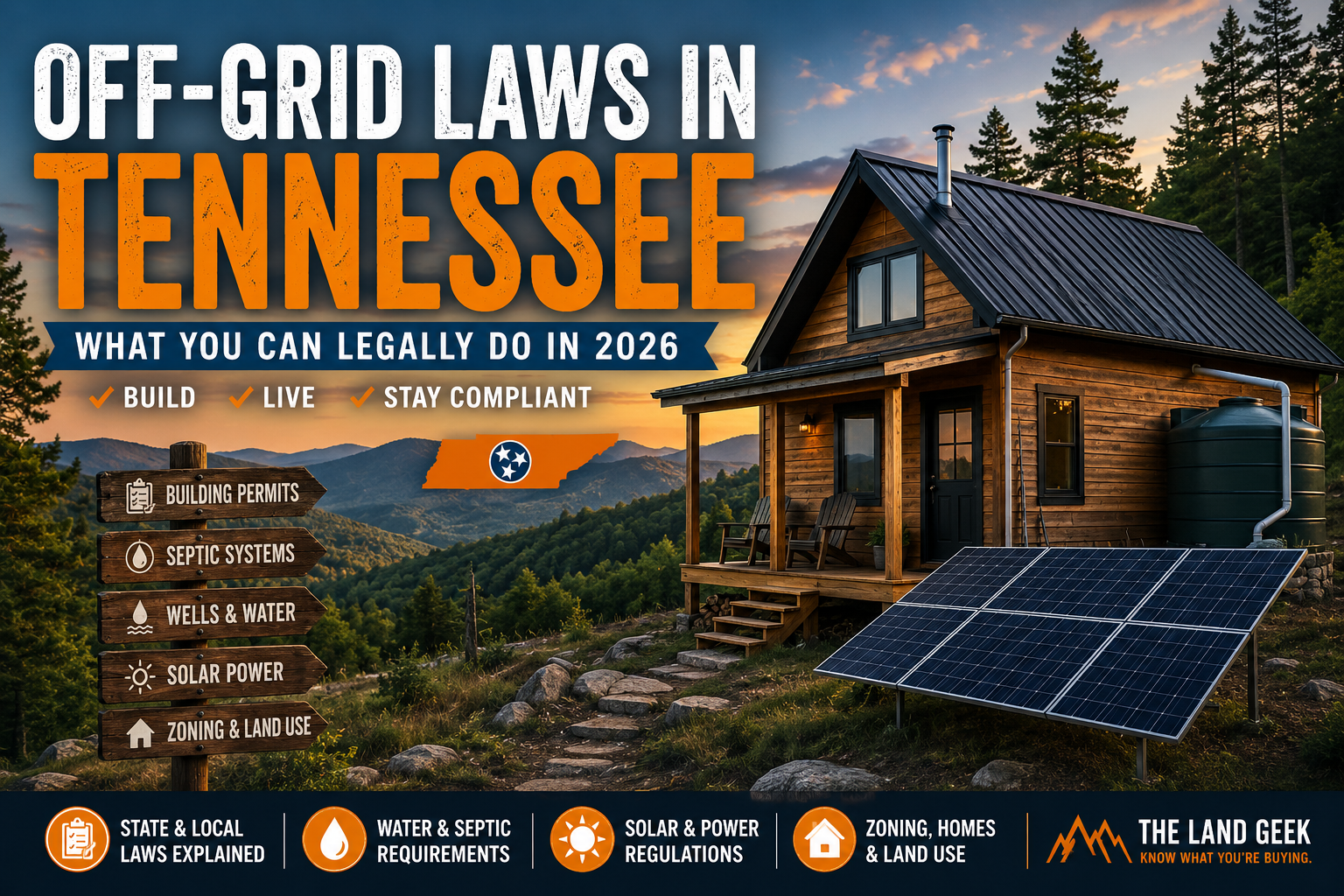

Yes, you can legally live off-grid in Tennessee, but “off-grid” does not mean exempt from building, wastewater, electrical, zoning, water, or health requirements.
The rules that affect an off-grid property come from a combination of Tennessee state law and local city or county requirements. Depending on where the land is located, you may need permits for the home itself, electrical work, a septic system, a well, or other parts of the project.
The biggest mistake buyers make is assuming that rural land automatically means they can build anything they want without permits. Tennessee can be attractive for self-sufficient living, but the legal feasibility of an off-grid project depends on the specific parcel and jurisdiction.
Before buying, verify zoning, legal access, building-code enforcement, wastewater options, water availability, electrical requirements, deed restrictions, and whether your planned type of dwelling is allowed.
Is Off-Grid Living Legal in Tennessee?
Yes. Living off-grid in Tennessee is generally possible when your property and systems comply with the laws and regulations that apply to the parcel.
Tennessee does not prohibit someone simply because a home produces its own electricity or uses a private water source. The legal issues arise from how the home is constructed, where wastewater goes, how electrical systems are installed, whether water systems comply with applicable requirements, and what the local zoning code allows.
That is why an off-grid buyer should think about individual systems rather than searching for a single “off-grid license.”
Does off-grid mean you can ignore building codes?
No. Disconnecting from public utilities does not automatically exempt a dwelling from applicable building-code and safety requirements.
Tennessee’s State Residential Building Code Enforcement Program applies to one- and two-family dwellings and townhouses in jurisdictions that have not qualified for an exemption or opted out of the state’s residential enforcement program.
The Tennessee Department of Commerce and Insurance explains the current residential permitting system on its official Residential Permits page.
Do local counties have different off-grid rules?
Yes. Local jurisdiction matters significantly because building, zoning, land-use, electrical and other requirements can vary between Tennessee counties and municipalities.
Some jurisdictions enforce their own building codes, some fall under state residential enforcement, and some have opted out of portions of the state program.
Always identify the actual city or county controlling the parcel before assuming what is allowed.
Is rural Tennessee automatically unrestricted?
No. Rural location does not automatically mean unrestricted use.
A rural parcel may still be affected by wastewater regulations, deed restrictions, subdivision rules, flood conditions, electrical requirements, road standards, environmental regulations and other limitations.
If you’re buying undeveloped acreage, use our vacant land due diligence checklist before relying on a listing’s claim that the property is “unrestricted.”
Do You Need a Building Permit for an Off-Grid Home in Tennessee?
A residential building permit may be required depending on where the property is located and which authority enforces residential codes in that jurisdiction.
The Tennessee State Fire Marshal’s Office administers residential building permits in areas covered by the state program. Other jurisdictions enforce their own local codes, while some jurisdictions have opted out of state residential enforcement.
This means the first question should not simply be, “Does Tennessee require a permit?” Instead ask, “Who has building-code jurisdiction over this parcel?”
How do you know whether a state residential permit is required?
Check whether your county or municipality participates in the Tennessee State Residential Building Code Enforcement Program or handles building enforcement locally.
The state’s Residential Permits resource provides current information about the program and where state permits apply.
Do this before purchasing land if your investment depends on constructing a residence.
Are sheds and barns treated the same as homes?
No. Tennessee’s state residential program distinguishes between dwellings and detached structures not used for living purposes.
The State Fire Marshal’s Office states that a state residential building permit is not required under its program for detached garages, sheds, barns or other detached structures that are not used for living purposes.
However, local zoning or building requirements may still apply, so do not assume that means every structure can be built anywhere without approval.
Can you build first and get the permit afterward?
That is a risky approach. Determine permit and inspection requirements before construction begins.
Permit requirements can affect foundations, electrical systems, plumbing, HVAC, wastewater and inspections. Discovering noncompliance after construction can create costly corrections.
Can You Build a Tiny Home Off-Grid in Tennessee?
Potentially, but a tiny home intended for residential use still has to fit within applicable zoning, construction, permitting and sanitation requirements.
The term “tiny home” does not create a blanket exemption from residential regulations.
A structure on a permanent foundation may be treated differently from a recreational vehicle, manufactured home, modular dwelling or portable structure.
Does Tennessee regulate non-traditional homes?
Yes. Tennessee provides specific guidance concerning ready-removables and non-traditional residential structures.
The State Fire Marshal’s Office explains that certain ready-removable structures cannot simply be modified for residential use. It also describes circumstances in which an off-site-built structure can instead be treated as a one- or two-family dwelling when applicable residential-code, foundation, permit and inspection requirements are satisfied.
Review Tennessee’s official guidance on ready-removables and non-traditional homes before buying a portable structure for permanent occupancy.
Can you permanently live in a shed in Tennessee?
You should not assume that a structure permitted or sold as a storage shed can legally become a residence.
Once a structure is used as a dwelling, residential building, sanitation, zoning and other requirements can apply.
If this is central to your off-grid plan, describe the exact structure to the local code authority before purchasing either the building or the land.
Can a tiny home be completely self-sufficient?
Technically it can use independent solar, battery, water and wastewater systems, but each system still needs to comply with applicable rules.
The question is not merely whether the technology works. It is whether the complete residential setup is legal on the specific parcel.
Can You Use Solar Power for an Off-Grid Home in Tennessee?
Yes, solar power can be part of an off-grid Tennessee property, but electrical installations remain subject to applicable electrical codes, permits and inspections.
Being disconnected from a utility does not mean electrical wiring becomes unregulated.
Tennessee’s electrical inspection program covers electrical installations in buildings and structures throughout much of the state, while certain cities and counties operate their own electrical programs.
Do you need an electrical permit for off-grid solar?
An electrical permit may be required depending on the installation and jurisdiction.
The Tennessee Department of Commerce and Insurance administers electrical permits and inspections throughout most of the state. Its Electrical Permits program explains how permits and inspections work.
Some jurisdictions are exempt from the state electrical program and instead use local permitting and inspection systems.
Does living off-grid eliminate electrical inspections?
No. Producing your own electricity does not automatically eliminate electrical safety requirements.
Battery banks, inverters, wiring, panels and connected equipment can still fall within applicable electrical codes.
Verify requirements before purchasing equipment or installing the system.
Can you stay connected to the grid and still use solar?
Yes. Some property owners use solar while remaining grid-connected, while others design fully independent systems.
If you connect generation equipment to a utility system, utility interconnection requirements can also become relevant.
Can You Drill a Private Well in Tennessee?
Private wells are an established water source in Tennessee, but well drilling and pump installation are regulated professional activities.
Tennessee’s Department of Environment and Conservation regulates water-well drillers and installers through the Division of Water Resources.
The state requires individuals who dig, drill, redrill or perform qualifying maintenance on wells, as well as certain pump and treatment installers, to hold the appropriate license.
Who can drill a water well in Tennessee?
Use an appropriately licensed Tennessee well driller for regulated well construction work.
TDEC provides the current licensing requirements through its Well Driller or Installer License program.
Before buying remote land, determine whether productive groundwater is realistically available and what drilling may cost.
Can you install your own well pump?
Do not assume that general contractor, electrical or plumbing credentials automatically authorize water-well pump work.
TDEC states that individuals installing or repairing qualifying well pumps and treatment devices must satisfy its water-well licensing requirements.
Should you check water before buying off-grid land?
Absolutely. Water feasibility should be investigated before purchasing land when a private supply is essential to your plan.
A low purchase price can become irrelevant if drilling is prohibitively expensive, water quality is poor or the site’s geology cannot reliably support your expected demand.
Can You Collect Rainwater in Tennessee?
Tennessee recognizes rainwater collection systems as one form of private water supply, but how collected water is used and treated still matters.
The Tennessee Department of Health lists wells, springs, rainwater collection systems, lakes and other surface-water sources among private water supplies used by Tennessee households.
That is different from saying untreated roof runoff is automatically safe to drink.
Is rainwater considered a private water source?
Yes. Tennessee health guidance recognizes rainwater collection systems as a private water source.
You can review the state’s information through the Tennessee Department of Health’s private water supply guidance.
Can you drink collected rainwater?
Do not assume collected rainwater is automatically safe for drinking.
The safety of a private water supply depends on source protection, storage, treatment, maintenance and water quality.
If rainwater is intended as potable water, obtain appropriate health and technical guidance before designing the system.
Should rainwater be your only water plan?
That depends on rainfall, roof collection area, storage capacity, household demand and backup options.
For land due diligence, calculate realistic dry-season storage requirements rather than assuming rainfall averages guarantee year-round supply.
Do You Need a Septic System for an Off-Grid Home in Tennessee?
If your property is not served by an accessible public sewer and uses a subsurface sewage-disposal system, Tennessee requires the appropriate septic permitting process.
This is one of the most important off-grid issues to investigate before buying Tennessee land.
TDEC’s Division of Water Resources administers the state’s Subsurface Sewage Disposal System program.
Do you need a permit before installing septic?
Yes. Tennessee requires a construction permit for installation of a conventional subsurface sewage disposal system.
TDEC specifically advises obtaining the septic permit before starting dirt work or construction of the building, including the building pad.
You can review the process on Tennessee’s official Septic Systems Permits page.
What if the soil will not support a conventional septic system?
Alternative systems may be possible in some situations, but additional soil evaluation and design requirements can apply.
TDEC offers conventional and alternative septic permitting pathways. Alternative systems are commonly considered where soil or site conditions are unsuitable for a conventional system.
This is why purchasing rural land before checking soil suitability can be expensive.
Can you use a composting toilet instead of septic?
Do not assume that installing a composting toilet automatically eliminates all wastewater requirements.
A household still produces graywater and other wastewater. The legal disposal method needs to comply with Tennessee and local requirements applicable to the site.
If a composting-toilet system is central to your plan, obtain a property-specific answer from TDEC and the applicable local authority before purchasing the land.
Can You Dump Graywater on Your Land in Tennessee?
You should not assume that household graywater can simply be discharged onto the ground because a property is off-grid.
Tennessee regulates wastewater disposal systems to protect groundwater and surface water.
Wastewater solutions that fall outside conventional septic treatment may require different approvals or operating permits depending on the system.
Why is wastewater one of the biggest off-grid risks?
Because a property can have plenty of acreage, excellent solar exposure and a usable well location but still be unsuitable for your intended residence if lawful wastewater disposal cannot be established.
Investigate wastewater before buying rather than after construction begins.
Can you use a holding tank?
Holding or pump-and-haul wastewater systems can fall within Tennessee’s water-quality permitting framework.
Do not treat them as an automatic substitute for a failed septic evaluation.
Does Tennessee Require You to Connect to Public Sewer?
Availability of an accessible public sewer can affect whether a private subsurface septic system is approved.
Tennessee’s subsurface sewage regulations state that a septic construction permit can be refused where an accessible public sewerage system exists.
That matters for buyers who specifically want to remain independent of municipal wastewater service.
Should you check sewer availability before buying?
Yes. Determine whether public sewer is accessible and whether connection requirements apply to the parcel.
Do this before assuming septic will be permitted simply because the lot is large enough.
Do Tennessee Zoning Laws Affect Off-Grid Living?
Yes. Zoning and land-use rules can affect what structures and activities are allowed on an off-grid property.
There is no single Tennessee zoning rule that applies identically to every rural parcel.
Local zoning may address residential use, agricultural activities, minimum lot size, setbacks, accessory structures, RV occupancy, manufactured housing, livestock, home businesses and subdivision.
Can agricultural zoning make off-grid living easier?
Sometimes agricultural or rural zoning can provide more flexibility for certain activities, but it should never be assumed to waive residential, septic, building or health requirements.
Read the actual local ordinance and discuss your intended use with the planning department.
Can you put multiple off-grid homes on one property?
Possibly, but dwelling density, subdivision, septic capacity, access and zoning requirements can affect whether multiple residences are allowed.
Do not value acreage based on an assumed ability to add multiple homes until the local jurisdiction confirms that strategy is feasible.
Can an HOA restrict off-grid systems?
Private covenants can create restrictions separate from government zoning.
A property may satisfy county requirements and still be subject to deed restrictions or HOA rules affecting structures, solar equipment, animals, exterior appearance or other uses.
Can You Live in an RV on Your Tennessee Land?
Owning land does not automatically create a statewide right to permanently use an RV as a residence.
RV occupancy can be affected by zoning, sanitation, building rules, campground regulations and local ordinances.
If living in an RV is part of your off-grid plan, ask the local planning and codes office specifically whether full-time occupancy is permitted on the parcel.
Can you live in an RV while building?
Possibly in some jurisdictions and under certain conditions, but temporary construction occupancy should be verified locally.
Do not assume a building permit automatically authorizes RV occupancy.
Can you put several RVs on rural acreage?
That can trigger different zoning, campground, sanitation or land-use requirements.
If your plan involves multiple RV sites, treat it as a separate development-use question rather than ordinary single-family off-grid living.
Can You Have Livestock on Off-Grid Land in Tennessee?
Potentially, but livestock rights depend on the property’s zoning, acreage, local ordinances and private restrictions.
Rural appearance does not guarantee unrestricted animal use.
Check whether the parcel allows the species and number of animals you intend to keep and whether setbacks or waste-management requirements apply.
Can you grow your own food?
Personal gardening is generally a much simpler land-use issue than operating a commercial agricultural enterprise.
If you plan to sell produce, process food, operate a farm business or construct substantial agricultural facilities, additional rules may apply.
Can You Burn Brush or Waste on Off-Grid Property?
Do not assume rural ownership gives you unrestricted burning rights.
Open burning can be regulated by state fire-safety and environmental rules, and seasonal or local restrictions can apply.
Before clearing land by burning, check current Tennessee and local requirements.
Can You Build an Off-Grid Home Anywhere in Tennessee?
No. Whether a parcel works for an off-grid home depends on zoning, buildability, access, soil, wastewater, water, electrical requirements, flood exposure, private restrictions and other property-specific conditions.
The cheapest rural land is not necessarily the best off-grid land.
A slightly more expensive parcel with legal access, suitable soils, good solar exposure and a practical water solution can be far more valuable than a cheaper parcel with unresolved development problems.
What Should You Check Before Buying Off-Grid Land in Tennessee?
Before buying Tennessee land for off-grid living, verify every major system you expect the property to support.
At minimum, investigate:
- Exact zoning classification
- Permitted residential use
- Building-permit jurisdiction
- Type of dwelling allowed
- Minimum lot requirements
- Setbacks
- Legal access
- Road quality and maintenance
- Septic feasibility
- Soil conditions
- Private well feasibility
- Rainwater-storage feasibility
- Electrical permit requirements
- Solar exposure
- Flood zones
- Streams and wetlands
- Topography
- Deed restrictions
- HOA restrictions
- Property taxes
- Comparable land sales
- Resale demand
Our 100-step land due diligence checklist provides a broader framework for investigating a parcel before closing.
What Should You Ask the County Before Buying?
Give the county or city the parcel number and describe exactly what you intend to build and how you plan to handle power, water and wastewater.
Specific questions produce better answers than simply asking, “Can I live off-grid here?”
Ask:
- Is a full-time residence permitted on this parcel?
- Which building-code authority has jurisdiction?
- What type of residential permit is required?
- Are tiny homes permitted?
- Are manufactured or modular homes permitted?
- Can an RV be occupied temporarily or permanently?
- What are the minimum lot size and setbacks?
- Does the parcel have any overlay zoning?
- Are there restrictions on solar installations?
- Are there local requirements beyond Tennessee’s septic rules?
- Can livestock be kept?
- Can additional dwellings be added?
What Should You Ask TDEC Before Buying?
If your off-grid plan depends on private wastewater or water systems, verify those systems with the Tennessee Department of Environment and Conservation before closing.
Important questions include whether the site can support septic, what type of soil evaluation is required, whether an alternative wastewater system may be necessary, and how well construction should be handled.
TDEC’s environmental permitting portal provides access to current water, wastewater and well-related programs.
What Are the Biggest Mistakes Off-Grid Buyers Make in Tennessee?
The biggest mistake is buying land first and investigating legal feasibility afterward.
A parcel may look ideal on satellite imagery but fail on one essential issue such as septic, legal access or residential use.
Mistake 1: Assuming “unrestricted” means no rules
Seller language is not a substitute for checking government regulations and recorded private restrictions.
Mistake 2: Checking power but ignoring wastewater
Solar is often technically solvable. Wastewater can be much more parcel-specific because soil and site conditions determine what systems are feasible.
Mistake 3: Buying land without legal access
A property can appear accessible on a map while lacking a recorded right to enter.
If access is questionable, review our guide to buying land without road access.
Mistake 4: Assuming any tiny home can be occupied
The legal classification and construction of the structure matter. A shed, RV, ready-removable building, manufactured home and code-compliant dwelling can be treated differently.
Mistake 5: Ignoring resale
Your off-grid setup might work perfectly for you but still have limited buyer demand.
If you’re purchasing for investment, evaluate the likely resale market before committing capital.
Is Tennessee a Good State for Off-Grid Land?
Tennessee can be attractive for off-grid buyers because it offers substantial rural acreage and multiple private-water and renewable-energy options, but the quality of an off-grid property depends on the individual parcel rather than the state alone.
What matters most is finding land where your intended residential use is allowed and where water, wastewater, access and power are realistically achievable.
If you’re purchasing land as an investment rather than solely for personal use, our land investing guide explains how due diligence, acquisition price, buyer demand and exit strategy fit together.
Frequently Asked Questions About Off-Grid Laws in Tennessee
Is it legal to live completely off-grid in Tennessee?
Yes, off-grid living can be legal in Tennessee when the dwelling and its water, wastewater, electrical and other systems comply with applicable state and local requirements. Being disconnected from public utilities does not create an exemption from those rules.
Can you legally live without electricity in Tennessee?
There is no general requirement that an off-grid residence purchase electricity from a utility simply because it is occupied. However, any electrical system installed in the dwelling must comply with the permitting and safety requirements that apply to the property.
Can you use solar panels off-grid in Tennessee?
Yes, solar can provide electricity to an off-grid property. Electrical permits and inspections may still apply, and some jurisdictions operate their own electrical inspection programs rather than the state program.
Can you collect rainwater in Tennessee?
Tennessee health guidance recognizes rainwater collection systems as a type of private water supply. If collected water will be used for drinking, appropriate treatment, storage and water-quality considerations are essential.
Can you drill your own well in Tennessee?
Tennessee regulates the digging, drilling and redrilling of water wells and requires appropriate professional licensing for regulated well-drilling and installation work. Verify the current TDEC requirements before beginning a well project.
Do you need a septic permit in Tennessee?
Yes, installation of a subsurface sewage disposal system requires the applicable Tennessee construction permit. TDEC advises obtaining septic approval before starting dirt work or construction of the residence.
Can you use a composting toilet instead of septic?
A composting toilet does not automatically eliminate wastewater requirements because the property may still generate graywater or other household wastewater. Obtain a property-specific answer from the relevant Tennessee and local authorities.
Can you live in a tiny home off-grid in Tennessee?
Potentially, but the structure must satisfy applicable zoning, residential-code, sanitation, permit and classification requirements. Do not assume that being small or movable makes a structure exempt.
Can you live permanently in an RV on your own Tennessee land?
Not automatically. Permanent RV occupancy can depend on local zoning, sanitation and land-use regulations. Verify the rules for the specific parcel before purchasing.
Do rural Tennessee counties have building codes?
Building-code enforcement varies. Some areas are covered by Tennessee’s state residential enforcement program, some enforce local codes, and others have opted out of the state residential program. Determine the authority responsible for the parcel before building.
Can you build a cabin without utilities in Tennessee?
Potentially, but a cabin intended as a residence still has to comply with the requirements applicable to residential construction and sanitation. Lack of utility connections does not automatically make a residential structure exempt.
What is the most important thing to check before buying off-grid land?
Verify that the parcel can legally and practically support your intended residence, especially zoning, legal access, septic feasibility and water. If any one of these fails, the property may not work for your off-grid plan.
The Bottom Line
Off-grid living is possible in Tennessee, but you cannot assume that buying rural land gives you unlimited freedom from building, electrical, wastewater, water or local land-use rules.
The strongest off-grid property is not simply the cheapest or most remote parcel.
It is land where the intended dwelling is permitted, legal access is established, wastewater is feasible, water is dependable, power can be safely installed and private restrictions do not undermine your plan.
Before buying, identify the jurisdiction, talk to the local planning and codes departments, verify septic feasibility with TDEC, investigate your water source and confirm electrical requirements.
Then evaluate the property as a land buyer:
Can this specific parcel legally and practically support the off-grid lifestyle that gives it value?
If you can answer that question before closing, you dramatically reduce the chance of buying rural land that looks perfect online but cannot support the life you planned for it.