

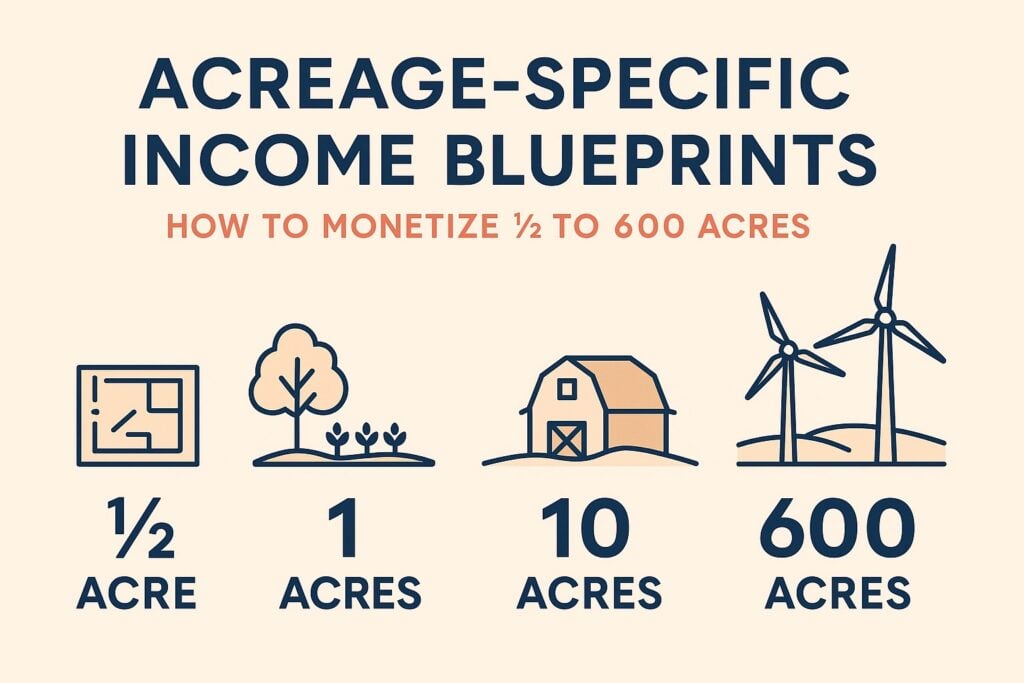

The best way to monetize land is not to start with acreage alone. Start with the parcel’s legal uses, access, water, power, terrain, neighborhood demand, and the amount of management you are willing to take on. Acreage matters because it limits scale, but a well-located half-acre can be more useful than a remote larger tract with no practical access.
The practical way to think about land income is to match the use to the land’s strongest feature. Small parcels often work best for intensive uses or simple storage. Mid-sized acreage can support agriculture, recreation, or carefully planned events. Larger tracts may create opportunities for leases, timber, habitat, recreation, or phased development. None of these uses is automatic income. Each requires local due diligence, a viable customer base, and a clear operating plan.
What should you verify before choosing an acreage-specific income strategy?
Before choosing a strategy, confirm what the parcel can legally and physically support, then test whether real local demand exists. A promising idea can fail quickly if access, zoning, water, setbacks, insurance, or neighborhood compatibility were treated as afterthoughts.
Begin with a written property profile. This is more useful than jumping straight to a business idea because it helps eliminate uses that do not fit the land.
- Legal use: Ask the planning or zoning office about permitted uses, conditional uses, parking, signs, events, camping, agricultural activity, and any applicable restrictions.
- Access: Confirm legal, practical road access. A visible path is not necessarily a recorded access right.
- Utilities and water: Identify available power, water source options, wastewater limits, and whether service extensions are realistic for your plan. Review the factors involved in the cost to run power to rural land before treating utility access as a minor detail.
- Terrain and drainage: Walk the parcel after weather changes if possible. Note slopes, low areas, erosion, shade, soil conditions, and usable flat ground.
- Restrictions: Review deed restrictions, homeowners association rules, easements, conservation limitations, and recorded agreements.
- Demand: Look for actual evidence that people need the use you are considering. Existing competitors, local listings, conversations with prospective users, and county activity can reveal more than assumptions.
A common mistake is evaluating only the acreage shown on a listing. The usable area may be much smaller once you account for setbacks, steep ground, wetlands, access lanes, drainage, utility corridors, and space needed for parking or turnaround.
How can you make money with half an acre of land?
Half an acre is usually best suited to an intensive, low-footprint use rather than a broad-acre project. The strongest candidates are uses that depend on location, convenience, or specialized production rather than sheer land area.
Depending on local rules and site conditions, possibilities may include a small nursery, specialty plants, cut flowers, culinary herbs, produce grown in beds or containers, equipment storage, or a simple parking or storage use. A residential-area parcel may have a very different opportunity set from a rural parcel near recreation traffic.
For a small growing operation, verify water reliability, sunlight, soil quality, wash or packing requirements, and where the product will be sold before planting. A small plot can produce a great deal of work, so choose a crop or product with a clear sales channel rather than growing first and looking for buyers later.
For vehicle or recreational parking, do not assume gravel and an online listing are enough. Verify land-use permission, access safety, drainage, fire access, sanitation expectations, occupancy rules, insurance needs, and neighbor impact. The use may be viable, but the operating details determine whether it stays manageable.
How can you make money with one acre of land?
One acre can support a focused land business if the site is easy to reach and the owner keeps the plan simple. The best one-acre ideas typically use the land efficiently and avoid infrastructure that the parcel cannot justify.
A small plant nursery, community garden, apiary, specialty crop operation, storage yard, or permitted short-stay use may fit an acre in the right location. Combining uses can work, but only when they complement one another. For example, a nursery and seasonal plant sales may share water, access, and customer traffic. An event use and quiet specialty agriculture may conflict.
Community garden concepts deserve a reality check before installation. Confirm who will manage plot assignments, water access, common areas, trash, disputes, and end-of-season cleanup. The landowner is still responsible for the overall condition of the property, even if individual users maintain their own spaces.
If your one-acre plan involves a tiny home, cabin, tent, or other overnight structure, start with local rules instead of marketing. This tiny home land checklist can help identify questions about placement, utilities, access, and local approvals that should be answered early.
How can you make money with two acres of land?
Two acres may offer enough room to separate customer activity from production or storage, but it is still a small site from a permitting and traffic perspective. Choose a use that works without creating congestion, noise, or expensive site improvements.
Potential directions include specialty agriculture, a modest plant operation, animal-related uses where permitted, storage, a small farm stand, or limited agritourism. The key is to build around a clear use case. A roadside parcel with safe entry may favor retail or farm-direct sales. A more private parcel may be better for production, storage, or a lease to a qualified local operator.
Before allowing livestock on a small parcel, verify local animal rules, fencing requirements, water, shelter, manure handling, predator pressure, and responsibility for veterinary care. A grazing arrangement can sound passive, but poorly defined responsibilities can create expensive conflict. Use a written agreement reviewed by an appropriate local professional.
How can you make money with three acres of land?
Three acres can support a small specialty farm or a more deliberate visitor-facing concept, provided the site can safely handle customers. This acreage is often large enough to create separate zones for production, access, parking, and a buffer from neighboring properties.
Specialty flowers, herbs, nursery stock, mushrooms in appropriate controlled settings, fruit production, and seasonal pick-your-own concepts are possible examples. The land itself does not make these businesses work. The operator needs production knowledge, a sales plan, and a realistic understanding of labor.
If visitors will come to the property, map the entire customer path: entrance, signs, parking, walking areas, restrooms where required, payment point, emergency access, and exit. A common mistake is focusing on the attractive field or crop while overlooking traffic circulation and liability exposure. For a fuller review of this risk area, see the guide to liability insurance for vacant land.
How can you make money with five acres of land?
Five acres can accommodate a mixed-use plan, but only if each use has a defined area, access route, and manager. The goal is not to put every possible revenue idea on the property. The goal is to create a land-use plan that is operationally coherent.
A five-acre parcel may support combinations such as an apiary beside compatible crops, a nursery with a farm-direct sales area, pasture with a carefully managed lease, or managed woodland with recreational access where allowed. Make a simple site map before committing: show entrances, internal lanes, water points, buildings, customer areas, storage, and no-access zones.
Beekeeping is a good example of why parcel fit matters. Hives need appropriate placement, access for maintenance, forage in the surrounding area, and consideration for nearby homes, animals, and public activity. The landowner should also understand who is responsible for routine care, harvesting, product handling, and claims arising from the operation.
How can you make money with seven acres of land?
Seven acres may create room for a larger agricultural use, storage, recreation, or a permitted event concept, but subdivision and venue plans require especially careful local review. More acreage does not eliminate approval requirements, infrastructure constraints, or community concerns.
Subdivision should never be treated as a simple drawing exercise. Feasibility can depend on frontage, road standards, utility access, soil conditions, drainage, environmental constraints, survey work, and local approval processes. Start by understanding the parcel boundaries and recorded access. A land survey at closing guide is useful context for understanding why clear boundaries and encroachments matter before planning a new layout.
For an event-oriented use, verify parking capacity, noise limits, hours, restroom requirements, emergency access, fire safety, alcohol rules where applicable, and whether the local jurisdiction views the activity as commercial. An attractive open field is not automatically an event venue.
How can you make money with ten acres of land?
Ten acres can support a more established agricultural, recreational, storage, or hospitality-oriented concept, but the right choice depends on water, access, location, and the owner’s ability to operate or supervise the use.
Orchards, vineyards, specialty livestock, plant nurseries, seasonal recreation, managed hunting where lawful, or a combination of pasture and forestry may be considered. Some uses take significant lead time before they become commercially useful, while others may require substantial ongoing customer service. Decide whether you want an operating business or a lease-oriented arrangement.
The distinction matters. Operating a farm store or visitor experience requires marketing, staffing, maintenance, customer service, product handling, and compliance. Leasing pasture or allowing a qualified operator to use part of the land may reduce hands-on involvement, but it still requires careful tenant selection, written terms, site rules, and oversight.
How can you make money with twenty acres of land?
Twenty acres can offer meaningful flexibility for timber, agriculture, recreation, leases, or phased improvements. At this size, the highest-value decision is often identifying which portions of the parcel should remain untouched and which areas are truly suited to active use.
Start with a land inventory. Separate woodland, open ground, drainage areas, road frontage, higher ground, utility-adjacent areas, and sensitive habitat. Then compare potential uses against the physical map. This prevents the common error of planning an intensive use on the wrong portion of an otherwise attractive tract.
For timber, consult a qualified forestry professional familiar with the local market and species before signing a harvest agreement. For renewable-energy interest, do not assume acreage alone creates value. Developers typically evaluate transmission access, site control, topography, environmental constraints, permitting risk, and project economics. Have any proposed lease reviewed by appropriate legal and financial advisers before granting long-term control of the property.
How can you make money with one hundred acres of land?
One hundred acres can support larger lease, forestry, recreation, conservation, agricultural, or development discussions, but larger scale also increases the consequences of weak due diligence. Professional input becomes more important when a decision could affect substantial portions of the property for a long time.
Potential strategies include leasing portions for agricultural use, managing timber, granting recreational access where appropriate, holding land for a future buyer profile, or exploring developer interest in suitable locations. Rather than committing the whole tract to one idea, consider whether a phased plan preserves flexibility.
For example, a landowner might identify an area with reliable access for active use while retaining another area for timber, habitat, or future optionality. The key is to avoid signing away rights that could interfere with access, future division, mineral interests, recreation, or a later sale. Every major agreement should clearly address access, maintenance, insurance, restoration obligations, assignment rights, and termination conditions.
How can you make money with six hundred acres of land?
Six hundred acres can support an integrated land-use strategy, but it should be managed as a portfolio of distinct zones rather than one giant project. The best plan protects the tract’s long-term flexibility while assigning each area a purpose based on its physical characteristics and market fit.
Large acreage may include areas suited to timber management, agricultural leases, recreation, habitat protection, water resources, or potential development review. The first task is not monetization. It is control: confirm boundaries, access points, encroachments, road maintenance responsibilities, water features, existing agreements, and title exceptions.
Use a written management framework that identifies who can enter the property, what activities are allowed, how damage is reported, where records are kept, and how lease or operating decisions are reviewed. If multiple operators are involved, establish boundaries and communication rules so one use does not interfere with another.
What are the biggest mistakes when monetizing land of any size?
The most expensive mistakes usually come from treating land income as a listing or marketing problem when it is really a property-control and operations problem. A strong idea still needs legal permission, physical feasibility, demand, and a workable management system.
- Assuming a use is allowed because a nearby property appears to do something similar.
- Ignoring recorded easements, boundaries, access rights, or deed restrictions.
- Building improvements before confirming drainage, permits, setbacks, and utility requirements.
- Choosing a crop, event, or storage use without validating local customer demand.
- Using verbal agreements for grazing, storage, recreation, or access.
- Overbuilding before testing a simple version of the business model.
- Failing to account for ongoing maintenance, security, insurance, cleanup, and neighbor relations.
How should you choose the right land-income blueprint?
Choose the strategy that fits your parcel’s verified capabilities, not the strategy that sounds most exciting online. The right blueprint has a clear legal path, practical access, manageable infrastructure needs, genuine demand, and responsibilities you are prepared to handle.
Start with one primary use and one backup use. Test the primary use with local officials, prospective customers or operators, and qualified professionals where needed. If the idea depends on building, grading, access changes, or site work, understand the local process first. The guide to a grading permit for land can help frame the questions to ask before altering the site.
Land can create income opportunities across a wide range of acreage, but acreage is only the starting point. The most durable plan is one that respects the parcel, the local rules, the surrounding community, and the real work required to operate it.